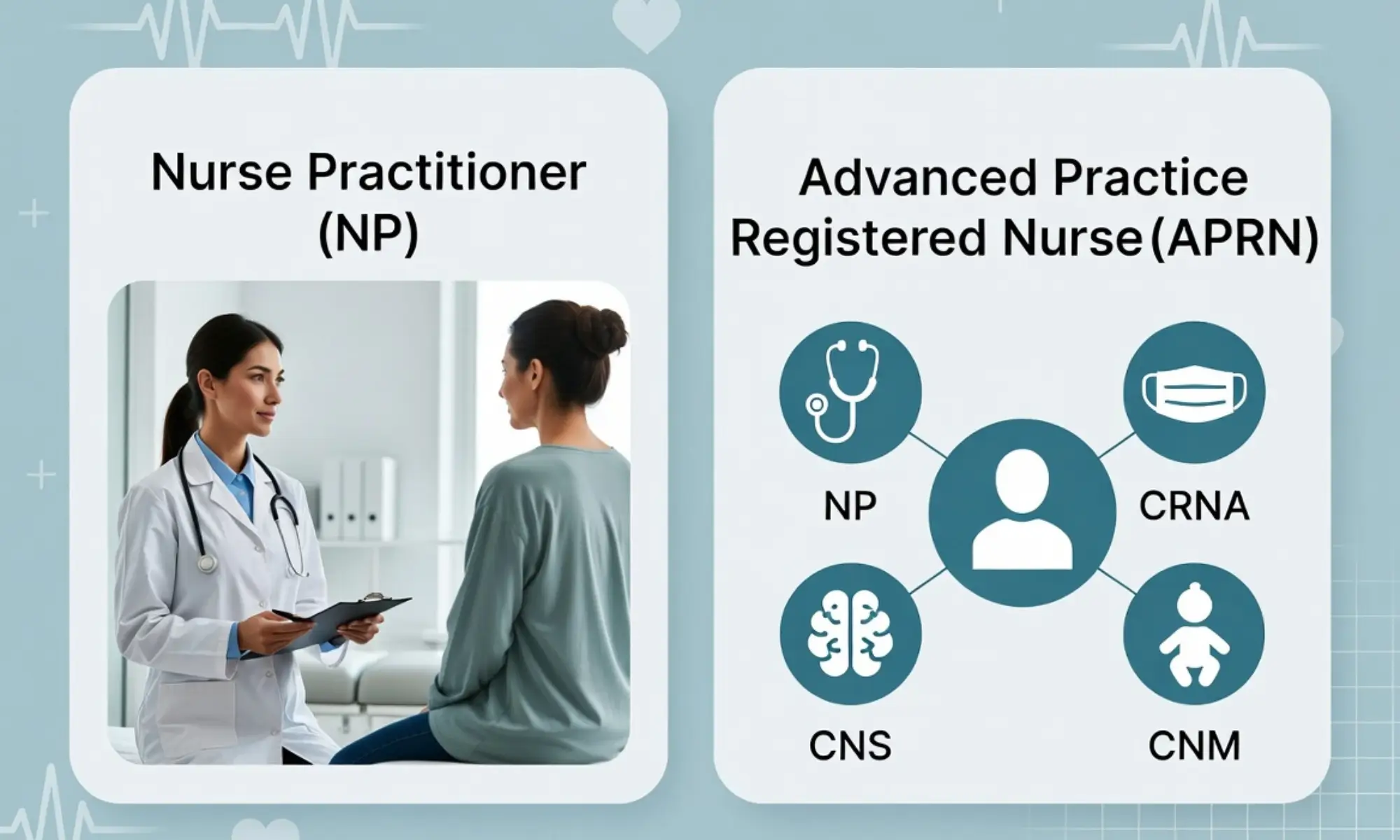
Last week, a patient at a busy clinic asked, “Are you a nurse or a doctor?” The provider smiled and replied, “I’m a Nurse Practitioner.” Moments like this show how common the confusion is.
Many people do not clearly understand the difference between NP and APRN. In simple words, an NP (Nurse Practitioner) is a type of advanced nurse who can diagnose and treat patients.
An APRN (Advanced Practice Registered Nurse) is a broader title that includes NPs and other advanced nurses.
Understanding the difference between NP and APRN helps patients, students, and healthcare workers make better choices.
The difference between NP and APRN is not just about titles. It is about roles, scope, and responsibility. When we explore the difference between NP and APRN, we see how both serve society in important ways.
Key Difference Between the Both
The main difference is simple:
- APRN is a broad category.
- NP is one specific type under that category.
All NPs are APRNs.
But not all APRNs are NPs.
Why Their Difference Is Important in Society
Knowing the difference is important for:
- Patients – They understand who is treating them.
- Students – They choose the right career path.
- Hospitals – They assign correct roles.
- Policy makers – They create proper healthcare laws.
Both NP and APRN play major roles in improving healthcare access, especially in rural and underserved areas.
Pronunciation (US & UK)
- NP
- US: /ˌɛn ˈpiː/
- UK: /ˌɛn ˈpiː/
- US: /ˌɛn ˈpiː/
- APRN
- US: /ˌeɪ piː ɑːr ˈɛn/
- UK: /ˌeɪ piː ɑːr ˈɛn/
- US: /ˌeɪ piː ɑːr ˈɛn/
Now that we understand the basics, let us move deeper into the full difference between NP and APRN.
Difference Between NP and APRN
1. Definition
NP: A Nurse Practitioner is an advanced nurse who diagnoses and treats patients.
Example 1: An NP prescribes antibiotics.
Example 2: An NP manages diabetes care.
APRN: An Advanced Practice Registered Nurse includes NP, CNM, CNS, and CRNA.
Example 1: A CRNA gives anesthesia.
Example 2: A CNM assists childbirth.
2. Scope
NP: Focuses mainly on primary or specialty care.
Example 1: Family NP treats children.
Example 2: Psychiatric NP treats depression.
APRN: Covers multiple advanced nursing roles.
Example 1: CNS improves hospital systems.
Example 2: CRNA works in surgery.
3. Education
NP: Requires a master’s or doctoral degree in NP specialization.
Example 1: Master of Science in Nursing (MSN).
Example 2: Doctor of Nursing Practice (DNP).
APRN: Requires advanced nursing degree for all categories.
Example 1: CNM degree.
Example 2: CRNA doctoral program.
4. Certification
NP: Must pass NP board exam.
Example 1: Family NP certification.
Example 2: Pediatric NP certification.
APRN: Certification depends on specialty.
Example 1: Nurse Midwife exam.
Example 2: CRNA licensing exam.
5. Role in Healthcare
NP: Direct patient care provider.
Example 1: Runs clinic visits.
Example 2: Orders lab tests.
APRN: May provide care or system leadership.
Example 1: CNS trains nurses.
Example 2: CRNA manages anesthesia team.
6. Autonomy
NP: Can work independently in many states.
Example 1: Opens own clinic.
Example 2: Prescribes medications.
APRN: Autonomy varies by role and law.
Example 1: CNM works with OB team.
Example 2: CRNA works in surgical team.
7. Specialization
NP: Specializes in population focus.
Example 1: Geriatric NP.
Example 2: Acute care NP.
APRN: Specializes in broader advanced fields.
Example 1: Clinical Nurse Specialist.
Example 2: Nurse Anesthetist.
8. Workplace
NP: Clinics, hospitals, community centers.
Example 1: Family practice clinic.
Example 2: Urgent care center.
APRN: Wider settings.
Example 1: Surgery room.
Example 2: Maternity ward.
9. Focus Area
NP: Patient-centered diagnosis and treatment.
Example 1: Treats infections.
Example 2: Manages chronic illness.
APRN: Can focus on patients or systems.
Example 1: Improves patient safety policy.
Example 2: Develops care protocols.
10. Category Relationship
NP: Subcategory.
Example 1: NP is an APRN.
Example 2: NP license shows APRN title.
APRN: Parent category.
Example 1: Includes NP.
Example 2: Includes CRNA.
Nature and Behaviour
NP Nature: Clinical, patient-focused, diagnostic.
APRN Nature: Advanced, specialized, leadership-driven.
Both are professional, skilled, and ethical.
Why People Are Confused
- Titles sound similar.
- Both require advanced degrees.
- Both treat patients.
- Many people use terms interchangeably.
Table: Difference and Similarity
| Feature | NP | APRN |
| Meaning | Nurse Practitioner | Advanced Practice Registered Nurse |
| Category | Subtype | Broad category |
| Scope | Primary/Specialty care | Multiple advanced roles |
| Education | MSN/DNP | Advanced degree |
| Patient Care | Yes | Yes (varies) |
| Leadership | Limited | Often included |
| License | NP specific | APRN umbrella |
| Similarity | Both advanced nurses | Both advanced nurses |
Which Is Better in What Situation?
If you want direct patient diagnosis and treatment, an NP is ideal. NPs are excellent for primary care clinics and community health centers. They manage chronic diseases and provide preventive care. Patients who need ongoing care often benefit from seeing an NP.
If you want specialized expertise like anesthesia, childbirth support, or hospital system leadership, APRN roles such as CRNA or CNS are better. APRNs in these roles handle high-level responsibilities and advanced procedures.
Use in Metaphors and Similes
- “An NP is like a bridge between nurse and doctor.”
- “An APRN is the umbrella covering advanced nursing roles.”
Connotative Meaning
NP: Positive, skilled, caring.
Example: “She is an NP who truly listens.”
APRN: Professional, advanced, authoritative.
Example: “The APRN led the clinical reform.”
Idioms or Proverbs (Used Creatively)
- “A stitch in time saves nine.”
Example: An NP treats illness early to prevent complications. - “Knowledge is power.”
Example: An APRN uses advanced education to improve care.
Works in Literature
(Healthcare-related themes including advanced nursing roles)
- Notes on Nursing – Nonfiction, Florence Nightingale, 1859
- The Shift – Memoir, Theresa Brown, 2015
Movies Related to Nursing
- Nightingale – 2014, USA
- One Flew Over the Cuckoo’s Nest – 1975, USA
FAQs
1. Is every NP an APRN?
Yes. Every NP is an APRN.
2. Is every APRN an NP?
No. APRN includes other roles too.
3. Can both prescribe medicine?
Yes, depending on state law.
4. Which requires more education?
Both require advanced degrees.
5. Why are titles important?
They show role and responsibility.
How Both Are Useful for Surroundings?
Both NP and APRN improve community health. They reduce doctor shortages. They provide affordable care. They support hospitals and clinics. They also promote preventive healthcare awareness.
Final Words for Both
NP represents focused patient care excellence.
APRN represents advanced nursing leadership and specialization.
Both are pillars of modern healthcare.
Conclusion
The difference between NP and APRN is simple but important. An NP is one type of APRN.
APRN is a broad category that includes multiple advanced nursing roles. While their education and responsibilities may overlap, their scope and specialization differ.
Understanding the difference helps patients choose care providers and helps students plan careers.
Both NP and APRN serve society with skill, compassion, and professionalism. Together, they strengthen healthcare systems and improve lives every day.