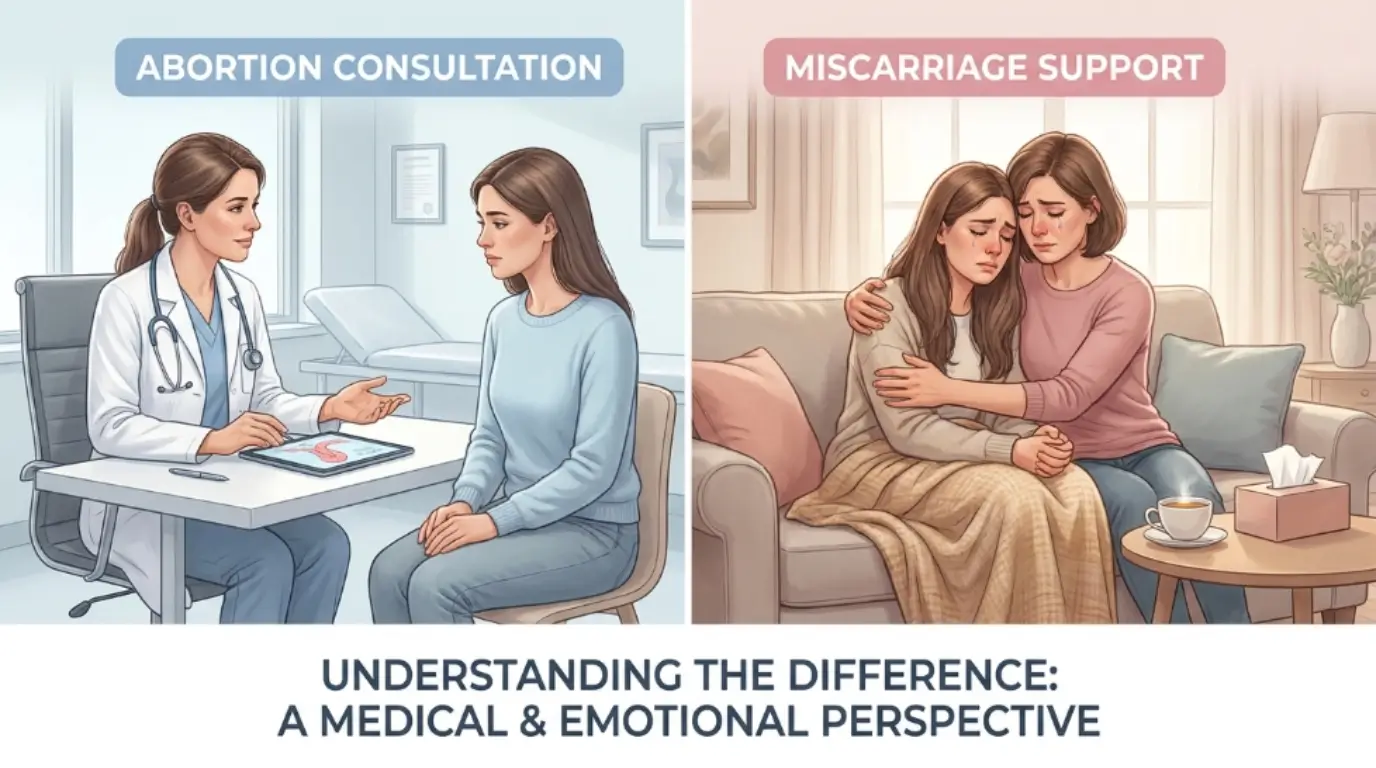
Pregnancy is one of the most emotional experiences in life, but sometimes it does not go as planned. Many people hear the words abortion and miscarriage in hospitals, news reports, or daily conversations and think they mean the same thing.
In reality, there is an important difference between abortion and miscarriage. A miscarriage usually happens naturally when a pregnancy ends on its own, while an abortion is a medical or intentional ending of pregnancy.
Understanding the difference between abortion and miscarriage helps students, medical experts, and ordinary readers avoid confusion.
In many real-life situations, families face emotional pain after pregnancy loss, and using the correct word matters greatly.
The difference between abortion and miscarriage is not only medical but also emotional, social, and legal. Learning the difference between abortion and miscarriage also improves communication in healthcare and society.
Key Difference Between the Both
The main difference is that a miscarriage happens naturally without planning, while an abortion is a deliberate medical procedure or action to end a pregnancy. Miscarriage is often unexpected, but abortion is usually a chosen medical decision.
Why Is Their Difference Necessary to Know?
Knowing the difference is important for learners, doctors, nurses, and society because these terms carry different emotional, legal, and medical meanings. A miscarriage often requires emotional support and medical care after natural pregnancy loss. Abortion involves ethical, legal, and personal decisions that vary across countries and cultures. Confusing these terms can hurt feelings and spread misinformation. Clear understanding improves communication in education, healthcare, counseling, and public discussions.
Pronunciation
- Abortion
- US: uh-BOR-shun
- UK: uh-BOH-shun
- Miscarriage
- US: miss-KAIR-ij
- UK: miss-KARR-ij
Both words relate to pregnancy loss, but their causes, meanings, and social understanding are very different. Let us now explore the detailed comparison.
Difference Between Abortion and Miscarriage
1. Meaning
Abortion:
Abortion is the intentional ending of a pregnancy through medicine or surgery.
Examples:
- The woman chose abortion for health reasons.
- Doctors performed an abortion at the hospital.
Miscarriage:
A miscarriage is the natural loss of pregnancy before the baby can survive outside the womb.
Examples:
- She suffered a miscarriage in the third month.
- Stress after the miscarriage affected her deeply.
2. Cause
Abortion:
It happens because of a planned medical decision.
Examples:
- The abortion was advised due to serious illness.
- Some women choose abortion for personal reasons.
Miscarriage:
It usually happens because of health complications or natural body issues.
Examples:
- Hormonal imbalance caused the miscarriage.
- The doctor explained possible reasons for the miscarriage.
3. Intention
Abortion:
It involves human intention or choice.
Examples:
- The couple discussed abortion carefully.
- Legal abortion services are available in some countries.
Miscarriage:
It is unplanned and accidental.
Examples:
- The miscarriage shocked the whole family.
- She blamed herself after the miscarriage.
4. Medical Procedure
Abortion:
It may involve medicines or surgery.
Examples:
- Medical abortion uses special pills.
- Surgical abortion is done in clinics.
Miscarriage:
It occurs naturally but may still need treatment afterward.
Examples:
- The miscarriage required hospital care.
- Doctors monitored her after the miscarriage.
5. Emotional Impact
Abortion:
People may feel relief, sadness, or mixed emotions.
Examples:
- She felt emotional after the abortion.
- Counseling helped after the abortion.
Miscarriage:
It often causes grief and emotional pain.
Examples:
- The miscarriage left the parents heartbroken.
- Friends supported her after the miscarriage.
6. Legal Issues
Abortion:
Laws about abortion differ across countries.
Examples:
- Abortion laws are strict in some places.
- Activists debate abortion rights worldwide.
Miscarriage:
Miscarriage is not considered a legal choice.
Examples:
- Doctors recorded the miscarriage naturally.
- There are no legal restrictions on miscarriage.
7. Social View
Abortion:
It is often debated in religion and politics.
Examples:
- Abortion remains a controversial topic.
- Society has divided opinions on abortion.
Miscarriage:
People usually view miscarriage with sympathy.
Examples:
- Her coworkers supported her miscarriage recovery.
- Communities often comfort families after miscarriage.
8. Timing
Abortion:
It usually happens during early pregnancy by choice.
Examples:
- Early abortion is medically safer.
- She scheduled the abortion appointment.
Miscarriage:
It can happen unexpectedly at different pregnancy stages.
Examples:
- The miscarriage occurred suddenly.
- Early miscarriage is more common than many think.
9. Medical Terminology
Abortion:
Doctors may use the term “induced abortion.”
Examples:
- The report mentioned induced abortion.
- Safe abortion procedures reduce health risks.
Miscarriage:
Doctors often call it “spontaneous abortion.”
Examples:
- The doctor explained spontaneous abortion.
- Medical records listed miscarriage complications.
10. Recovery Process
Abortion:
Recovery depends on the procedure and emotional condition.
Examples:
- She recovered quickly after abortion treatment.
- Rest was advised after the abortion.
Miscarriage:
Recovery often includes emotional healing and physical care.
Examples:
- The miscarriage recovery took several months.
- Therapy helped after the miscarriage.
Nature and Behaviour of Both
Abortion is usually connected with decision-making, healthcare planning, and legal discussions. It is often viewed through ethical, social, and political perspectives.
Miscarriage is natural and unexpected. It is commonly linked with grief, sadness, and emotional support. Families usually see it as a tragic loss rather than a choice.
Why People Are Confused About Their Use?
People become confused because both terms involve pregnancy ending before birth. Medical language also adds confusion because doctors sometimes use “spontaneous abortion” for miscarriage. Many people do not understand the technical meanings and use the words incorrectly in conversation.
Difference and Similarity Table
| Feature | Abortion | Miscarriage | Similarity |
| Meaning | Intentional pregnancy ending | Natural pregnancy loss | Both involve pregnancy ending |
| Cause | Planned decision | Natural causes | Both affect health |
| Emotional Impact | Mixed emotions | Grief and sadness | Both can be emotional |
| Medical Care | Often required | Often required | Both may need doctors |
| Legal Aspect | Legally debated | No legal debate | Both discussed in healthcare |
| Timing | Usually planned | Unexpected | Both occur during pregnancy |
Which Is Better in What Situation?
A miscarriage is never considered “better” because it is usually a painful and unwanted experience. It is a natural medical event that requires care and emotional support. Families often need time to recover emotionally after miscarriage.
Abortion may be considered medically necessary in situations involving serious health risks, unsafe pregnancy conditions, or personal circumstances. Doctors and patients usually make such decisions carefully. The situation depends on health, law, personal beliefs, and medical advice.
How the Keywords Are Used in Metaphors and Similes
Abortion in Metaphors
The word abortion is sometimes used metaphorically to describe something stopped before completion.
Examples:
- The project became an abortion of the original plan.
- His dream ended like an aborted mission.
Miscarriage in Metaphors
Miscarriage can describe failure or unsuccessful outcomes.
Examples:
- The negotiation was a miscarriage of justice.
- Their plan ended in a miscarriage of effort.
Connotative Meaning
Abortion
- Negative: controversial, painful
- Neutral: medical procedure
- Positive: life-saving choice in some situations
Examples:
- The abortion debate continues globally.
- Safe abortion protects some women’s health.
Miscarriage
- Negative: loss, sadness
- Neutral: medical condition
- Positive: rarely positive, but sometimes linked with survival of the mother
Examples:
- The miscarriage caused emotional pain.
- Doctors treated the miscarriage carefully.
Idioms or Proverbs Related to the Words
There are no common direct idioms for abortion or miscarriage, but related expressions exist.
- “Loss before gain”
- Example: After the miscarriage, the family stayed hopeful.
- “A hard road to recovery”
- Example: Emotional healing after abortion can be difficult.
Works in Literature
Abortion
- The Cider House Rules — Drama, John Irving, 1985
- Abortion — Satirical novel, Richard Brautigan, 1971
Miscarriage
- The Crimson Petal and the White — Historical fiction, Michel Faber, 2002
- Revolutionary Road — Literary fiction, Richard Yates, 1961
Movies Made on the Keywords
Abortion
- Never Rarely Sometimes Always — 2020, USA
- If These Walls Could Talk — 1996, USA
Miscarriage
- Pieces of a Woman — 2020, Canada/Hungary
- Rabbit Hole — 2010, USA
Frequently Asked Questions
1. Is miscarriage the same as abortion?
No. Miscarriage happens naturally, while abortion is intentional.
2. Why do doctors sometimes call miscarriage spontaneous abortion?
It is a medical term used for natural pregnancy loss.
3. Can both require medical treatment?
Yes. Both may need medical care and monitoring.
4. Which is more emotionally painful?
Experiences differ for every person, but miscarriage often involves unexpected grief.
5. Why is it important to know the difference?
It improves understanding, communication, and emotional sensitivity.
How Both Are Useful for Surroundings
Understanding abortion helps society discuss healthcare rights, medical safety, and reproductive education responsibly. It also helps healthcare systems provide safe treatment and counseling.
Understanding miscarriage increases empathy and emotional support for families experiencing pregnancy loss. It encourages better healthcare awareness and mental health support in communities.
Final Words for the Both
The difference between abortion and miscarriage is important medically, emotionally, and socially. Although both involve the ending of pregnancy, their causes, meanings, and public understanding are very different.
Miscarriage is usually natural and unexpected, while abortion is intentional and often linked with personal or medical decisions.
Learning these differences helps students, professionals, and ordinary readers communicate more accurately and compassionately.
It also reduces misunderstanding in healthcare and social discussions. By understanding both terms clearly, society can respond with better awareness, empathy, and respect for people facing difficult situations.