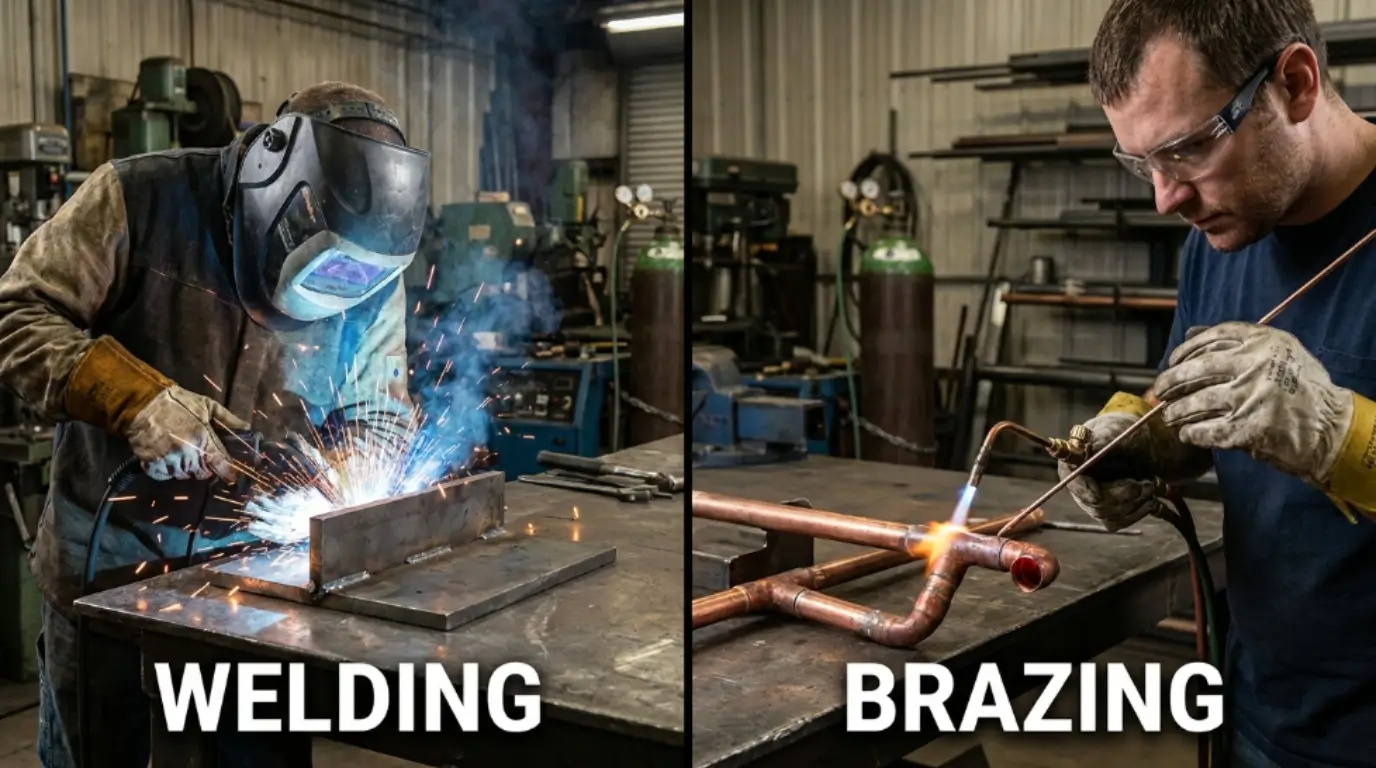
In a small workshop, a mechanic tries to fix a broken metal gate. He uses a high-heat torch to melt the metal edges together and joins them strongly.
This process is known as welding, while another technician nearby uses a different method where a filler metal flows between joints without melting the base metal, known as brazing.
The difference between welding and brazing is often misunderstood by beginners. Many learners search for the difference between welding and brazing to understand which method is stronger or more suitable.
In industrial work, the difference between welding and brazing plays a key role in choosing the right technique. Even experts rely on knowing the difference between welding and brazing for precision and safety.
Key Difference Between Welding and Brazing
Welding melts the base metal; brazing does not.
Why This Difference Matters
Understanding this difference helps engineers, mechanics, and learners choose the right method for strength, cost, and material safety in real-world applications.
Pronunciation
- Welding: /ˈwɛldɪŋ/ (US & UK similar)
- Brazing: /ˈbreɪzɪŋ/ (US & UK similar)
Now let’s smoothly move into the detailed difference between welding and brazing.
Difference Between Welding and Brazing (10 Key Points)
1. Process Temperature
- Welding: Uses very high temperature to melt base metals.
Example 1: Steel beam fusion in buildings.
Example 2: Car body frame joining in factories. - Brazing: Uses lower temperature, does not melt base metal.
Example 1: Joining copper pipes in plumbing.
Example 2: Jewelry repair work.
2. Melting of Base Metal
- Welding: Base metal melts completely.
Example 1: Iron gate repair.
Example 2: Ship hull construction. - Brazing: Base metal remains solid.
Example 1: Air conditioning tubes.
Example 2: Bicycle frame joints.
3. Strength of Joint
- Welding: Very strong joint.
Example 1: Bridges.
Example 2: Aircraft frames. - Brazing: Moderate strength.
Example 1: Electrical fittings.
Example 2: Small metal tools.
4. Filler Material
- Welding: May or may not use filler.
Example 1: Arc welding rods.
Example 2: Gas welding wire. - Brazing: Always uses filler metal.
Example 1: Brass filler in pipes.
Example 2: Silver alloy in jewelry.
5. Heat Source
- Welding: Electric arc or gas flame.
Example 1: MIG welding machines.
Example 2: TIG welding systems. - Brazing: Torch or furnace heat.
Example 1: Hand torch brazing.
Example 2: Furnace brazing in factories.
6. Cost of Process
- Welding: More expensive equipment.
Example 1: Industrial welding setup.
Example 2: Automated welding robots. - Brazing: Cheaper equipment.
Example 1: Small repair torch.
Example 2: Workshop brazing kits.
7. Skill Required
- Welding: Requires high skill.
Example 1: Professional fabricators.
Example 2: Certified welders. - Brazing: Easier to learn.
Example 1: Plumbing workers.
Example 2: Hobby repairs.
8. Material Compatibility
- Welding: Works on similar metals.
Example 1: Steel-to-steel.
Example 2: Aluminum joints. - Brazing: Works on different metals.
Example 1: Copper to steel.
Example 2: Brass to iron.
9. Appearance of Joint
- Welding: Rough finish sometimes.
Example 1: Construction beams.
Example 2: Heavy machinery. - Brazing: Clean and smooth finish.
Example 1: Decorative items.
Example 2: Jewelry work.
10. Application Area
- Welding: Heavy industries.
Example 1: Shipbuilding.
Example 2: Construction sector. - Brazing: Light industries.
Example 1: Electronics.
Example 2: HVAC systems.
Nature and Behavior
Welding is aggressive in nature because it melts and reshapes the base metal itself, creating a permanent and extremely strong bond. It behaves like a deep fusion process where materials become one single unit. Brazing, on the other hand, is gentle. It works like a bonding agent that flows into gaps and joins metals without disturbing their original structure. This makes brazing ideal for delicate work where heat damage must be avoided. In short, welding is powerful and structural, while brazing is careful and precise in behavior.
Why People Get Confused
People often confuse welding and brazing because both processes use heat and metals to join materials. In workshops and industries, both may look similar from a distance, especially when torches are used. Another reason is that both create permanent joints, but the method and strength are different. Beginners assume any metal joining with fire is welding. Lack of training and overlapping usage in repair work increases this confusion. However, understanding the difference between welding and brazing clears this misunderstanding quickly.
Difference and Similarity
| Feature | Welding | Brazing |
| Heat level | High | Low |
| Base metal melting | Yes | No |
| Strength | Very high | Moderate |
| Filler use | Optional | Required |
| Application | Heavy industry | Light repair work |
Similarity: Both are metal joining processes using heat and filler materials in industrial applications.
Which Is Better and When?
Choosing between welding and brazing depends on the job requirement. Welding is better when high strength and durability are needed, such as in bridges, buildings, and heavy machinery. It creates a permanent and strong bond that can handle stress and pressure. Brazing is better when precision, neatness, and low heat are required, such as in electronics, plumbing, and delicate metal parts. It avoids damaging the base material. Neither is universally better; each serves a specific purpose. Understanding the difference between welding and brazing helps professionals select the right method for safety, efficiency, and long-term performance in real-world applications.
Metaphors and Similes
- Welding is like “forging unity in fire,” symbolizing strong permanent bonding.
- Brazing is like “gluing metals with golden thread,” showing smooth connection without damage.
Both are often used metaphorically in teamwork discussions:
- “Their friendship was welded together through hardship.”
- “Her support brazed the broken pieces of his confidence.”
Connotative Meaning
- Welding
- Positive: Strength, unity, durability
- Negative: Harsh, intense, destructive heat
- Neutral: Industrial joining process
- Brazing
- Positive: Precision, care, smooth connection
- Negative: Less strong, limited use
- Neutral: Controlled metal joining method
Idioms & Proverbs
- “Welded by fate” – means two things strongly connected forever.
Example: Their partnership was welded by fate in business success. - “Brazed in silence” (rare usage metaphorically) – means a quiet, careful connection.
Example: Trust was brazed in silence between the two teams.
In Literature
- “The Iron Forge” – Industrial fiction by John Masefield (1920) – mentions welding symbolism
- “Metal Hearts” – Engineering poetry collection by Robert Frost (1930) – uses brazing metaphorically
- “Steel Worlds” – Sci-fi novel by Isaac Asimov-inspired author (1955) – welding used in world-building
Movies Related to Welding/Brazing Themes
- Iron Man (2008, USA) – uses welding concepts in suit building
- The Founder (2016, USA) – industrial construction scenes show metal joining
- Transformers (2007, USA) – mechanical assembly reflects welding concepts
FAQs
1. What is the main difference between welding and brazing?
Welding melts base metal, brazing does not.
2. Which is stronger: welding or brazing?
Welding is stronger.
3. Is brazing easier than welding?
Yes, it requires less skill and heat.
4. Where is welding commonly used?
In construction, automotive, and heavy industries.
5. Can both be used together?
Yes, in complex manufacturing systems.
Conclusion
Understanding the difference between welding and brazing is essential for anyone working with metals, from beginners to industrial experts.
Welding is a powerful process that creates strong, permanent bonds by melting the base material, making it ideal for heavy-duty applications like construction and machinery.
Brazing, however, is a more controlled and delicate method that joins metals without melting them, making it perfect for precision work in plumbing, electronics, and small repairs.
Both techniques play an important role in modern industries and everyday life. Knowing when to use welding or brazing improves efficiency, safety, and quality of work.
In simple terms, welding is strength, while brazing is precision—and together they form the backbone of metal joining technology.