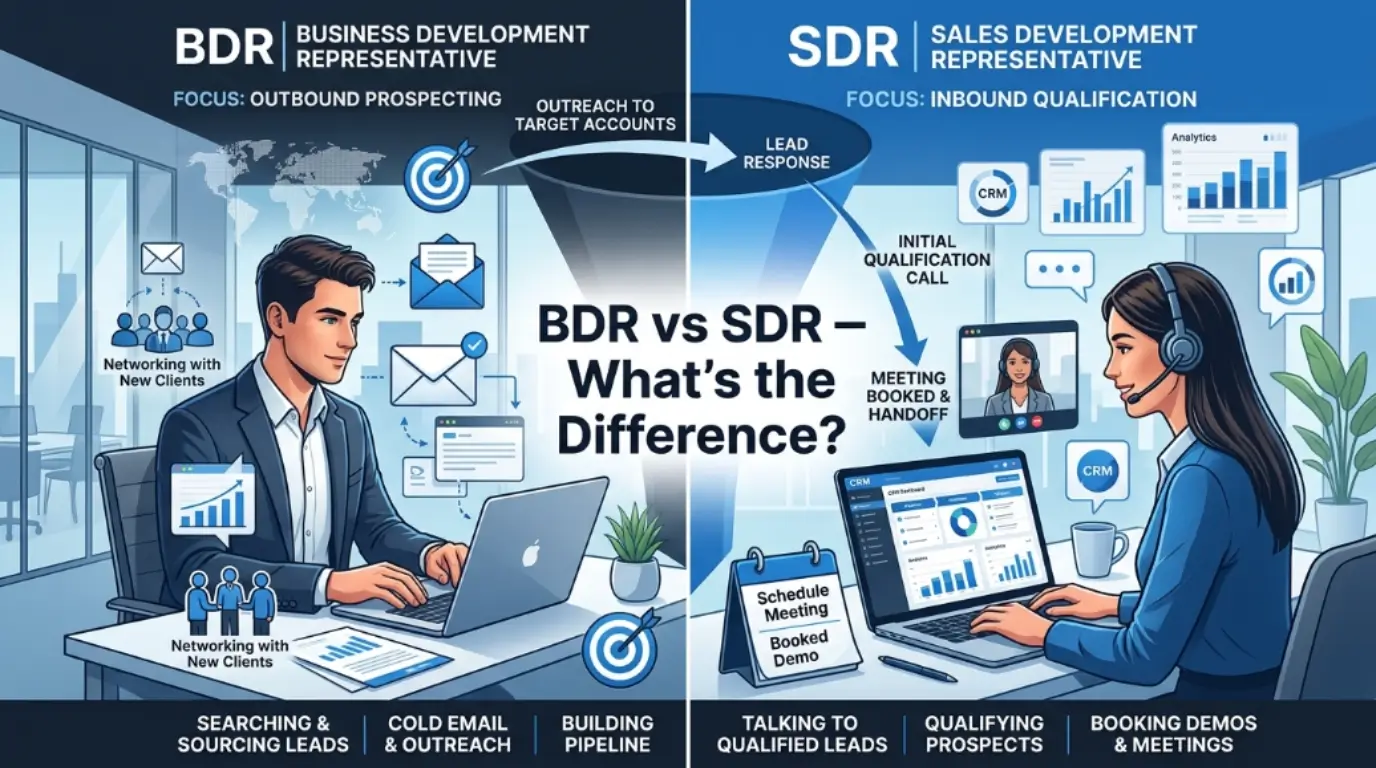
In the modern sales world, companies often divide their sales teams into different roles to improve performance. Two of the most common roles are BDR and SDR.
Many beginners feel confused about the difference between BDR and SDR because both jobs involve finding customers and helping businesses grow.
Imagine a software company launching a new product. One employee spends time finding new companies to contact, while another talks to interested leads and qualifies them for sales calls. Even though both support sales, their responsibilities are different.
Understanding the difference between BDR and SDR helps students, job seekers, marketers, and business owners communicate more clearly in the professional world.
The difference between BDR and SDR also explains how companies organize sales processes for better results and customer relationships.
Key Difference Between BDR and SDR
The main difference is that a BDR (Business Development Representative) focuses on outbound lead generation and building new business opportunities, while an SDR (Sales Development Representative) mainly qualifies leads and prepares them for the sales team.
Why Is Their Difference Necessary to Know?
Knowing the difference between BDR and SDR is important because many companies use these job titles differently. Learners and professionals need this knowledge to understand career paths, hiring roles, and business communication. A clear understanding improves teamwork and helps businesses assign the right tasks to the right employees. In society, sales teams play a major role in economic growth because they connect businesses with customers. Understanding these roles also helps job seekers apply for suitable positions according to their skills and interests.
Pronunciation of Both Terms
- BDR
- US Pronunciation: /ˌbiː.diːˈɑːr/
- UK Pronunciation: /ˌbiː.diːˈɑː/
- SDR
- US Pronunciation: /ˌes.diːˈɑːr/
- UK Pronunciation: /ˌes.diːˈɑː/
Now that we understand the basics, let us explore the detailed difference between BDR and SDR with practical examples and comparisons.
Difference Between BDR and SDR
1. Main Focus
BDR:
A BDR focuses on creating new business opportunities through outreach and networking.
Examples:
- A BDR contacts new companies through LinkedIn.
- A BDR attends trade shows to find clients.
SDR:
An SDR focuses on qualifying leads before passing them to account executives.
Examples:
- An SDR calls interested customers to ask questions.
- An SDR schedules demos for the sales team.
2. Type of Leads
BDR:
Usually works with cold leads who have never interacted with the company.
Examples:
- Sending emails to unknown businesses.
- Reaching companies from industry directories.
SDR:
Usually handles warm leads already interested in the product.
Examples:
- Following up after webinar sign-ups.
- Contacting people who downloaded a brochure.
3. Goal
BDR:
The goal is to create awareness and generate opportunities.
Examples:
- Introducing a company to new markets.
- Building first connections with prospects.
SDR:
The goal is to qualify prospects for the sales team.
Examples:
- Checking budget and needs.
- Confirming decision-making authority.
4. Communication Style
BDR:
Communication is often persuasive and exploratory.
Examples:
- Sending personalized outreach emails.
- Starting networking conversations.
SDR:
Communication is more investigative and informative.
Examples:
- Asking qualifying questions.
- Explaining product benefits briefly.
5. Daily Tasks
BDR:
Daily work includes research and outbound prospecting.
Examples:
- Searching target companies online.
- Creating outreach campaigns.
SDR:
Daily work includes follow-up calls and lead management.
Examples:
- Updating CRM records.
- Booking meetings for sales executives.
6. Relationship with Customers
BDR:
Builds initial contact with potential clients.
Examples:
- First introductory call.
- Connecting on social media.
SDR:
Builds trust before handing leads to the closer.
Examples:
- Discussing customer pain points.
- Preparing prospects for sales meetings.
7. Performance Measurement
BDR:
Measured by opportunities created.
Examples:
- Number of new leads generated.
- Number of meetings arranged.
SDR:
Measured by qualified leads.
Examples:
- Quality of appointments booked.
- Conversion rate of prospects.
8. Required Skills
BDR:
Needs strong networking and communication skills.
Examples:
- Public speaking confidence.
- Relationship-building ability.
SDR:
Needs analytical and listening skills.
Examples:
- Understanding customer needs.
- Asking effective questions.
9. Position in Sales Funnel
BDR:
Works at the top of the sales funnel.
Examples:
- Prospect discovery stage.
- Initial market outreach.
SDR:
Works in the middle of the funnel.
Examples:
- Lead qualification stage.
- Appointment preparation stage.
10. Career Growth
BDR:
May grow into partnership or business strategy roles.
Examples:
- Business development manager.
- Strategic partnerships executive.
SDR:
Often grows into sales closing roles.
Examples:
- Account executive.
- Sales manager.
Nature and Behaviour of Both
Nature of BDR
A BDR is usually proactive, outgoing, and energetic. They enjoy meeting new people and opening conversations. Their work requires confidence and persistence because they often contact strangers.
Nature of SDR
An SDR is usually analytical, patient, and detail-oriented. They focus on understanding customer needs and qualifying leads carefully before passing them forward.
Why People Are Confused About Their Use?
People become confused because many companies use BDR and SDR interchangeably. In some organizations, both roles perform similar tasks. The confusion also happens because both positions are part of sales development and involve customer communication. Different industries may define the roles differently, which creates misunderstanding among learners and professionals.
Difference and Similarity Table
| Feature | BDR | SDR | Similarity |
| Full Form | Business Development Representative | Sales Development Representative | Both are sales roles |
| Main Work | Finding opportunities | Qualifying leads | Both support revenue growth |
| Lead Type | Cold leads | Warm leads | Both handle prospects |
| Funnel Position | Top of funnel | Middle of funnel | Both work before final sales |
| Communication | Outreach focused | Qualification focused | Both communicate with clients |
| Goal | Generate interest | Prepare qualified leads | Both help sales teams |
| Skills | Networking | Listening and analysis | Both need communication skills |
| Daily Activity | Prospecting | Follow-ups | Both use CRM tools |
| Customer Stage | New contact | Interested contact | Both guide customer journey |
| Career Path | Business strategy | Sales closing | Both can lead to management |
Which Is Better in What Situation?
When BDR Is Better
A BDR role is better when a company wants to enter new markets or find completely new customers. Businesses needing aggressive outreach and networking benefit more from BDR professionals. Startups often depend heavily on BDRs to create awareness and discover new opportunities.
When SDR Is Better
An SDR role is better when a company already receives many leads and needs someone to qualify them properly. SDRs help improve efficiency by ensuring only serious prospects reach the sales team. Companies with strong marketing systems often rely more on SDRs.
How the Keywords Are Used in Metaphors and Similes
- “The BDR was like a fisherman casting a wide net for opportunities.”
- “The SDR acted like a gatekeeper filtering serious buyers.”
- “A BDR is the spark that starts business conversations.”
- “An SDR is the bridge between interest and final sales.”
Connotative Meaning of Both Terms
BDR
- Positive Meaning: Ambitious, proactive, growth-focused.
- Neutral Meaning: Outreach specialist.
- Negative Meaning: Sometimes viewed as overly persistent.
Examples:
- “The BDR brought fresh opportunities to the company.”
- “Some clients think BDR outreach emails are repetitive.”
SDR
- Positive Meaning: Organized, analytical, customer-focused.
- Neutral Meaning: Sales qualifier.
- Negative Meaning: Sometimes seen as too scripted.
Examples:
- “The SDR carefully understood customer needs.”
- “The conversation sounded too scripted because of the SDR process.”
Idioms or Proverbs Related to Their Work
- “First impressions matter.”
- Example: A BDR must remember that first impressions matter during outreach.
- “Strike while the iron is hot.”
- Example: An SDR should strike while the iron is hot when a lead shows interest.
- “Actions speak louder than words.”
- Example: Both BDRs and SDRs prove value through performance.
Works in Literature Related to Sales and Business
- The Psychology of Selling — Brian Tracy (Business, 1985)
- How to Win Friends and Influence People — Dale Carnegie (Self-help, 1936)
- To Sell Is Human — Daniel H. Pink (Business, 2012)
- The Challenger Sale — Matthew Dixon and Brent Adamson (Sales, 2011)
Movies Related to Sales and Business Development
- The Wolf of Wall Street (2013, USA)
- Boiler Room (2000, USA)
- Glengarry Glen Ross (1992, USA)
- Jerry Maguire (1996, USA)
Frequently Asked Questions
1. What is the main difference between BDR and SDR?
A BDR mainly generates opportunities, while an SDR qualifies leads before sales meetings.
2. Do BDR and SDR work together?
Yes, both roles support the sales process and often collaborate closely.
3. Which role is better for beginners?
Both are good for beginners, but SDR roles may suit people who enjoy analysis and communication.
4. Can a BDR become a sales manager?
Yes, many BDRs grow into leadership and strategy positions.
5. Why do companies separate BDR and SDR roles?
Companies separate them to improve efficiency and specialization in sales operations.
How Both Are Useful for Surroundings
BDRs help businesses grow by discovering new markets and opportunities. SDRs improve customer experiences by ensuring people receive suitable solutions. Together, they support economic activity, create jobs, and strengthen communication between businesses and customers.
Final Words for Both
The difference between BDR and SDR may appear small at first, but each role has a unique purpose in the sales process.
BDRs focus on opening doors and creating new opportunities, while SDRs focus on qualifying leads and preparing them for successful sales conversations. Both roles require communication skills, persistence, and teamwork.
Understanding the difference between BDR and SDR helps learners, professionals, and businesses work more efficiently and choose the right career paths.
In today’s competitive business world, both BDRs and SDRs play an important role in building customer relationships and driving company success.