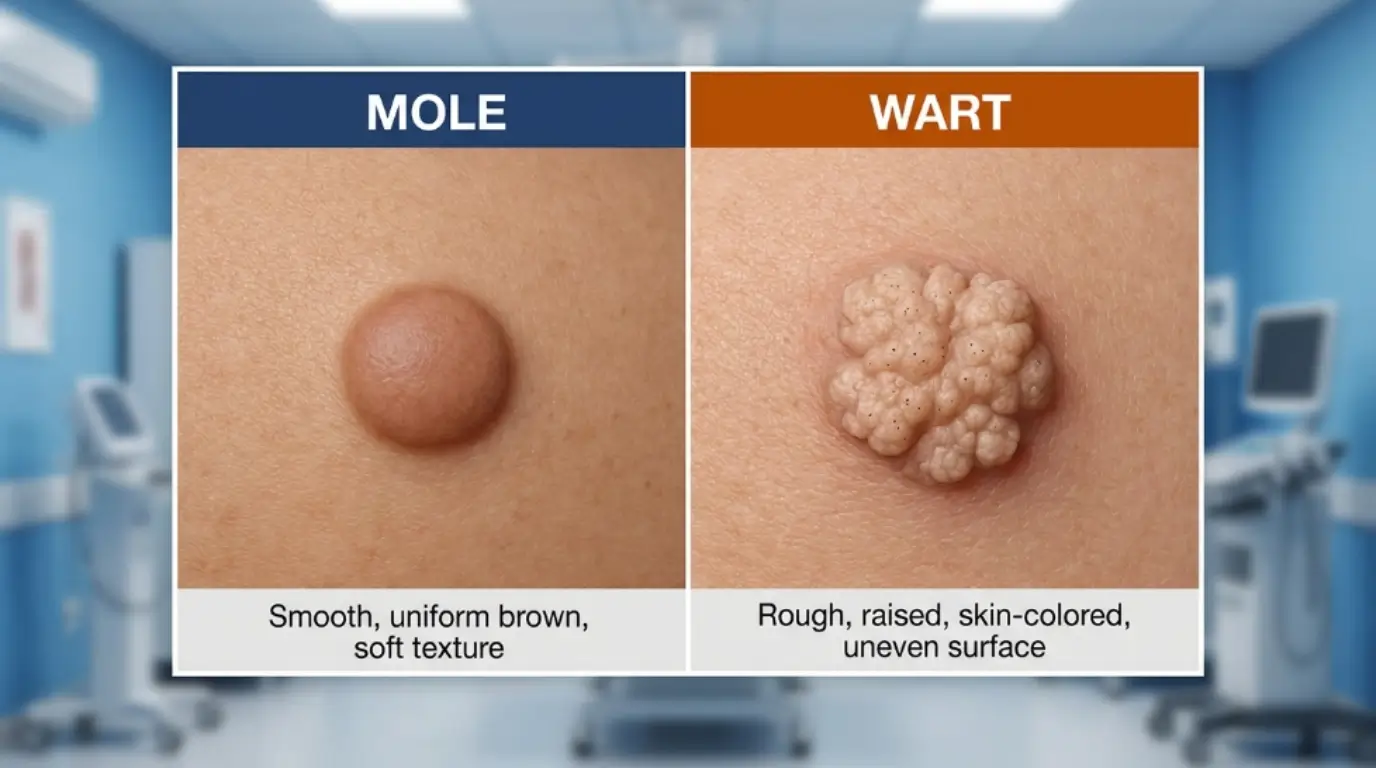
Have you ever noticed a small bump or dark spot on your skin and wondered whether it was a mole or a wart? Many people confuse these two common skin conditions because both appear on the body and can change the skin’s texture or color.
The difference between mole and wart is important because each has a different cause, appearance, and treatment method.
A mole is usually linked to skin pigmentation, while a wart is caused by a viral infection. Understanding the difference between mole and wart helps people care for their skin properly and avoid unnecessary fear.
Doctors, students, and everyday people often study the difference between mole and wart to recognize healthy skin changes and know when medical attention is needed.
Learning the difference between mole and wart can protect health and improve awareness about skin conditions.
Key Difference Between Mole and Wart
A mole is a cluster of pigmented skin cells that usually appears brown, black, or tan. It is mostly harmless and may stay unchanged for years. A wart, however, is a rough skin growth caused by the human papillomavirus (HPV). Warts are contagious, while moles are not.
Why Knowing Their Difference Is Important
Knowing the difference between moles and warts is important for both learners and experts because skin conditions can sometimes signal health problems. A changing mole may indicate skin cancer, while untreated warts can spread to other areas or people. Understanding these conditions helps society improve personal hygiene, early disease detection, and proper medical care.
Pronunciation of Mole and Wart
- Mole (US): /moʊl/
- Mole (UK): /məʊl/
- Wart (US): /wɔːrt/
- Wart (UK): /wɔːt/
Now that the basic meanings are clear, let us explore the detailed differences between these two skin conditions.
Difference Between Mole and Wart
1. Cause
Mole:
A mole develops because of extra pigment-producing cells called melanocytes.
Examples:
- A child may be born with a mole on the arm.
- Sun exposure can increase the number of moles.
Wart:
A wart forms due to infection by the human papillomavirus (HPV).
Examples:
- Touching infected skin may spread warts.
- Walking barefoot in public showers can cause plantar warts.
2. Appearance
Mole:
Moles are usually smooth, flat, or slightly raised with even color.
Examples:
- A brown round spot on the neck.
- A flat black mark on the hand.
Wart:
Warts often look rough, bumpy, and uneven.
Examples:
- A cauliflower-like bump on a finger.
- A rough growth on the sole of the foot.
3. Color
Mole:
Moles are mostly brown, black, or tan.
Examples:
- Dark brown facial mole.
- Light tan mole on the shoulder.
Wart:
Warts are skin-colored, gray, or slightly darker.
Examples:
- Pale wart on the knee.
- Gray wart on the thumb.
4. Contagious Nature
Mole:
Moles are not contagious.
Examples:
- Family members cannot catch a mole.
- Touching a mole does not spread it.
Wart:
Warts can spread through contact.
Examples:
- Sharing towels may spread warts.
- Skin-to-skin contact can transfer the virus.
5. Texture
Mole:
Moles are usually soft or smooth.
Examples:
- Smooth mole on the cheek.
- Slightly raised soft mole on the back.
Wart:
Warts are rough and hard.
Examples:
- Hard wart on the palm.
- Rough wart near the nail.
6. Pain Level
Mole:
Moles are usually painless.
Examples:
- A mole on the leg causes no discomfort.
- A facial mole remains harmless for years.
Wart:
Warts can become painful, especially on feet.
Examples:
- Plantar wart hurts while walking.
- Wart on finger becomes sore.
7. Growth Speed
Mole:
Moles grow slowly or remain unchanged.
Examples:
- A mole stays the same for years.
- A small mole slowly darkens with age.
Wart:
Warts may grow quickly.
Examples:
- A wart doubles in size in months.
- Multiple warts appear together.
8. Removal Method
Mole:
Doctors remove moles through surgery or laser treatment.
Examples:
- Cosmetic mole removal from the face.
- Surgical removal of suspicious mole.
Wart:
Warts are treated with freezing or medicated creams.
Examples:
- Liquid nitrogen removes wart.
- Salicylic acid cream treats wart.
9. Health Risk
Mole:
Some moles may become cancerous.
Examples:
- Irregular mole checked for melanoma.
- Bleeding mole examined by dermatologist.
Wart:
Most warts are harmless.
Examples:
- Common wart disappears naturally.
- Finger wart treated without complications.
10. Common Locations
Mole:
Moles can appear anywhere on the body.
Examples:
- Mole on the neck.
- Mole on the chest.
Wart:
Warts commonly appear on hands and feet.
Examples:
- Wart on finger.
- Plantar wart on foot.
Nature and Behaviour of Mole and Wart
Mole
Moles are generally stable skin marks. They often remain unchanged for years and are usually harmless. Some may grow hair or darken over time. Doctors monitor unusual changes because they can rarely become cancerous.
Wart
Warts behave differently because they are caused by a virus. They can spread from one body part to another or from person to person. Some disappear naturally, while others require treatment.
Why People Are Confused About Their Use
People often confuse moles and warts because both are visible skin growths. Small raised moles may look similar to smooth warts. Lack of medical knowledge also causes misunderstanding. Many people use the terms casually without knowing the scientific difference.
Table of Difference and Similarity Between Mole and Wart
| Feature | Mole | Wart | Similarity |
| Cause | Pigment cells | HPV virus | Both affect skin |
| Texture | Smooth | Rough | Both can be raised |
| Contagious | No | Yes | Both are common |
| Color | Brown/black | Skin-colored | Visible on skin |
| Pain | Usually painless | Sometimes painful | May require treatment |
| Growth | Slow | Faster | Can change over time |
| Removal | Surgery/laser | Freezing/cream | Both removable |
| Health Risk | Possible cancer risk | Usually harmless | Need monitoring |
Which Is Better in What Situation?
A mole is usually harmless when it stays small, even-colored, and unchanged. In many cases, it is simply a natural skin mark and does not require treatment. Some people even consider beauty marks attractive.
A wart is not “better,” but it is usually less dangerous than an abnormal mole because most warts are non-cancerous. However, warts should be treated quickly if they spread or become painful.
How Mole and Wart Are Used in Metaphors and Similes
Mole
- “A mole on the landscape” means a small but noticeable flaw.
- “Hidden like a mole underground” describes secrecy.
Wart
- “Warts and all” means accepting flaws honestly.
- “Sticking out like a wart” describes something unwanted or obvious.
Connotative Meaning
Mole
- Positive: Beauty mark
- Example: “Her mole made her look unique.”
- Negative: Spy or hidden traitor
- Example: “The agency discovered a mole.”
- Neutral: Skin mark
- Example: “The doctor examined the mole.”
Wart
- Positive: Rarely positive, but linked to honesty in “warts and all.”
- Example: “He shared his story warts and all.”
- Negative: Ugly flaw
- Example: “The wart embarrassed him.”
- Neutral: Skin growth
- Example: “The wart was removed safely.”
Idioms and Proverbs Related to the Words
- “Warts and all” – accepting someone completely, including flaws.
- Example: “She loved him warts and all.”
- “Make a mountain out of a molehill” – exaggerate a small problem.
- Example: “He made a mountain out of a molehill over the tiny scratch.”
Works in Literature
Mole
- The Wind in the Willows — Kenneth Grahame — Children’s Fiction — 1908
- Mole Music — David McPhail — Picture Book — 1999
Wart
- The Wartville Wizard — Don Madden — Children’s Literature — 1986
- The Once and Future King (character nicknamed Wart) — T.H. White — Fantasy — 1958
Movies Related to the Keywords
Mole
- The Mole Song — 2013 — Japan
- Mole Men Against the Son of Hercules — 1961 — Italy
Wart
- The Sword in the Stone (Arthur called Wart) — 1963 — USA
- Warts and All — 2009 — UK
Frequently Asked Questions
1. What is the main difference between a mole and a wart?
A mole is made of pigment cells, while a wart is caused by a virus.
2. Are warts contagious?
Yes, warts can spread through direct or indirect contact.
3. Can moles become dangerous?
Yes, unusual changes in a mole may indicate skin cancer.
4. Do warts disappear naturally?
Some warts disappear without treatment over time.
5. Should I see a doctor for a mole or wart?
Yes, especially if the growth changes shape, color, or causes pain.
How Both Are Useful for Surroundings
Moles help doctors study skin health and identify early signs of diseases like melanoma. Warts help medical researchers understand viral infections and immunity. Both conditions increase awareness about hygiene, skin care, and health monitoring in society.
Final Words
The difference between mole and wart becomes clear when we study their causes, appearance, texture, and health effects.
A mole is mainly related to skin pigmentation, while a wart is caused by a viral infection. Although both appear on the skin, their behavior and treatment methods are very different.
Knowing these differences helps people make better health decisions and seek medical care when necessary. Students, doctors, and ordinary individuals all benefit from understanding these common skin conditions.
By learning about moles and warts, society becomes more aware of personal hygiene, disease prevention, and skin health. Simple knowledge about these conditions can prevent fear, confusion, and unnecessary risks.