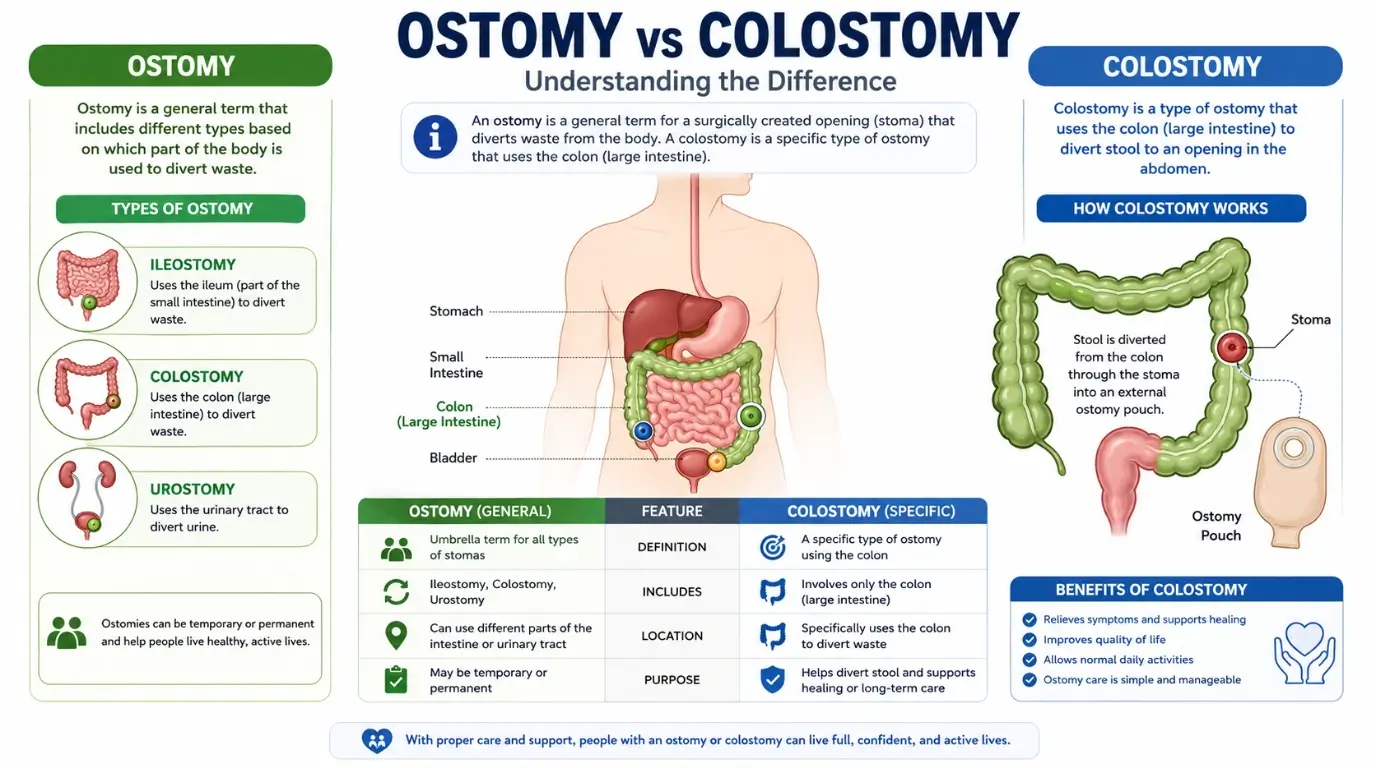
Imagine a patient who has undergone surgery due to colorectal cancer. After the operation, the doctor explains that a new opening has been created in the abdomen to help remove waste from the body.
At this point, many people hear the terms ostomy and colostomy and assume they mean the same thing.
However, understanding the difference between ostomy and colostomy is important for patients, caregivers, students, and healthcare professionals.
The difference between ostomy and colostomy lies in their scope and purpose. While both involve surgically created openings, they are not identical terms.
Learning the difference between ostomy and colostomy helps people understand medical treatments, recovery plans, and long-term care needs.
This knowledge is valuable not only in healthcare settings but also in society, where awareness can reduce confusion and support patients living with these conditions.
In this article, we will explore the difference between ostomy and colostomy, their uses, characteristics, similarities, and practical applications.
Key Difference Between Ostomy and Colostomy
An ostomy is a general term for a surgically created opening that allows waste or bodily fluids to leave the body.
A colostomy is a specific type of ostomy that connects the colon (large intestine) to an opening in the abdominal wall.
In simple words, every colostomy is an ostomy, but not every ostomy is a colostomy.
Why Is Understanding Their Difference Important?
Understanding these terms is important for medical students, healthcare workers, patients, and caregivers.
- Helps patients understand treatment options.
- Improves communication with doctors.
- Reduces medical misunderstandings.
- Supports proper postoperative care.
- Encourages awareness about digestive health.
- Assists researchers and healthcare educators.
- Helps families provide better patient support.
Pronunciation of Ostomy and Colostomy
| Word | US Pronunciation | UK Pronunciation |
| Ostomy | OSS-tuh-mee | OSS-tuh-mee |
| Colostomy | Kuh-LOSS-tuh-mee | Koh-LOSS-tuh-mee |
Before diving into the detailed comparison, let’s explore the major differences between these two medical terms.
Ostomy vs Colostomy: 10 Key Differences
1. Definition
Ostomy
A surgical opening created in the body for waste removal.
Examples:
- An ileostomy after bowel surgery.
- A urostomy for urinary diversion.
Colostomy
A surgical opening specifically involving the colon.
Examples:
- Colostomy after colon cancer surgery.
- Colostomy after severe bowel injury.
2. Scope
Ostomy
A broad category covering several procedures.
Examples:
- Ileostomy.
- Urostomy.
Colostomy
One specific type within the ostomy category.
Examples:
- Sigmoid colostomy.
- Transverse colostomy.
3. Body Organ Involved
Ostomy
Can involve different organs.
Examples:
- Small intestine.
- Urinary system.
Colostomy
Always involves the large intestine.
Examples:
- Descending colon.
- Sigmoid colon.
4. Purpose
Ostomy
Used for various medical conditions.
Examples:
- Digestive disorders.
- Urinary disorders.
Colostomy
Mainly used for colon-related conditions.
Examples:
- Colon cancer.
- Diverticulitis.
5. Waste Type
Ostomy
May discharge stool or urine.
Examples:
- Urine from a urostomy.
- Stool from an ileostomy.
Colostomy
Discharges stool only.
Examples:
- Formed stool.
- Semi-formed stool.
6. Surgical Location
Ostomy
Location depends on the organ involved.
Examples:
- Right abdomen.
- Lower abdomen.
Colostomy
Usually located on the left side of the abdomen.
Examples:
- Left lower abdomen.
- Left upper abdomen.
7. Stool Consistency
Ostomy
Varies greatly depending on the type.
Examples:
- Liquid output.
- Semi-solid output.
Colostomy
Generally produces more formed stool.
Examples:
- Soft stool.
- Firm stool.
8. Frequency of Output
Ostomy
Output frequency varies.
Examples:
- Frequent ileostomy drainage.
- Continuous urinary drainage.
Colostomy
Usually more predictable.
Examples:
- Once daily output.
- Scheduled bowel movements.
9. Common Conditions Treated
Ostomy
Treats many conditions.
Examples:
- Bladder cancer.
- Crohn’s disease.
Colostomy
Primarily treats colon diseases.
Examples:
- Colon obstruction.
- Colorectal cancer.
10. Types
Ostomy
Includes multiple subtypes.
Examples:
- Ileostomy.
- Urostomy.
Colostomy
Has fewer variations.
Examples:
- Loop colostomy.
- End colostomy.
Nature and Behaviour of Both Terms
Ostomy
Ostomy acts as an umbrella term. It describes several surgical procedures that create an opening from an internal organ to the outside of the body. The term is flexible and widely used in medicine.
Colostomy
Colostomy is more specific. It refers only to openings involving the colon. It is a specialized form of ostomy with unique care requirements and outcomes.
Why Are People Confused About Their Use?
People often confuse these terms because:
- Both involve surgical openings.
- Both require ostomy bags.
- Both are used after major surgery.
- Medical professionals sometimes use “ostomy” as a general term.
- The words sound similar.
The easiest way to remember is that colostomy is a type of ostomy.
Difference and Similarity Table
| Feature | Ostomy | Colostomy |
| Meaning | General surgical opening | Opening involving the colon |
| Scope | Broad category | Specific procedure |
| Organ Involved | Various organs | Colon only |
| Output | Stool or urine | Stool only |
| Types | Many | Limited |
| Medical Use | Multiple conditions | Colon conditions |
| Surgical Opening | Yes | Yes |
| Requires Care | Yes | Yes |
| Uses Collection Bag | Often | Yes |
| Improves Quality of Life | Yes | Yes |
Which Is Better in What Situation?
Ostomy is better when discussing surgical openings in general. It helps doctors and healthcare professionals describe a wide range of procedures involving different organs. The best type of ostomy depends entirely on the patient’s condition and medical needs.
Colostomy is better when the problem specifically affects the colon or large intestine. Patients with colon cancer, bowel obstruction, or severe intestinal injuries may benefit from a colostomy. It provides a focused solution for colon-related disorders and can significantly improve health and quality of life.
Ostomy and Colostomy in Metaphors and Similes
Although these terms are primarily medical, they can occasionally be used metaphorically.
Ostomy
Metaphor
- The new policy became an ostomy for the struggling organization, providing an alternative route for progress.
Simile
- The emergency solution worked like an ostomy, creating a new pathway when the old one failed.
Colostomy
Metaphor
- The backup system acted as a colostomy for the company during a crisis.
Simile
- The replacement process functioned like a colostomy, redirecting operations smoothly.
Connotative Meanings
Ostomy
Positive
- Recovery
- Adaptation
- Survival
Negative
- Surgery
- Medical dependency
Neutral
- Medical procedure
- Clinical treatment
Colostomy
Positive
- Healing
- Life-saving intervention
Negative
- Lifestyle adjustment
- Emotional challenges
Neutral
- Surgical treatment option
Idioms or Proverbs Related to the Terms
There are no widely recognized English idioms or proverbs specifically using the words “ostomy” or “colostomy.” However, related medical expressions include:
- A second chance at life.
- Finding a new path forward.
- Where there’s a will, there’s a way.
Works in Literature Featuring Ostomy or Colostomy
- The Ostomy Book: Living Comfortably with Colostomies, Ileostomies and Urostomies — Barbara Dorr Mullen & Kerry Anne McGinn (Medical Guide, 2002)
- Trust Your Gut — Jini Patel Thompson (Health Literature, 2009)
- The Complete Guide to Ostomy Care — Carol A. Salvadalena (Medical Reference, 2015)
Movies and Documentaries Related to Ostomy and Colostomy
- A New Normal: Living with an Ostomy (2018, USA)
- Ostomy and Me (2019, UK)
- Life After Surgery (2021, Canada)
Frequently Asked Questions
What is the main difference between ostomy and colostomy?
An ostomy is a general surgical opening, while a colostomy is a specific type of ostomy involving the colon.
Is every colostomy an ostomy?
Yes. Every colostomy is an ostomy, but not every ostomy is a colostomy.
Which is more common, ostomy or colostomy?
Colostomy is one of the most common types of ostomy procedures.
Can a colostomy be temporary?
Yes. Some colostomies are temporary, while others are permanent.
Do both require special care?
Yes. Both require proper hygiene, monitoring, and pouch management.
How Are Both Useful for Society?
Ostomy and colostomy procedures save lives and improve quality of life for millions of people worldwide. They allow patients with severe digestive or urinary conditions to continue daily activities, work, and social interactions. These procedures also support modern healthcare by providing effective treatment options when natural bodily functions are impaired.
Conclusion
Understanding the difference between ostomy and colostomy is essential for anyone interested in healthcare, patient care, or medical education.
While ostomy is a broad term covering several types of surgically created openings, colostomy refers specifically to an opening involving the colon. Their relationship is simple: a colostomy is one type of ostomy.
Both procedures play a crucial role in modern medicine by helping patients manage serious health conditions and maintain a better quality of life.
By learning their differences, similarities, and practical applications, individuals can communicate more effectively with healthcare professionals and better understand the treatments available for digestive and urinary disorders.