When people hear the term sign language, they often assume that deaf communities around the world use the same system of communication.
Imagine a traveler from the United States meeting a deaf person from the United Kingdom.
Both use sign language, yet they may struggle to understand each other because they communicate through different sign languages. This is where the difference between ASL and BSL becomes important.
ASL stands for American Sign Language, while BSL stands for British Sign Language. Although both help deaf and hard-of-hearing individuals communicate effectively, they differ in vocabulary, grammar, hand shapes, and sentence structure.
Understanding the difference between ASL and BSL helps learners, educators, interpreters, and researchers appreciate the richness of sign languages.
The difference between ASL and BSL also highlights the cultural identities of deaf communities.
In this article, we will explore the difference between ASL and BSL, their pronunciation, usage, similarities, and importance in society.
Key Difference Between ASL and BSL
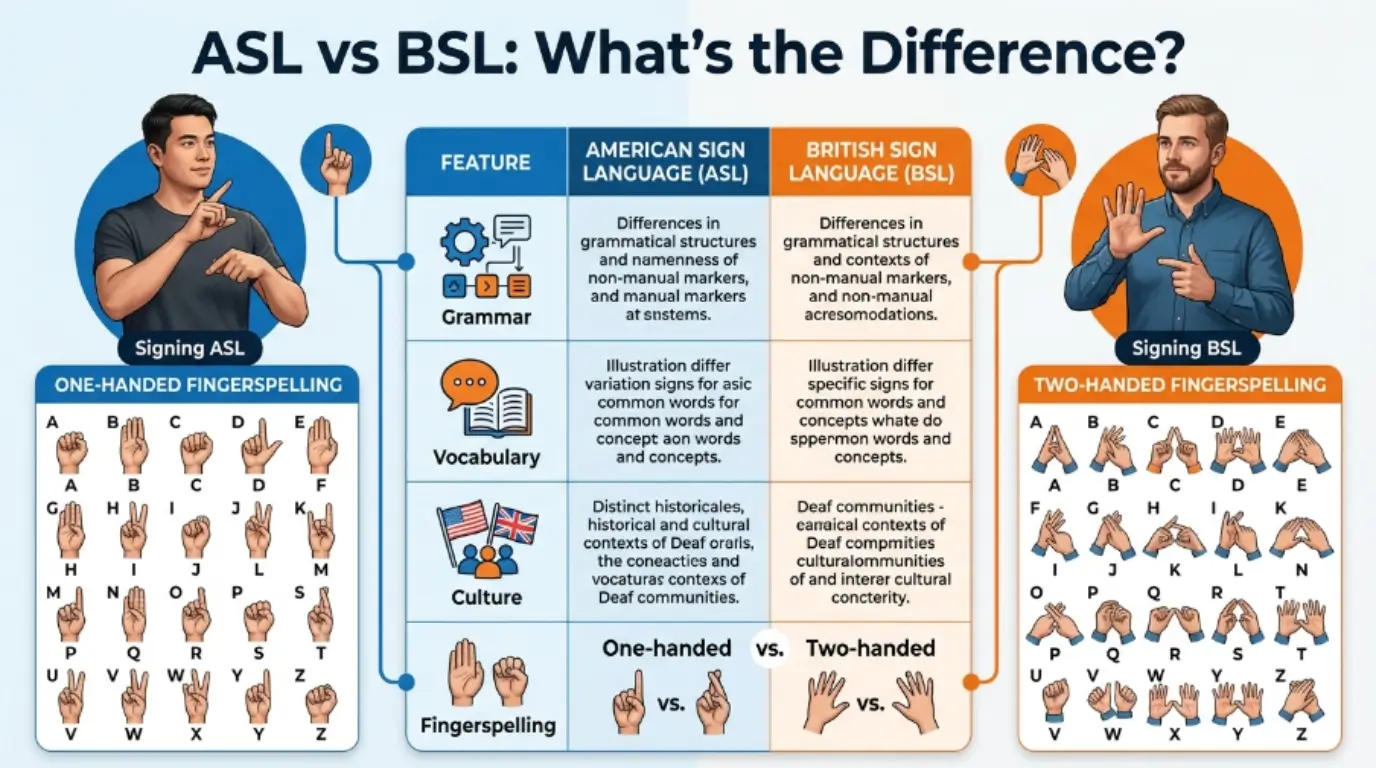
The primary difference between ASL and BSL is that ASL originated in the United States and uses a one-handed fingerspelling system, whereas BSL developed in the United Kingdom and uses a two-handed fingerspelling system. They are separate languages with unique grammar, vocabulary, and cultural influences.
Why Is Their Difference Necessary to Know for Learners and Experts?
Understanding the difference between ASL and BSL is important because sign languages are complete languages, not universal gestures.
Learners can communicate more effectively with the correct deaf community, while experts can conduct better research and provide accurate interpretation services.
Knowledge of these differences promotes inclusion, accessibility, and respect for linguistic diversity. It also helps educators create appropriate learning materials and supports international communication among deaf communities.
Pronunciation of ASL and BSL
ASL
- US Pronunciation: A-S-L (Ay Ess El)
- UK Pronunciation: A-S-L (Ay Ess El)
BSL
- US Pronunciation: B-S-L (Bee Ess El)
- UK Pronunciation: B-S-L (Bee Ess El)
Now that we understand what ASL and BSL mean, let’s explore their major differences in detail.
Difference Between ASL and BSL
1. Origin
ASL
ASL originated in the United States during the early 19th century and was influenced by French Sign Language.
Examples:
- ASL is widely used in American schools for the deaf.
- Many ASL signs have roots in French Sign Language.
BSL
BSL developed independently in Britain and has a much older history.
Examples:
- BSL evolved through British deaf communities.
- BSL has unique signs not found in ASL.
2. Fingerspelling System
ASL
Uses one hand for alphabet signs.
Examples:
- A person’s name can be spelled with one hand.
- Classroom instruction often uses one-handed spelling.
BSL
Uses both hands for fingerspelling.
Examples:
- Names are spelled using two hands.
- British interpreters commonly use two-handed alphabets.
3. Grammar Structure
ASL
Uses topic-comment sentence structure.
Examples:
- Book, I read.
- Movie, she likes.
BSL
Has different grammatical patterns and sentence order.
Examples:
- Yesterday I shop go.
- Friend my visit tomorrow.
4. Vocabulary
ASL
Contains signs unique to American culture.
Examples:
- Signs for American cities.
- Signs related to U.S. institutions.
BSL
Contains signs linked to British culture.
Examples:
- Signs for British landmarks.
- Signs for UK educational systems.
5. Alphabet Similarity
ASL
Closer to French Sign Language.
Examples:
- Similar alphabet formations.
- Shared historical influences.
BSL
Different alphabet design.
Examples:
- Two-handed letters.
- Distinct hand positions.
6. Geographic Use
ASL
Used mainly in the United States and parts of Canada.
Examples:
- American deaf schools.
- U.S. interpreter services.
BSL
Used mainly in the United Kingdom.
Examples:
- British public services.
- UK deaf organizations.
7. Learning Difficulty
ASL
Often considered easier for beginners due to one-handed spelling.
Examples:
- Faster alphabet learning.
- Easier hand coordination.
BSL
Requires coordination of both hands.
Examples:
- Two-hand alphabet practice.
- More complex finger movements.
8. Cultural Influence
ASL
Reflects American deaf culture.
Examples:
- American social expressions.
- U.S.-based community events.
BSL
Reflects British deaf culture.
Examples:
- British traditions.
- UK community identity.
9. International Recognition
ASL
Widely taught worldwide.
Examples:
- Online ASL courses.
- International ASL programs.
BSL
Popular mainly in Britain and neighboring regions.
Examples:
- UK educational courses.
- British interpreter training.
10. Number Signs
ASL
Uses distinct hand positions for numbers.
Examples:
- Number 1 shown differently.
- Number 5 has unique placement.
BSL
Uses alternative number formations.
Examples:
- Different hand orientation.
- Different counting methods.
Nature and Behavior of ASL and BSL
ASL
ASL is expressive, visual, and strongly influenced by American deaf culture. It relies on facial expressions, body movement, and hand signs to convey meaning.
BSL
BSL is equally expressive and visual but follows linguistic traditions developed within British deaf communities. It emphasizes two-handed communication and unique grammatical structures.
Why Are People Confused About Their Use?
Many people assume sign language is universal. Since both ASL and BSL are used by English-speaking countries, people expect them to be the same. However, just as American English and British English differ, ASL and BSL are separate languages with different vocabularies and grammar.
Difference and Similarity Table
| Feature | ASL | BSL | Similarity |
| Full Form | American Sign Language | British Sign Language | Both are sign languages |
| Origin | USA | UK | Used by deaf communities |
| Fingerspelling | One-handed | Two-handed | Alphabet communication |
| Grammar | Unique ASL grammar | Unique BSL grammar | Complete languages |
| Vocabulary | American-based | British-based | Visual communication |
| Culture | American deaf culture | British deaf culture | Cultural identity |
| Facial Expressions | Important | Important | Convey meaning |
| Education | Used in US schools | Used in UK schools | Educational use |
| Interpretation | US services | UK services | Accessibility support |
| Recognition | Internationally known | Widely recognized in UK | Official communication |
Which Is Better in What Situation?
ASL is better when communicating within American deaf communities, studying in the United States, or working with organizations that use American Sign Language. It is also widely available through online learning platforms.
BSL is better when interacting with deaf individuals in the United Kingdom, working in British educational institutions, or providing interpretation services in British settings. Neither language is superior; the best choice depends on the community and environment where it is used.
How Are ASL and BSL Used in Metaphors and Similes?
ASL
- Like a bridge connecting silent worlds.
- As expressive as a painted canvas.
- Like a dance of meaningful gestures.
BSL
- Like a conversation woven through motion.
- As clear as a visual storybook.
- Like a language painted in the air.
Connotative Meaning
ASL
Positive
- Inclusive
- Expressive
- Empowering
Negative
- Misunderstood by people who think sign languages are universal
Neutral
- Communication system
Examples:
- ASL opened new opportunities for communication.
- She studies ASL at university.
BSL
Positive
- Cultural identity
- Accessibility
- Community connection
Negative
- Sometimes overlooked internationally
Neutral
- Linguistic system
Examples:
- BSL supports communication in British communities.
- He became fluent in BSL.
Idioms and Proverbs Related to Communication
Since ASL and BSL are sign languages rather than spoken words, direct idioms are rare. Related communication idioms include:
- Actions speak louder than words.
- Speak the same language.
- Get the message across.
- Read the signs.
- Communication is the key to understanding.
Examples:
- Learning ASL helps people get the message across.
- BSL users often prove that actions speak louder than words.
Works in Literature Related to Sign Language
ASL
- Train Go Sorry – Leah Hager Cohen (Memoir, 1994)
- Seeing Voices – Oliver Sacks (Nonfiction, 1989)
- The Silent Garden – Paul W. Ogden (Educational, 1996)
BSL
- The Sign of the Dragon – Mary Hooper (Historical Fiction, 2004)
- Deaf Sentence – David Lodge (Novel, 2008)
- Understanding BSL Grammar – Various Linguists (Academic Works)
Movies Related to Sign Language
ASL
- Children of a Lesser God (1986, USA)
- CODA (2021, USA)
- The Hammer (2010, USA)
BSL
- Name Me Lawand (2022, United Kingdom)
- Four Weddings and a Funeral (1994, United Kingdom – includes BSL representation)
- Love Is Never Silent (1985, USA/UK influence)
Frequently Asked Questions
Is ASL the same as BSL?
No. They are different languages with different grammar and vocabulary.
Which sign language is easier to learn?
Many beginners find ASL easier because it uses one-handed fingerspelling.
Can ASL users understand BSL users?
Generally not without learning the other language.
Why do ASL and BSL differ?
They developed independently in different countries and cultures.
Are both recognized languages?
Yes. Both are recognized and respected sign languages used by deaf communities.
How Both Are Useful for Surroundings
ASL and BSL improve communication, accessibility, and inclusion. They help deaf individuals participate fully in education, workplaces, healthcare, and public life. Both languages strengthen communities and promote equal opportunities for everyone.
Final Words
ASL and BSL are remarkable languages that demonstrate the diversity and richness of human communication.
While they share the common purpose of helping people communicate visually, they differ significantly in origin, grammar, vocabulary, and fingerspelling systems.
Understanding the difference between ASL and BSL helps learners, educators, interpreters, and researchers appreciate the unique identities of deaf communities around the world.
Rather than viewing one as better than the other, it is more accurate to recognize that each language serves its own community and cultural context.
Learning either ASL or BSL opens doors to inclusion, accessibility, and meaningful human connection.
As awareness of sign languages continues to grow, both ASL and BSL will remain essential tools for communication, education, and social equality.