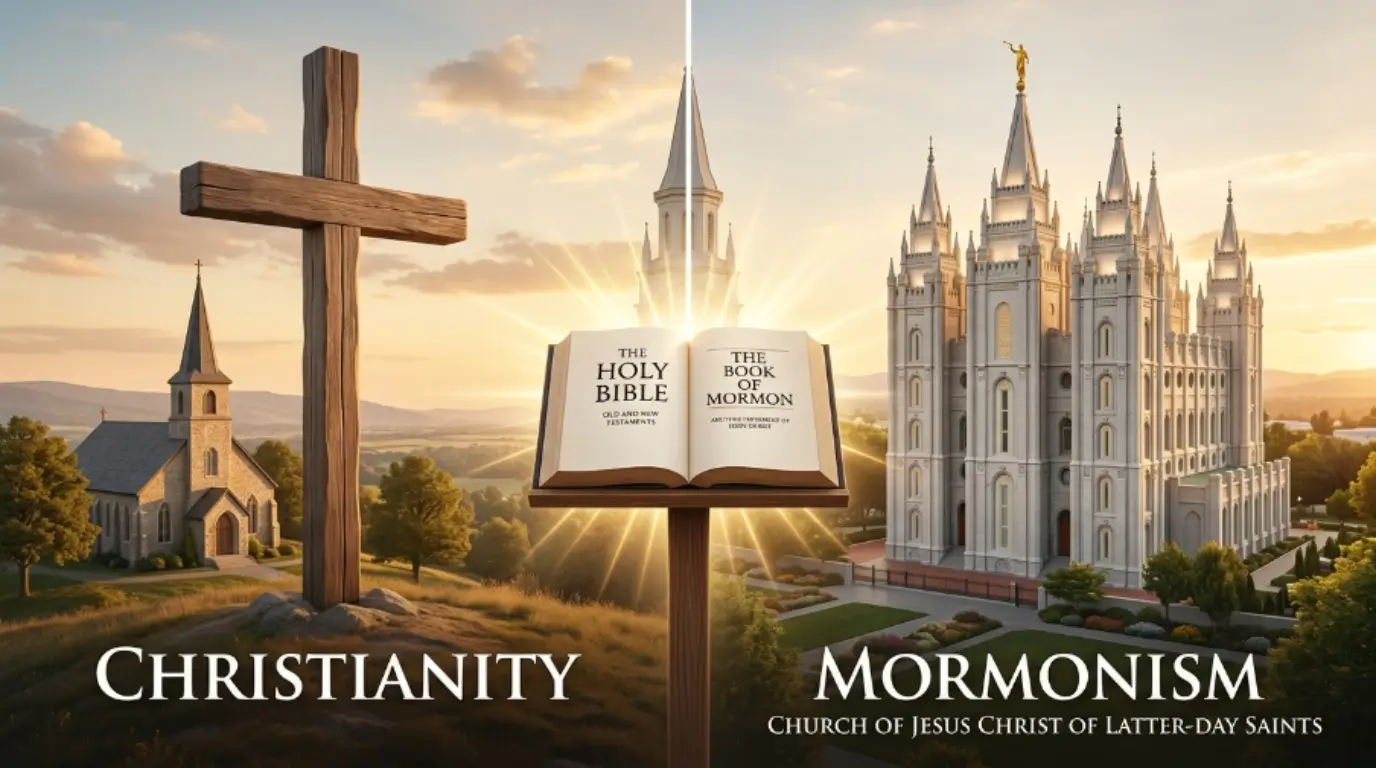
The difference between Christianity and Mormonism is a topic that many people search for when learning about world religions and faith traditions.
Imagine a student attending a religious studies class and hearing both terms used in the same discussion.
Since Mormons believe in Jesus Christ, the student may wonder whether Mormonism and Christianity are exactly the same or if important distinctions exist.
Understanding the difference between Christianity and Mormonism helps learners, researchers, and religious scholars better appreciate the beliefs, history, and practices of both faiths.
While Mormonism developed from a Christian background, several theological teachings make it unique.
Exploring the difference between Christianity and Mormonism allows people to understand religious diversity and engage in informed discussions.
This guide explains the difference between Christianity and Mormonism in simple terms, covering beliefs, practices, history, similarities, and key distinctions.
Key Difference Between Christianity and Mormonism
The main difference lies in religious authority and doctrine. Traditional Christianity relies on the Bible as its primary scripture, while Mormonism accepts additional scriptures such as the Book of Mormon, Doctrine and Covenants, and Pearl of Great Price. Mormonism also teaches beliefs about God, revelation, and human destiny that differ from mainstream Christian teachings.
Why Is Their Difference Important to Know?
Understanding these differences is important for students, researchers, theologians, and anyone interested in religion. Knowledge of these distinctions helps:
- Promote religious literacy.
- Encourage respectful interfaith dialogue.
- Prevent misunderstandings about beliefs.
- Improve academic and theological studies.
- Foster appreciation for cultural diversity.
Both Christianity and Mormonism influence millions of people worldwide and contribute significantly to society through community service, family values, education, and charitable work.
Pronunciation
Christianity
- US: kris-chee-AN-uh-tee
- UK: kris-tee-AN-uh-tee
Mormonism
- US: MOR-muh-niz-uhm
- UK: MOR-muh-niz-uhm
Now that we understand the basic meanings and pronunciations, let’s explore the detailed difference between Christianity and Mormonism through ten major comparison points.
Difference Between Christianity and Mormonism
1. Founding Origins
Christianity
- Began in the 1st century AD.
- Based on the teachings of Jesus Christ.
Examples
- Early church in Jerusalem.
- Teachings of the Apostles.
Mormonism
- Founded in 1830 by Joseph Smith.
- Established in the United States.
Examples
- Publication of the Book of Mormon.
- Formation of The Church of Jesus Christ of Latter-day Saints.
2. Sacred Scriptures
Christianity
- Uses the Bible as its central scripture.
Examples
- Old Testament.
- New Testament.
Mormonism
- Uses the Bible plus additional scriptures.
Examples
- Book of Mormon.
- Doctrine and Covenants.
3. Understanding of God
Christianity
- Generally teaches the Trinity.
Examples
- God the Father.
- God the Holy Spirit.
Mormonism
- Teaches God, Jesus, and the Holy Ghost are distinct beings.
Examples
- Separate divine persons.
- United in purpose rather than substance.
4. View of Jesus Christ
Christianity
- Jesus is the eternal Son of God.
Examples
- Savior of humanity.
- Second person of the Trinity.
Mormonism
- Jesus is the Son of God and central Savior.
Examples
- Redeemer of mankind.
- Spirit child of Heavenly Father.
5. Salvation
Christianity
- Salvation through faith in Christ.
Examples
- Grace through faith.
- Repentance and belief.
Mormonism
- Combines faith, ordinances, and obedience.
Examples
- Baptism.
- Temple ordinances.
6. Church Authority
Christianity
- Authority comes from scripture and church traditions.
Examples
- Catholic bishops.
- Protestant pastors.
Mormonism
- Authority comes through modern prophets.
Examples
- Church president.
- Apostolic leadership.
7. Continuing Revelation
Christianity
- Most denominations believe scripture is complete.
Examples
- Biblical canon.
- Historic church teachings.
Mormonism
- Accepts ongoing revelation.
Examples
- Modern prophets.
- New church guidance.
8. Afterlife
Christianity
- Heaven and hell are common teachings.
Examples
- Eternal life in heaven.
- Separation from God.
Mormonism
- Multiple kingdoms of glory.
Examples
- Celestial Kingdom.
- Terrestrial Kingdom.
9. Worship Practices
Christianity
- Worship styles vary by denomination.
Examples
- Sunday services.
- Communion.
Mormonism
- Structured worship and church programs.
Examples
- Sacrament meetings.
- Family home evening.
10. Temple Use
Christianity
- Churches are primary worship places.
Examples
- Cathedrals.
- Local congregations.
Mormonism
- Temples play a unique role.
Examples
- Eternal marriage ceremonies.
- Sacred ordinances.
Nature and Behavior of Christianity
Christianity emphasizes faith in Jesus Christ, prayer, worship, charity, forgiveness, and service. Christian communities often focus on spreading the Gospel and helping those in need.
Nature and Behavior of Mormonism
Mormonism strongly emphasizes family unity, missionary work, personal discipline, community service, and continuing revelation. Family-centered teachings play a major role in daily life.
Why Are People Confused About Their Use?
People often become confused because Mormons believe in Jesus Christ and use the Bible.
Many Christian teachings are shared by both groups, including prayer, faith, repentance, and moral living.
However, differences in scripture, authority, and theology lead many scholars to classify Mormonism separately from traditional Christianity.
Difference and Similarity Table
| Feature | Christianity | Mormonism | Similarity |
| Founder | Jesus Christ | Joseph Smith | Believe in Jesus |
| Main Scripture | Bible | Bible + Book of Mormon | Use Bible |
| Godhead | Trinity | Separate divine beings | Believe in God |
| Salvation | Faith and grace | Faith plus ordinances | Jesus as Savior |
| Authority | Church traditions | Modern prophets | Religious leadership |
| Revelation | Mostly complete | Continuing revelation | Divine guidance |
| Worship | Churches | Churches and temples | Weekly worship |
| Missionary Work | Common | Very strong emphasis | Share faith |
| Family Values | Important | Central focus | Strong family teachings |
| Prayer | Essential | Essential | Personal prayer |
Which Is Better in What Situation?
Christianity may be preferred by those seeking a faith tradition rooted in the earliest teachings of Jesus Christ and the historical church. Many people appreciate its long history, diverse denominations, and global influence.
Mormonism may appeal to individuals who value continuing revelation, strong family-centered teachings, organized community involvement, and additional scriptures. Which is better depends entirely on personal beliefs, spiritual goals, and theological convictions rather than objective superiority.
How the Keywords Are Used in Metaphors and Similes
Christianity
Metaphors
- Christianity is a guiding light.
- Christianity is a spiritual compass.
Similes
- Faith spread like sunlight.
- Hope shines like a candle.
Mormonism
Metaphors
- Mormonism is a family tree.
- Mormonism is a bridge of faith.
Similes
- Members work together like a team.
- Faith grows like a garden.
Connotative Meanings
Christianity
Positive
- Compassion
- Faith
- Hope
Neutral
- Religion
- Tradition
Negative
- Sometimes associated with historical controversies
Examples
- Christianity inspired charitable work worldwide.
- Christianity remains a major global faith.
Mormonism
Positive
- Family values
- Community service
- Dedication
Neutral
- Religious movement
- Faith tradition
Negative
- Sometimes misunderstood due to unique beliefs
Examples
- Mormonism encourages strong family relationships.
- Mormonism has active missionary programs.
Idioms and Proverbs Related to the Words
There are no widely recognized English idioms containing Christianity or Mormonism directly, but related religious expressions include:
- Faith can move mountains.
- Walk by faith, not by sight.
- Let your light shine.
Examples
- Her dedication showed that faith can move mountains.
- He chose to walk by faith, not by sight.
- Volunteers let their light shine through service.
Works in Literature
Christianity
- The Pilgrim’s Progress — Allegory — John Bunyan — 1678
- Mere Christianity — Theology — C. S. Lewis — 1952
- Confessions — Autobiography — Saint Augustine — 397 AD
- The Cost of Discipleship — Theology — Dietrich Bonhoeffer — 1937
Mormonism
- The Book of Mormon — Religious Scripture — Joseph Smith — 1830
- Rough Stone Rolling — Biography — Richard Lyman Bushman — 2005
- No Man Knows My History — History — Fawn Brodie — 1945
- Saints — Church History — LDS Church — 2018
Movies Related to Christianity
- The Passion of the Christ — 2004 — USA
- Risen — 2016 — USA
- The Nativity Story — 2006 — USA
- Son of God — 2014 — USA
Movies Related to Mormonism
- The Other Side of Heaven — 2001 — USA
- The Saratov Approach — 2013 — USA
- Meet the Mormons — 2014 — USA
- The RM — 2003 — USA
Frequently Asked Questions
Is Mormonism a form of Christianity?
Mormonism originated from Christianity and follows Jesus Christ, but some theological differences lead many scholars to classify it separately from mainstream Christianity.
Do Christians and Mormons use the same Bible?
Yes, both use the Bible, but Mormonism also accepts additional scriptures.
Who founded Mormonism?
Joseph Smith founded Mormonism in 1830.
Do both believe in Jesus Christ?
Yes, both Christianity and Mormonism teach that Jesus Christ is the Savior.
Why do people compare Christianity and Mormonism?
Because they share many beliefs while also having important doctrinal differences.
How Both Are Useful for Society
Christianity contributes through charitable organizations, education, healthcare institutions, and moral teachings that influence communities worldwide.
Mormonism contributes through strong family support systems, humanitarian aid, volunteer service, missionary efforts, and community-building activities. Both encourage ethical behavior, service, and personal spiritual development.
Conclusion
The difference between Christianity and Mormonism centers on scripture, authority, theology, and religious practices.
Christianity traces its roots directly to the teachings of Jesus Christ and the early church, while Mormonism emerged in the nineteenth century with additional scriptures and doctrines.
Despite their differences, both faiths emphasize belief in Jesus Christ, moral living, prayer, family values, and service to others.
Understanding these distinctions helps students, researchers, and curious readers develop a clearer perspective on two influential religious traditions.
Rather than focusing only on differences, recognizing their shared commitment to faith, community, and spiritual growth can promote greater respect and understanding among people of diverse beliefs.