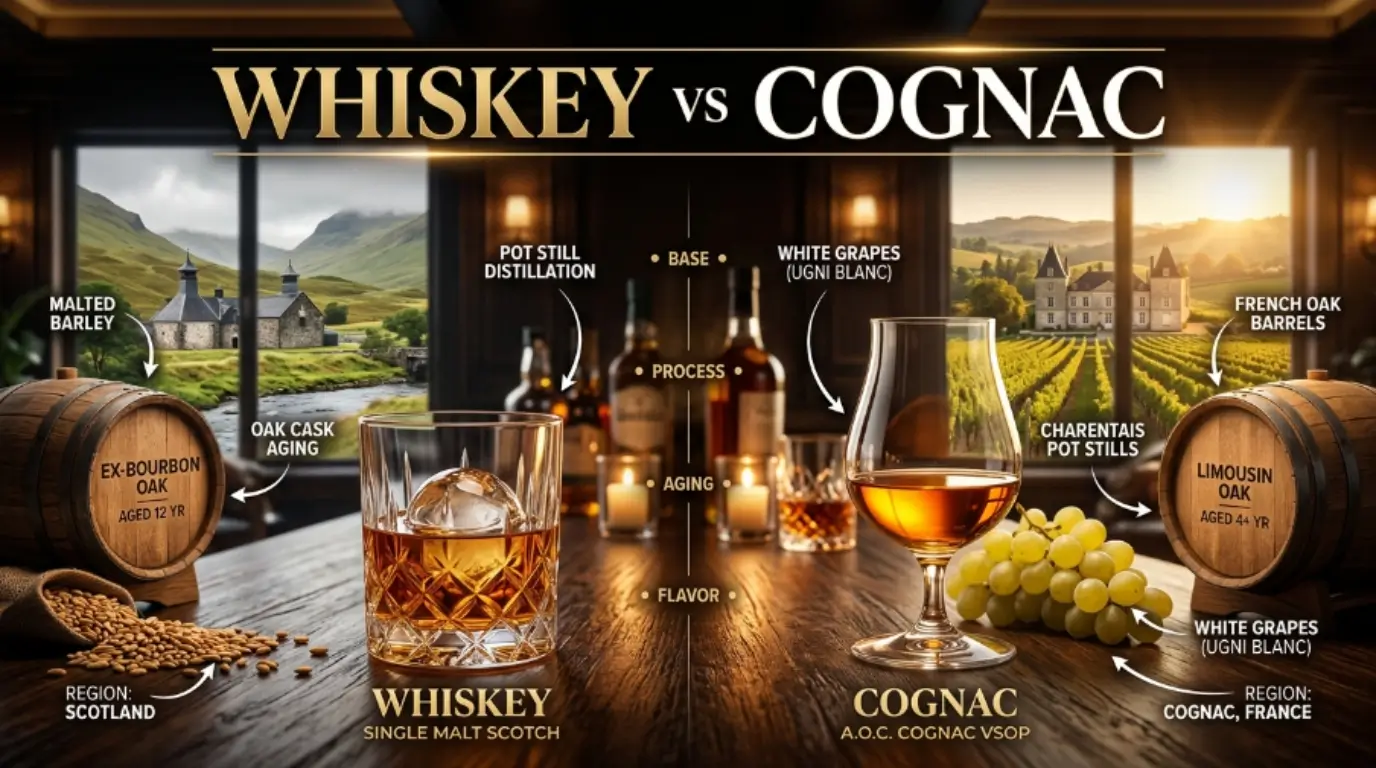
The difference between whiskey and cognac is a topic that often confuses both beginners and experienced drink enthusiasts.
Imagine two friends sitting in a restaurant after dinner. One orders a glass of whiskey while the other chooses cognac.
At first glance, both drinks appear similar because they are aged spirits often enjoyed on special occasions. However, they are made from different ingredients, produced in different regions, and offer unique flavors and experiences.
Understanding the difference between whiskey and cognac helps consumers make informed choices and appreciate each drink’s heritage.
The difference between whiskey and cognac is important not only for drink lovers but also for students of culinary arts, hospitality professionals, and cultural historians.
In this guide, we will explore the difference between whiskey and cognac in detail, covering their origins, production methods, characteristics, uses, and cultural significance.
Key Difference Between Whiskey and Cognac
The primary difference is that whiskey is typically made from fermented grain mash such as barley, corn, rye, or wheat, while cognac is made exclusively from white grapes and produced in the Cognac region of France.
Why Is Their Difference Important to Know?
Understanding the distinction between whiskey and cognac is important because these beverages represent different traditions, production methods, and cultural identities.
For hospitality professionals, knowing the differences helps in proper serving and recommendations.
For consumers, it improves appreciation of flavor profiles and quality standards. Historians and cultural researchers also study these spirits as symbols of regional heritage and craftsmanship.
Pronunciation
Whiskey
- US: WHIS-kee /ˈwɪski/
- UK: WHIS-kee /ˈwɪski/
Cognac
- US: KOHN-yak /ˈkoʊn.jæk/
- UK: KON-yak /ˈkɒn.jæk/
Now that we know how to pronounce them, let’s explore the detailed comparison between these two famous spirits.
Difference Between Whiskey and Cognac
1. Main Ingredient
Whiskey: Made from grains such as barley, rye, corn, or wheat.
Examples:
- Scotch whisky made from malted barley.
- Bourbon made primarily from corn.
Cognac: Made exclusively from white grapes.
Examples:
- Ugni Blanc grapes.
- Folle Blanche grapes.
2. Place of Origin
Whiskey: Produced worldwide.
Examples:
- Scotland.
- United States.
Cognac: Produced only in Cognac, France.
Examples:
- Grande Champagne region.
- Borderies region.
3. Production Process
Whiskey: Grain fermentation followed by distillation.
Examples:
- Single malt distillation.
- Rye whiskey production.
Cognac: Wine fermentation followed by double distillation.
Examples:
- Traditional copper pot stills.
- Double distillation method.
4. Aging Method
Whiskey: Aged in wooden barrels.
Examples:
- Oak casks.
- Charred American oak barrels.
Cognac: Aged in French oak barrels.
Examples:
- Limousin oak barrels.
- Tronçais oak barrels.
5. Flavor Profile
Whiskey: Can be smoky, spicy, sweet, or woody.
Examples:
- Peaty Scotch.
- Sweet bourbon.
Cognac: Usually fruity, floral, and smooth.
Examples:
- Notes of dried fruits.
- Hints of flowers and vanilla.
6. Alcohol Content
Whiskey: Usually 40% to 50% ABV.
Examples:
- Bourbon at 40%.
- Scotch at 46%.
Cognac: Typically around 40% ABV.
Examples:
- VS Cognac.
- XO Cognac.
7. Legal Protection
Whiskey: Regulations vary by country.
Examples:
- Scotch Whisky Regulations.
- Bourbon standards in the USA.
Cognac: Protected geographical indication.
Examples:
- Produced only in Cognac.
- Must follow French regulations.
8. Serving Style
Whiskey: Served neat, on rocks, or in cocktails.
Examples:
- Old Fashioned.
- Whiskey Sour.
Cognac: Often served neat after meals.
Examples:
- Digestif service.
- Luxury tasting events.
9. Cultural Association
Whiskey: Linked to Scotland, Ireland, and America.
Examples:
- Scottish traditions.
- Kentucky bourbon culture.
Cognac: Associated with French luxury.
Examples:
- French celebrations.
- Premium gifting culture.
10. Price Range
Whiskey: Available in all price categories.
Examples:
- Affordable blends.
- Premium single malts.
Cognac: Generally positioned as a luxury spirit.
Examples:
- VSOP bottles.
- Rare XO collections.
Nature and Behavior of Both
Whiskey
Whiskey is often viewed as bold, diverse, and adaptable. It can range from smoky and intense to sweet and smooth. Its versatility allows it to be enjoyed casually or formally.
Cognac
Cognac is known for elegance, refinement, and sophistication. It is often associated with luxury, celebrations, and fine dining experiences.
Why Are People Confused About Their Use?
People often confuse whiskey and cognac because both are aged spirits with similar amber colors. They are commonly served in similar glassware and enjoyed during special occasions.
Their premium reputation also leads many people to assume they are the same type of drink when they actually come from different ingredients and traditions.
Difference and Similarity Table
| Feature | Whiskey | Cognac | Similarity |
| Main Ingredient | Grains | Grapes | Both are distilled spirits |
| Origin | Worldwide | Cognac, France | Both have strong traditions |
| Aging | Oak barrels | French oak barrels | Both require aging |
| Flavor | Smoky, spicy, sweet | Fruity, floral | Both offer complex flavors |
| Serving | Neat, cocktails | Mostly neat | Both enjoyed socially |
| Alcohol Content | 40–50% | Around 40% | Similar strength |
Which Is Better in What Situation?
Whiskey is often better for cocktails, casual gatherings, and people who enjoy a wide range of flavor styles. Its versatility makes it suitable for many occasions, from social events to quiet evenings at home.
Cognac is often preferred for formal dinners, celebrations, and luxury experiences. Its smooth and elegant profile makes it ideal for sipping slowly and appreciating complex aromas after a meal.
Metaphors and Similes
Whiskey
Metaphors:
- He is a whiskey soul—strong and mature.
- Her determination is pure whiskey.
Similes:
- Strong as whiskey.
- Smooth like aged whiskey.
Cognac
Metaphors:
- She carried herself like cognac—refined and elegant.
- His wisdom was aged cognac.
Similes:
- Smooth as cognac.
- Rich like fine cognac.
Connotative Meaning
Whiskey
Positive:
- Strength
- Tradition
- Character
Negative:
- Excess
- Recklessness
Neutral:
- Distilled spirit
Examples:
- His confidence was whiskey-strong.
- The room smelled of whiskey and nostalgia.
Cognac
Positive:
- Luxury
- Sophistication
- Prestige
Negative:
- Elitism
- Expensiveness
Neutral:
- Premium grape spirit
Examples:
- The event carried a cognac-like elegance.
- She appreciated cognac for its history.
Idioms and Proverbs Related to the Words
Whiskey
- Whiskey is liquid sunshine.
- Good whiskey takes time.
Examples:
- His patience proved that good whiskey takes time.
- After years of effort, her success became liquid sunshine.
Cognac
There are no widely recognized traditional English idioms specifically centered on cognac, but expressions often use it symbolically.
Examples:
- His taste is as refined as cognac.
- The evening felt smooth like cognac.
Works in Literature
Whiskey
- Whiskey Galore — Novel by Compton Mackenzie (1947), Comedy
- Under the Volcano — Malcolm Lowry (1947), Literary Fiction
- The Lost Weekend — Charles R. Jackson (1944), Psychological Fiction
Cognac
- The Count of Monte Cristo — Alexandre Dumas (1844), Adventure
- Remembrance of Things Past — Marcel Proust (1913), Literary Fiction
- Bel-Ami — Guy de Maupassant (1885), Realist Fiction
Movies Related to Whiskey
- Whiskey Galore! (1949, United Kingdom)
- Whiskey Tango Foxtrot (2016, United States)
- The Angel’s Share (2012, United Kingdom)
Movies Related to Cognac
- Cognac (1988, France)
- A Year in Champagne (2014, United States)
- Mondovino (2004, France/USA)
Frequently Asked Questions
Is cognac a type of whiskey?
No. Cognac is a grape-based brandy, while whiskey is grain-based.
Which is stronger, whiskey or cognac?
Most have similar alcohol content, though some whiskeys may be stronger.
Why is cognac more expensive?
Its strict production rules and limited geographic origin often increase its value.
Can whiskey and cognac be used in cocktails?
Yes. Both are used in different classic and modern cocktails.
Which is smoother for beginners?
Many beginners find cognac smoother because of its fruity and floral character.
How Both Are Useful for Surroundings
Whiskey contributes to cultural traditions, tourism, hospitality industries, and economic growth in producing regions. It supports local communities through production, distribution, and tourism activities.
Cognac plays a similar role by preserving French heritage, supporting vineyards, and promoting luxury tourism. Both beverages contribute significantly to global trade and cultural exchange.
Final Words for Both
The difference between whiskey and cognac goes far beyond taste. Whiskey is a grain-based spirit known for its versatility, bold character, and global presence.
Cognac is a grape-based spirit celebrated for elegance, luxury, and strict regional traditions.
While both are aged distilled beverages with rich histories, their ingredients, production methods, flavors, and cultural identities make them unique.
Understanding these distinctions allows consumers, students, and professionals to appreciate each spirit on its own merits.
Whether you prefer the robust complexity of whiskey or the refined smoothness of cognac, both represent centuries of craftsmanship and tradition.
Knowing the difference helps you choose the right drink for the right occasion and deepens your appreciation for the world of fine spirits.