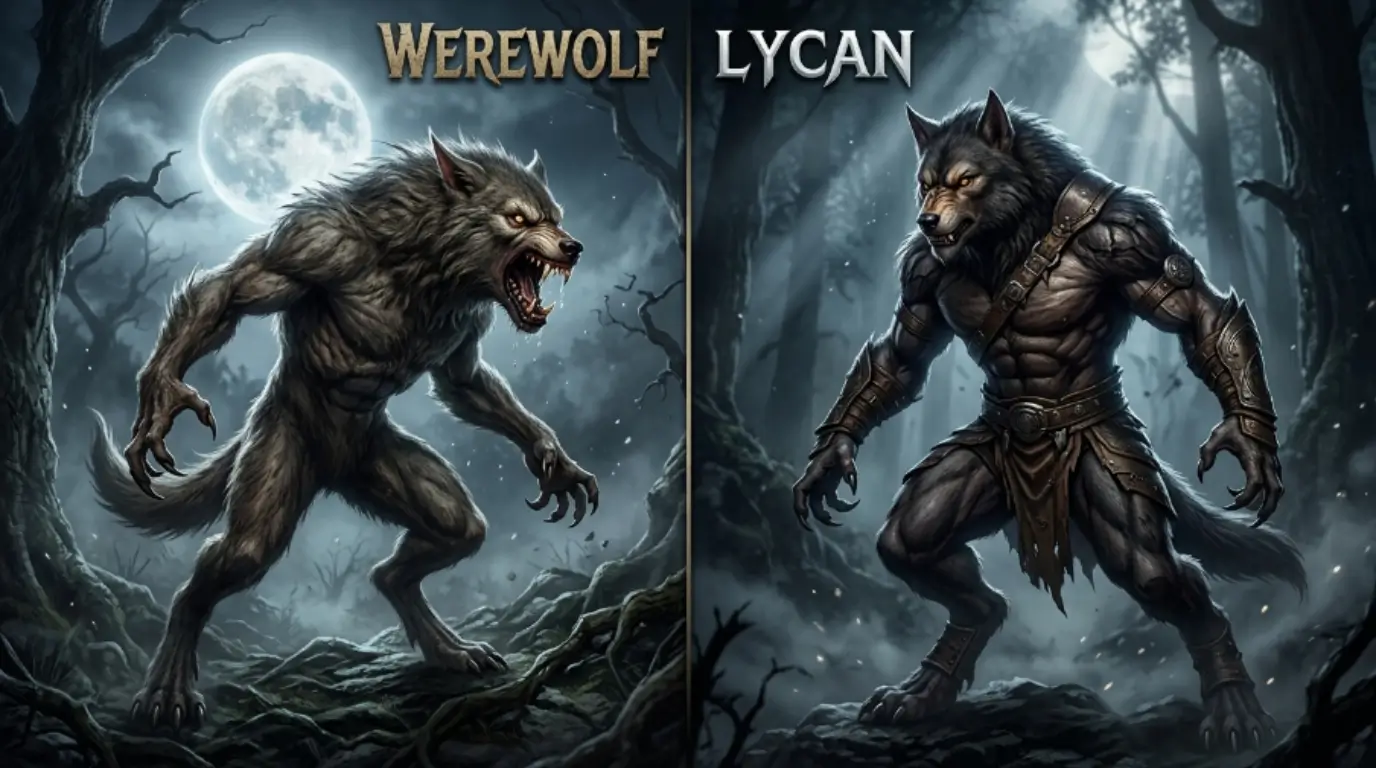
The terms werewolf and lycan are often used as if they mean the same thing, but they have different origins and meanings. Imagine watching a fantasy movie where a character transforms into a wolf under the full moon.
Some people call that creature a werewolf, while others call it a lycan. This confusion has existed for many years because both creatures share wolf-like features and supernatural abilities.
Understanding the difference between werewolf and lycan is important for fans of mythology, literature, movies, and folklore. Although both creatures can transform between human and wolf forms, their origins, powers, and characteristics vary significantly.
The difference between werewolf and lycan is often highlighted in fantasy stories and horror films. Knowing the difference between werewolf and lycan helps readers better understand popular culture, mythology, and fictional storytelling.
In this article, we will explore the complete difference between werewolf and lycan in simple and easy-to-understand language.
Key Difference Between Werewolf and Lycan
The main difference is that a werewolf is traditionally a human who transforms into a wolf-like creature, often because of a curse or a bite from another werewolf. A lycan, on the other hand, is usually portrayed as a more powerful and naturally born wolf-human hybrid with greater control over transformation.
Why Is It Important to Know Their Difference?
Understanding the distinction helps students, researchers, writers, and fantasy enthusiasts interpret folklore and fiction correctly. The difference influences character development, storytelling, mythology studies, and cultural analysis. It also helps viewers better understand movies, novels, and games that feature these supernatural beings.
Pronunciation
Werewolf
- US: /ˈwer.wʊlf/
- UK: /ˈweə.wʊlf/
Lycan
- US: /ˈlaɪ.kən/
- UK: /ˈlaɪ.kən/
Now that we know the basic meaning and pronunciation, let’s explore the detailed differences between these legendary creatures.
Difference Between Werewolf and Lycan
1. Origin
Werewolf: Originates from European folklore and ancient legends.
Examples:
- Medieval German werewolf tales.
- French loup-garou legends.
Lycan: Derived from Greek mythology, especially the story of King Lycaon.
Examples:
- The myth of King Lycaon.
- Modern fantasy adaptations.
2. Transformation Cause
Werewolf: Often transforms due to a curse or bite.
Examples:
- Bitten by another werewolf.
- Cursed by supernatural forces.
Lycan: Usually born with the ability.
Examples:
- Inherited from parents.
- Ancient bloodline powers.
3. Control Over Transformation
Werewolf: Often loses control.
Examples:
- Full moon triggers change.
- Becomes uncontrollably violent.
Lycan: Usually has better control.
Examples:
- Changes voluntarily.
- Maintains awareness.
4. Intelligence During Transformation
Werewolf: Human reasoning may decrease.
Examples:
- Acts on instinct.
- Difficulty recognizing friends.
Lycan: Retains intelligence.
Examples:
- Plans attacks strategically.
- Communicates effectively.
5. Physical Appearance
Werewolf: More wolf-like.
Examples:
- Extended snout.
- Dense fur covering.
Lycan: More human-wolf hybrid.
Examples:
- Muscular humanoid body.
- Human facial features remain visible.
6. Strength
Werewolf: Stronger than humans.
Examples:
- Breaks doors.
- Lifts heavy objects.
Lycan: Typically portrayed as stronger.
Examples:
- Defeats multiple enemies.
- Exceptional combat ability.
7. Weaknesses
Werewolf: Vulnerable to silver.
Examples:
- Silver bullets.
- Silver weapons.
Lycan: Weakness varies by story.
Examples:
- Magical weapons.
- Ancient rituals.
8. Social Structure
Werewolf: Often solitary.
Examples:
- Wanders alone.
- Lives in isolation.
Lycan: Frequently shown in clans.
Examples:
- Organized packs.
- Leadership hierarchy.
9. Mythological Basis
Werewolf: Rooted in European folklore.
Examples:
- Scandinavian legends.
- Germanic myths.
Lycan: Rooted in Greek mythology.
Examples:
- King Lycaon story.
- Ancient Greek traditions.
10. Modern Portrayal
Werewolf: Common in horror stories.
Examples:
- Classic monster films.
- Gothic literature.
Lycan: Popular in action-fantasy stories.
Examples:
- Modern fantasy movies.
- Supernatural television series.
Nature and Behavior
Werewolf
Werewolves are often depicted as aggressive, unpredictable, and heavily influenced by instinct. During transformation, they may lose self-control and become dangerous to humans and animals.
Lycan
Lycans are usually portrayed as disciplined, intelligent, and strategic. They often maintain awareness during transformation and can function within organized groups.
Why Are People Confused About Their Use?
People often confuse werewolves and lycans because both transform into wolf-like creatures and share many supernatural abilities.
Modern movies, games, and novels sometimes use the terms interchangeably, which increases confusion. Both creatures belong to the broader category of shape-shifting wolf beings.
Difference and Similarity Table
| Feature | Werewolf | Lycan |
| Origin | European folklore | Greek mythology |
| Transformation | Curse or bite | Usually inherited |
| Control | Limited | Greater control |
| Intelligence | Often reduced | Usually retained |
| Appearance | More wolf-like | Human-wolf hybrid |
| Strength | Very strong | Extremely strong |
| Social Structure | Often solitary | Pack-oriented |
| Weakness | Silver | Varies |
| Genre Popularity | Horror | Fantasy/Action |
| Similarity | Wolf-human creature | Wolf-human creature |
Which Is Better in What Situation?
A werewolf is generally more effective in horror storytelling because its uncontrollable nature creates suspense, fear, and unpredictability. Horror writers often prefer werewolves when they want to emphasize danger and loss of control.
A lycan is usually better suited for fantasy and action stories because it combines immense power with intelligence. Lycans often serve as warriors, leaders, or protectors, making them ideal for complex storylines involving strategy and combat.
How Are They Used in Metaphors and Similes?
Werewolf
Connotative Meaning:
- Negative
- Fear
- Loss of control
Examples:
- He became a werewolf whenever he got angry.
- Her mood changed like a werewolf under a full moon.
Lycan
Connotative Meaning:
- Neutral to Positive
- Strength
- Leadership
Examples:
- He led the team like a lycan leading its pack.
- She was as fearless as a lycan in battle.
Idioms or Expressions Related to the Words
Werewolf
- A wolf in sheep’s clothing
Example:
- The scammer was a wolf in sheep’s clothing.
Lycan
No widely accepted traditional idioms exist, but fantasy writers often use:
- Leader of the pack
Example:
- She became the leader of the pack after years of hard work.
Works in Literature
Werewolf
- The Were-Wolf — Clemence Housman (1896) — Gothic Horror
- The Wolf Leader — Alexandre Dumas (1857) — Fantasy
- Cycle of the Werewolf — Stephen King (1983) — Horror
Lycan
- Lycanthropy Reader — Charlotte F. Otten (1986) — Mythology
- Various modern fantasy novels inspired by Greek mythology
Movies Featuring Werewolves
- An American Werewolf in London (1981, United Kingdom)
- The Wolfman (2010, United States)
- Ginger Snaps (2000, Canada)
Movies Featuring Lycans
- Underworld (2003, United States)
- Underworld: Rise of the Lycans (2009, United States)
- Underworld: Evolution (2006, United States)
Frequently Asked Questions
Are werewolves and lycans the same?
No. Lycans are generally portrayed as more powerful and controlled than werewolves.
Which came first, werewolves or lycans?
Werewolf legends appeared widely in European folklore, while lycan concepts originated from Greek mythology.
Can a werewolf become a lycan?
Traditional mythology does not support this idea, though some fantasy stories do.
Are lycans stronger than werewolves?
Many modern fantasy stories portray lycans as stronger and more intelligent.
Why do movies use both terms?
Different writers and filmmakers use the terms to create unique mythologies and character types.
How Both Are Useful for Surroundings
Werewolves and lycans contribute to storytelling, cultural studies, mythology research, entertainment, and creative writing.
They help preserve folklore traditions while inspiring modern books, movies, games, and television series. Their legends encourage imagination and provide insight into how different cultures explain fear, transformation, and human nature.
Conclusion
The difference between werewolf and lycan goes far beyond simple terminology. While both are supernatural wolf-human creatures, they differ in origin, transformation methods, intelligence, strength, and cultural background.
Werewolves are primarily rooted in European folklore and are often associated with curses and loss of control.
Lycans, meanwhile, stem from Greek mythology and are typically portrayed as stronger, more intelligent, and more disciplined beings.
Understanding the difference between werewolf and lycan helps readers appreciate mythology, literature, and popular culture more deeply.
Whether you prefer the terrifying unpredictability of werewolves or the powerful leadership qualities of lycans, both creatures continue to fascinate audiences around the world.