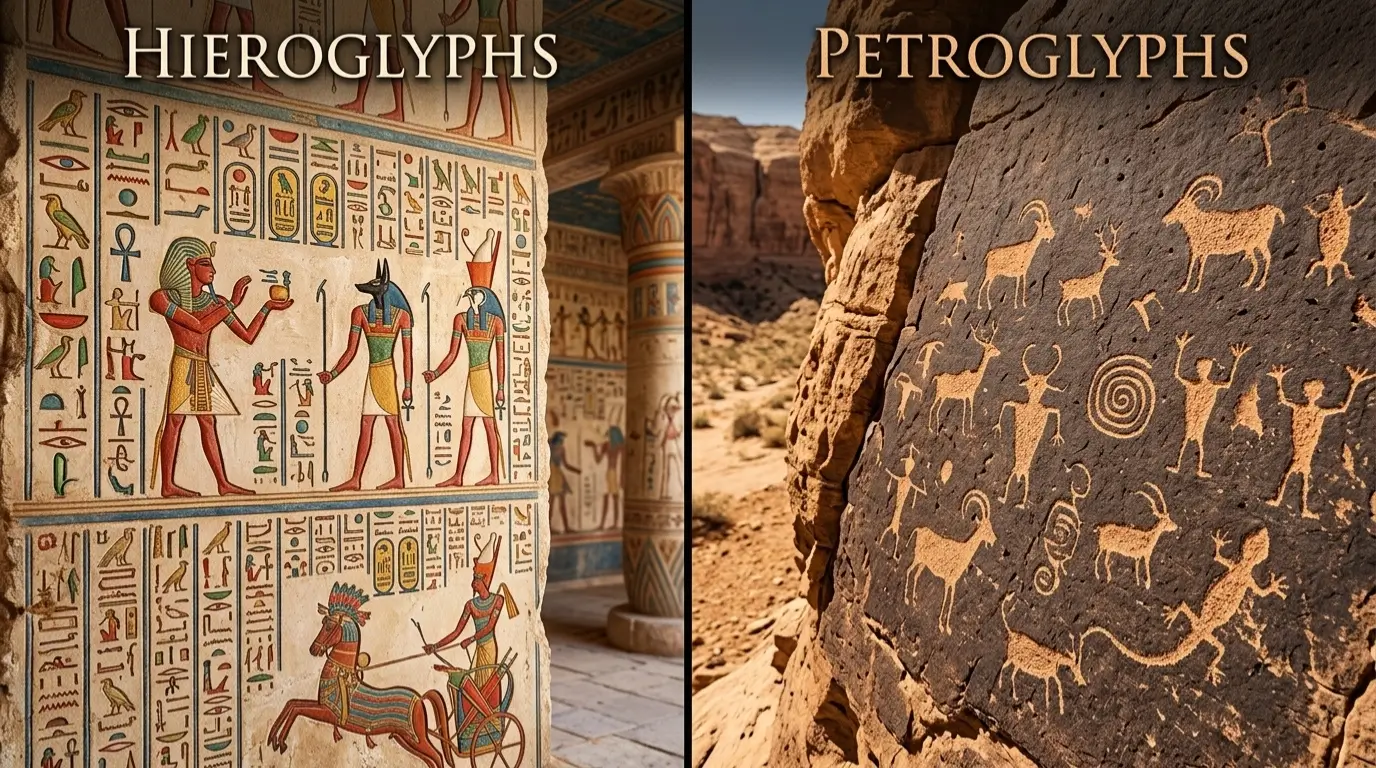
Imagine walking through an ancient desert valley and spotting strange carvings on a rock wall. Some look like animals and shapes scratched into stone, while others resemble symbols telling a story.
This is where the difference between hieroglyphs and petroglyphs becomes fascinating. Many people confuse these two because both are ancient visual markings, but they serve very different purposes.
Understanding the difference between hieroglyphs and petroglyphs helps us connect with human history in a deeper way.
Whether you are a student, traveler, or history lover, knowing the difference between hieroglyphs and petroglyphs can unlock stories carved thousands of years ago.
In this guide, we will clearly explain the difference between hieroglyphs and petroglyphs using simple examples and real-world context.
Key Difference Between the Both
Hieroglyphs are a formal writing system made of symbols used mainly by ancient Egyptians to record language. Petroglyphs, on the other hand, are rock carvings or images created by chipping away stone surfaces, often without forming a structured language.
Why Is Their Difference Important?
Understanding the difference between hieroglyphs and petroglyphs is important for both learners and experts. It helps historians decode ancient civilizations correctly. Misunderstanding them can lead to wrong interpretations of history. In society, this knowledge preserves cultural heritage and allows archaeologists to identify whether markings are communication systems or artistic expressions. It also helps tourists and students appreciate ancient sites more meaningfully.
Pronunciation
- Hieroglyphs
- US: /ˈhaɪəroʊɡlɪfs/
- UK: /ˈhaɪərəʊɡlɪfs/
- Petroglyphs
- US: /ˈpɛtroʊɡlɪfs/
- UK: /ˈpɛtrəʊɡlɪfs/
Now that you understand the basics, let’s explore the detailed differences.
Difference Between Hieroglyphs and Petroglyphs (10 Key Points)
1. Purpose
- Hieroglyphs: Used for writing language
- Example 1: Recording royal decrees
- Example 2: Writing religious texts
- Petroglyphs: Used for art or symbolic expression
- Example 1: Animal carvings
- Example 2: Hunting scenes
2. Origin
- Hieroglyphs: Ancient Egypt
- Example 1: Temple walls
- Example 2: Tomb inscriptions
- Petroglyphs: Found worldwide
- Example 1: Cave carvings in Asia
- Example 2: Rock art in America
3. Structure
- Hieroglyphs: Organized symbols forming language
- Example 1: Words and sentences
- Example 2: Grammar rules
- Petroglyphs: Random or artistic images
- Example 1: Shapes
- Example 2: Figures
4. Method of Creation
- Hieroglyphs: Painted or carved
- Example 1: Ink writing
- Example 2: Wall carvings
- Petroglyphs: Carved by chipping rocks
- Example 1: Hammering stone
- Example 2: Scratching surface
5. Meaning
- Hieroglyphs: Specific meanings (words/sounds)
- Example 1: Names
- Example 2: Messages
- Petroglyphs: Symbolic or unclear meanings
- Example 1: Ritual signs
- Example 2: Cultural symbols
6. Complexity
- Hieroglyphs: Highly complex system
- Example 1: Hundreds of symbols
- Example 2: Multiple meanings
- Petroglyphs: Simple designs
- Example 1: Basic shapes
- Example 2: Repeated patterns
7. Usage
- Hieroglyphs: Used by trained scribes
- Example 1: Priests
- Example 2: Officials
- Petroglyphs: Made by common people
- Example 1: Tribes
- Example 2: Hunters
8. Time Period
- Hieroglyphs: Developed around 3100 BCE
- Example 1: Egyptian civilization
- Example 2: Pyramid era
- Petroglyphs: Much older and widespread
- Example 1: Prehistoric times
- Example 2: Early humans
9. Location
- Hieroglyphs: Mostly in temples and tombs
- Example 1: Walls
- Example 2: Monuments
- Petroglyphs: Found on rocks and caves
- Example 1: Mountains
- Example 2: Deserts
10. Interpretation
- Hieroglyphs: Can be translated
- Example 1: Decoded texts
- Example 2: Historical records
- Petroglyphs: Often open to interpretation
- Example 1: Unknown meanings
- Example 2: Cultural guesses
Nature and Behaviour
Hieroglyphs behave like a structured language system. They follow rules and carry clear meaning. Petroglyphs are more artistic and expressive, often reflecting emotions, beliefs, or daily life without strict rules.
Why People Get Confused
People confuse them because both are ancient carvings and look similar at first glance. Also, both appear on stone surfaces, making it hard to distinguish without deeper knowledge.
Difference and Similarity Table
| Feature | Hieroglyphs | Petroglyphs | Similarity |
| Purpose | Writing system | Rock art | Both visual |
| Structure | Organized symbols | Random images | Both symbolic |
| Meaning | Clear and readable | Often unclear | Cultural value |
| Location | Egypt mainly | Worldwide | Ancient origin |
| Creation | Painted/carved | Carved | Stone-based |
Which Is Better in What Situation?
Hieroglyphs are better when you need structured communication or written records. They help historians understand exact messages from the past.
Petroglyphs are better for artistic expression and storytelling through visuals. They give insight into emotions, culture, and daily life of ancient people.
Metaphors and Similes
Hieroglyphs
- Metaphor: “His notes were hieroglyphs no one could read.”
- Simile: “The code looked like hieroglyphs on paper.”
- Connotation: Neutral to positive
Petroglyphs
- Metaphor: “Her memories were petroglyphs carved in time.”
- Simile: “The wall looked like petroglyphs from history.”
- Connotation: Neutral
Idioms or Expressions
(Not direct idioms, but usage examples)
- “His handwriting is like hieroglyphs.”
- “The markings looked like ancient petroglyphs.”
Works in Literature
- Egyptian Hieroglyphs for Complete Beginners – Mark Collier (Educational, 2003)
- The Writing of the Gods – Edward Dolnick (History, 2021)
- Petroglyphs of North America – James D. Keyser (Archaeology, 1992)
Movies Related to the Topic
- The Mummy (1999, USA) – Features hieroglyphs
- Stargate (1994, USA) – Ancient symbols and language
- Quest for Fire (1981, Canada/France) – Early human carvings
FAQs
1. What is the main difference between hieroglyphs and petroglyphs?
Hieroglyphs are a writing system, while petroglyphs are rock carvings or art.
2. Can petroglyphs be read like language?
No, most petroglyphs are symbolic and cannot be read like words.
3. Where are hieroglyphs mostly found?
They are mainly found in ancient Egyptian temples and tombs.
4. Why are petroglyphs important?
They help us understand early human culture and lifestyle.
5. Are both still used today?
No, but they are studied for historical and cultural knowledge.
How Both Are Useful for Surroundings
Both hieroglyphs and petroglyphs help preserve human history. They guide archaeologists, educate students, and attract tourism. They also inspire modern art and storytelling.
Final Words
The difference between hieroglyphs and petroglyphs is simple yet powerful. One represents structured communication, while the other reflects artistic expression. Both hold deep historical value and teach us about human evolution, creativity, and culture.
By understanding the difference between hieroglyphs and petroglyphs, we not only learn about the past but also appreciate how humans have always found ways to express themselves.
Whether through language or art, these ancient markings continue to speak across time, reminding us of our shared history.