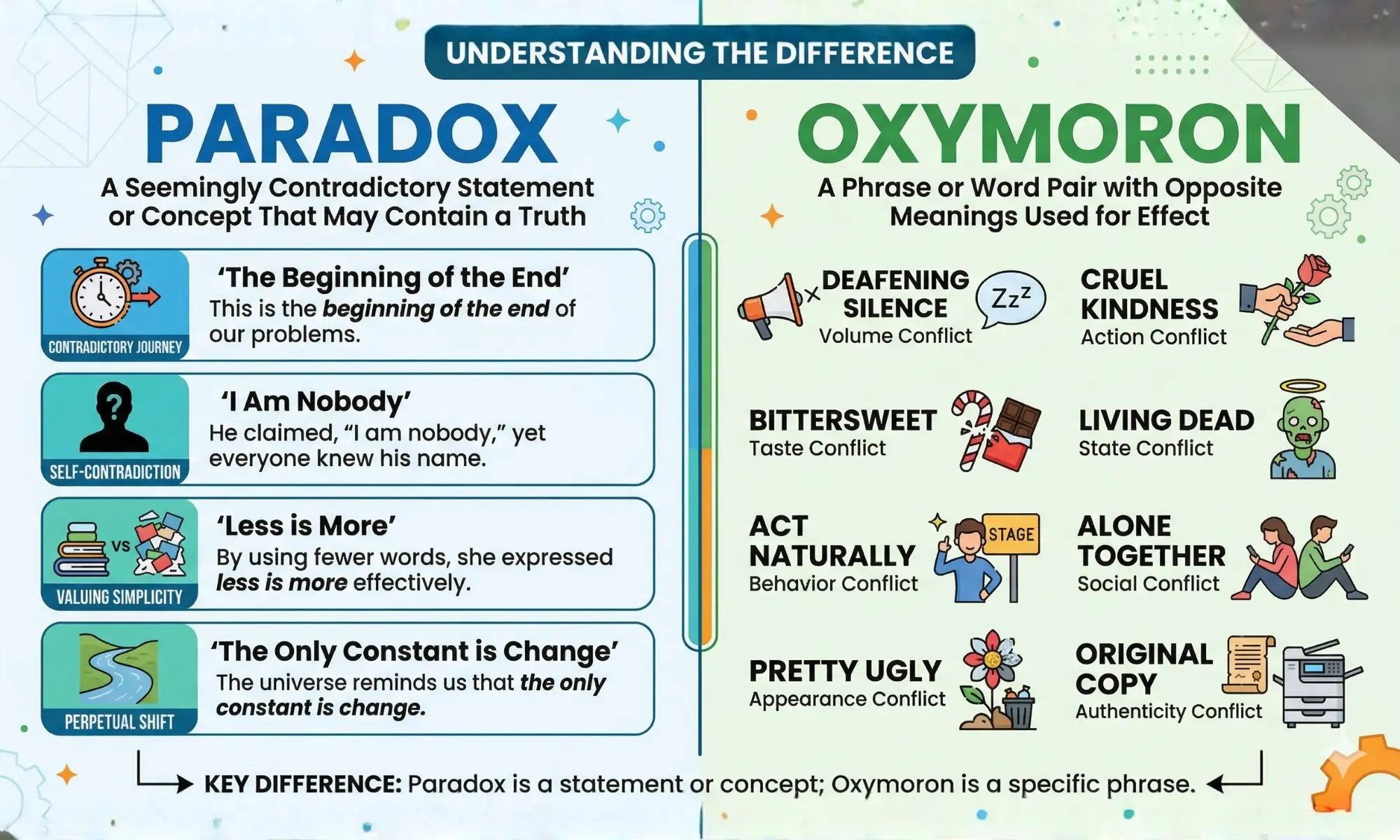
Have you ever heard someone say, “less is more” or “bittersweet moment” and wondered what they really mean? These phrases may sound confusing at first, but they are powerful tools in language.
The difference between paradox and oxymoron becomes clear when we look at real-life conversations. Imagine a teacher explaining a tough concept by saying, “This is clearly confusing.” It feels strange, yet meaningful.
Understanding the difference between paradox and oxymoron helps writers, students, and even speakers express deeper ideas. Many people mix them up, but knowing the difference between paradox and oxymoron can improve communication and creativity.
In everyday life, we use such expressions without even noticing. So, learning the difference between paradox and oxymoron is not just for exams it’s for better thinking and expression.
Key Difference Between Paradox and Oxymoron
A paradox is a statement that seems contradictory but reveals a deeper truth.
An oxymoron is a combination of two opposite words placed together.
Why Is Their Difference Important?
Understanding the difference between paradox and oxymoron is important for learners and experts. It helps students write better essays and improves critical thinking. Writers use these tools to make their content more engaging. In society, these expressions shape speeches, literature, and even advertising. For experts, it helps in analyzing texts deeply. For learners, it builds clarity in language.
Pronunciation
- Paradox (US): /ˈper.ə.dɑːks/
- Paradox (UK): /ˈpær.ə.dɒks/
- Oxymoron (US): /ˌɑːk.sɪˈmɔːr.ɑːn/
- Oxymoron (UK): /ˌɒk.sɪˈmɔː.rɒn/
Now that you know the basics, let’s explore their differences in detail.
Difference Between Paradox and Oxymoron
1. Definition
- Paradox: A full statement with hidden truth.
Example: “The more you learn, the less you know.”
Example: “Silence can be louder than words.” - Oxymoron: Two opposite words together.
Example: “Deafening silence.”
Example: “Living dead.”
2. Structure
- Paradox: Complete sentence.
Example: “I must be cruel to be kind.”
Example: “This statement is false.” - Oxymoron: Short phrase.
Example: “Open secret.”
Example: “Awfully good.”
3. Purpose
- Paradox: To provoke thought.
Example: “Less is more.”
Example: “You must lose yourself to find yourself.” - Oxymoron: To create effect.
Example: “Sweet sorrow.”
Example: “Cold fire.”
4. Meaning
- Paradox: Deep meaning.
Example: “Freedom is slavery.”
Example: “The beginning of the end.” - Oxymoron: Immediate contrast.
Example: “Bittersweet.”
Example: “Jumbo shrimp.”
5. Complexity
- Paradox: Complex idea.
Example: “The only constant is change.”
Example: “I know that I know nothing.” - Oxymoron: Simple contrast.
Example: “Pretty ugly.”
Example: “Seriously funny.”
6. Usage
- Paradox: Used in philosophy and writing.
Example: “Time flies slowly.”
Example: “War is peace.” - Oxymoron: Used in everyday speech.
Example: “Virtual reality.”
Example: “Original copy.”
7. Length
- Paradox: Longer statements.
Example: “The more you give, the more you receive.”
Example: “Truth is hidden in lies.” - Oxymoron: Short phrases.
Example: “Act naturally.”
Example: “Clearly confused.”
8. Effect on Reader
- Paradox: Makes you think deeply.
Example: “You have to spend money to save money.”
Example: “The only rule is no rules.” - Oxymoron: Creates quick impact.
Example: “Random order.”
Example: “Alone together.”
9. Context
- Paradox: Needs explanation.
Example: “Less effort brings more success.”
Example: “Failure is success.” - Oxymoron: Easy to understand.
Example: “Small crowd.”
Example: “Old news.”
10. Literary Use
- Paradox: Used in deeper themes.
Example: “All animals are equal, but some are more equal than others.”
Example: “It was the best of times, it was the worst of times.” - Oxymoron: Used for style.
Example: “Parting is such sweet sorrow.”
Example: “Loving hate.”
Nature and Behaviour
A paradox behaves like a puzzle. It looks wrong but makes sense after thinking.
An oxymoron behaves like a contrast. It shows opposite ideas instantly.
Why People Are Confused
People confuse them because both involve contradictions. However, paradox is a full idea, while oxymoron is just a pair of words.
Comparison Table
| Feature | Paradox | Oxymoron | Similarity |
| Form | Sentence | Phrase | Both show contrast |
| Meaning | Deep | Immediate | Both create interest |
| Usage | Literature, philosophy | Daily speech | Both expressive tools |
| Length | Long | Short | Both involve opposites |
Which Is Better in What Situation?
A paradox is better when you want to explain deep ideas or philosophical truths. It is useful in essays, speeches, and storytelling.
An oxymoron is better for quick expression. It works well in poetry, captions, and casual conversations.
Metaphors and Similes
- Paradox: “Life is a beautiful struggle.”
- Oxymoron: “Her silence was deafening like a storm.”
Connotative Meaning
- Paradox: Positive (deep thinking), Neutral
Example: “Less is more.” - Oxymoron: Neutral, sometimes creative
Example: “Bittersweet memory.”
Idioms / Proverbs
- “Less is more.” (Paradox)
- “Sweet sorrow.” (Oxymoron style expression)
Works in Literature
- Animal Farm – Satire, George Orwell, 1945
- Hamlet – Tragedy, William Shakespeare, 1603
Movies
- The Truman Show – 1998, USA (paradox theme)
- Dead Poets Society – 1989, USA (uses oxymoron expressions)
FAQs
1. What is the main difference?
Paradox is a full statement; oxymoron is a pair of opposite words.
2. Are they both contradictions?
Yes, but used differently.
3. Which is easier to understand?
Oxymoron.
4. Where are they used?
Paradox in deep writing, oxymoron in daily speech.
5. Why are they useful?
They make language creative and expressive.
Conclusion
Understanding the difference between paradox and oxymoron helps improve language skills and thinking ability.
A paradox challenges the mind and reveals hidden truths, while an oxymoron adds creativity through simple word combinations.
Both play a vital role in communication, literature, and daily speech. By learning their differences, you can use them effectively in writing and speaking.
Whether you want to impress readers or simply express ideas better, mastering these tools will make your language more powerful and engaging.