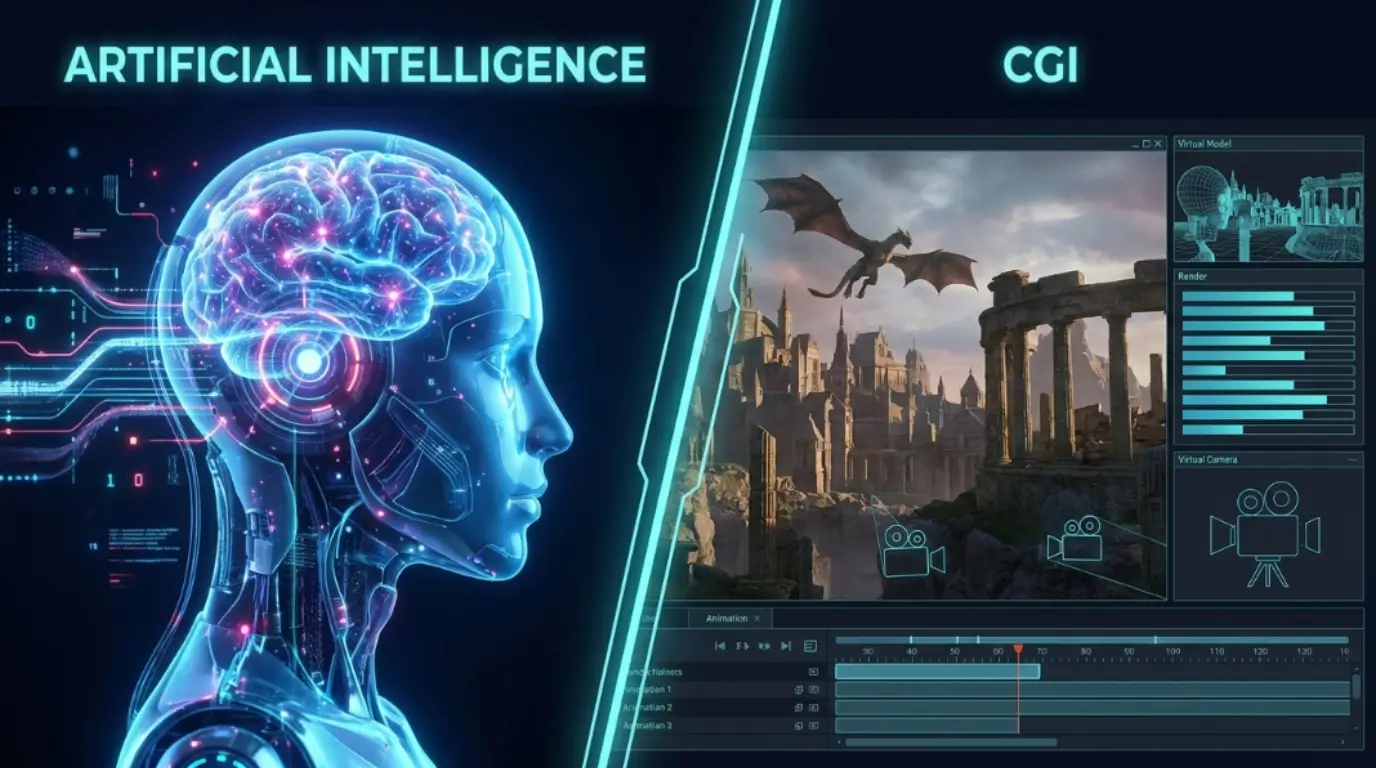
Imagine watching a movie where a robot talks like a human or a dragon flies across the sky. You may wonder—how is this possible? This is where the difference between AI and CGI becomes important.
Artificial Intelligence (AI) helps machines think and act smart, while Computer-Generated Imagery (CGI) creates stunning visuals you see on screens.
In today’s digital world, understanding the difference between AI and CGI is more useful than ever. AI powers chatbots, smart assistants, and even self-driving cars. CGI, on the other hand, brings movies, games, and ads to life with realistic graphics.
Many people mix them up, but the difference between AI and CGI is clear when you look closely. Knowing the difference between AI and CGI helps learners and experts use them better in real life.
Pronunciation (US & UK)
- AI (Artificial Intelligence)
- US: /ˌɑːr.t̬əˈfɪʃ.əl ɪnˈtel.ə.dʒəns/
- UK: /ˌɑː.tɪˈfɪʃ.əl ɪnˈtel.ɪ.dʒəns/
- CGI (Computer-Generated Imagery)
- US: /ˌsiː.dʒiːˈaɪ/
- UK: /ˌsiː.dʒiːˈaɪ/
Now that you know how to say them, let’s explore what truly sets them apart.
Key Difference Between AI and CGI
The main difference between AI and CGI is their purpose. AI focuses on intelligence and decision-making, while CGI focuses on visuals and design. AI “thinks,” CGI “creates images.”
Why Understanding Their Difference Matters
Knowing the difference between AI and CGI helps students, developers, and creators choose the right tool. AI is important in healthcare, business, and automation. CGI is key in entertainment, marketing, and design. In society, both shape how we work, learn, and enjoy content.
Difference Between AI and CGI (10 Points)
1. Purpose
- AI: Designed to simulate human thinking
- Example 1: Chatbots answering questions
- Example 2: Self-driving cars making decisions
- CGI: Designed to create visuals
- Example 1: Movie animations
- Example 2: Video game graphics
2. Function
- AI: Processes data and learns
- Example 1: Recommendation systems
- Example 2: Voice assistants
- CGI: Renders images and scenes
- Example 1: 3D modeling
- Example 2: Animated ads
3. Core Technology
- AI: Uses algorithms and machine learning
- Example 1: Neural networks
- Example 2: Predictive analytics
- CGI: Uses rendering software
- Example 1: Blender
- Example 2: Maya
4. Output
- AI: Decisions or predictions
- Example 1: Fraud detection
- Example 2: Language translation
- CGI: Images or videos
- Example 1: Movie effects
- Example 2: Game environments
5. Human Interaction
- AI: Interacts with users
- Example 1: Virtual assistants
- Example 2: AI tutors
- CGI: Visual experience only
- Example 1: Animated films
- Example 2: Visual ads
6. Learning Ability
- AI: Learns over time
- Example 1: Improving search results
- Example 2: Personalized ads
- CGI: Does not learn
- Example 1: Static animation
- Example 2: Pre-designed visuals
7. Industry Use
- AI: Healthcare, finance, tech
- Example 1: Diagnosis systems
- Example 2: Stock predictions
- CGI: Film, gaming, advertising
- Example 1: Movies
- Example 2: Game design
8. Complexity
- AI: Highly complex
- Example 1: Deep learning models
- Example 2: Robotics
- CGI: Less complex in logic
- Example 1: Rendering tools
- Example 2: Animation software
9. Goal
- AI: Solve problems
- Example 1: Automation
- Example 2: Data analysis
- CGI: Enhance visuals
- Example 1: Special effects
- Example 2: Product design
10. Real-Time Use
- AI: Works in real-time
- Example 1: Chat responses
- Example 2: Smart devices
- CGI: Often pre-rendered
- Example 1: Movie scenes
- Example 2: Animations
Nature and Behaviour
- AI: Dynamic, adaptive, and intelligent. It changes with data.
- CGI: Static and creative. It depends on human design.
Why People Get Confused
People confuse AI and CGI because both are used in movies and technology. For example, a character may look real (CGI) and act smart (AI), making it hard to tell the difference.
Comparison Table
| Feature | AI | CGI |
| Purpose | Intelligence | Visuals |
| Output | Decisions | Images |
| Learning | Yes | No |
| Use | Tech, business | Movies, games |
| Nature | Dynamic | Static |
Which Is Better?
AI is better when decision-making and automation are needed. It helps in solving real-world problems. CGI is better when visual creativity is required, like in movies and games. Both are powerful in their own fields.
Metaphors and Similes
- AI is like a “brain” that thinks.
- CGI is like a “paintbrush” that creates images.
Connotative Meaning
- AI: Positive (innovation), Negative (job loss fears), Neutral (technology tool)
- CGI: Positive (creativity), Neutral (visual tool), Rarely negative
Examples:
- AI is shaping the future. (Positive)
- CGI makes movies magical. (Positive)
Idioms / Proverbs
- “Seeing is believing” → often linked with CGI visuals
- “Use your head” → relates to AI thinking
Works in Literature
- Artificial Intelligence
- Science Fiction, Isaac Asimov, 1950
- Sci-Fi, Arthur C. Clarke, 1968
- CGI (Visual Arts)
- Digital Art, Various Artists, 2000s
- Animation Studies, John Lasseter, 1995
Movies Based on AI and CGI
- AI:
- A.I. Artificial Intelligence (2001, USA)
- Ex Machina (2014, UK)
- CGI:
- Avatar (2009, USA)
- Toy Story (1995, USA)
FAQs
1. What is the main difference between AI and CGI?
AI focuses on intelligence, while CGI focuses on visuals.
2. Can AI and CGI work together?
Yes, they are often combined in movies and games.
3. Which is more advanced?
AI is more complex due to learning ability.
4. Is CGI part of AI?
No, they are separate technologies.
5. Why are both important?
They improve technology, entertainment, and daily life.
Conclusion
The difference between AI and CGI is simple but powerful. AI is about thinking and learning, while CGI is about creating visuals.
Both play a huge role in modern society. From smart devices to blockbuster movies, they shape how we live and interact.
Understanding the difference between AI and CGI helps you use them wisely, whether you are a student, creator, or tech expert. In the end, both are tools that make our world smarter and more exciting.