Imagine you are filling air in your car tire at a petrol pump. The meter shows pressure, and you trust that number to keep your drive safe.
But have you ever wondered what that pressure really means? This is where the difference between PSIA and PSIG becomes important.
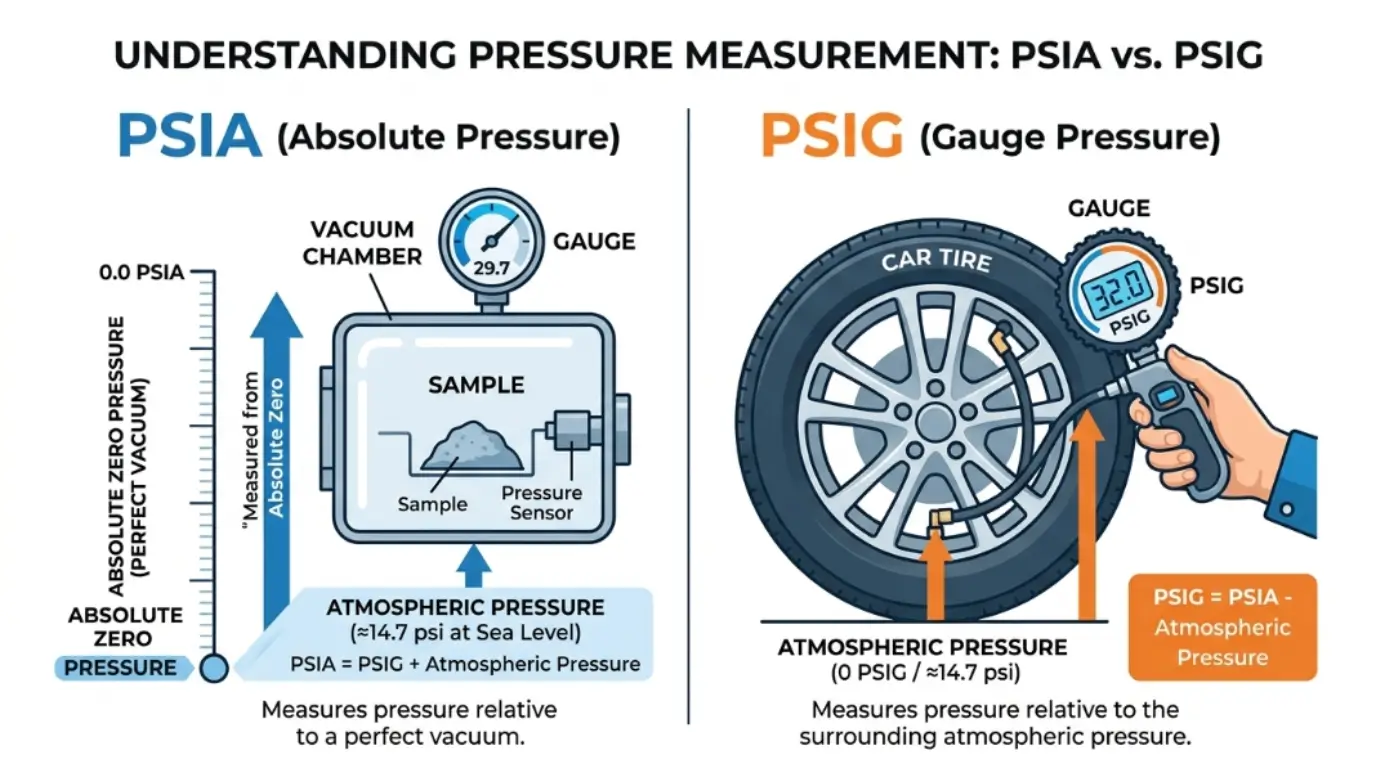
PSIA (Pounds per Square Inch Absolute) measures pressure relative to a perfect vacuum, while PSIG (Pounds per Square Inch Gauge) measures pressure relative to atmospheric pressure. In real life, both are used every day in industries, vehicles, and even weather systems.
Understanding the difference between PSIA and PSIG helps avoid mistakes in engineering, science, and daily tasks.
Whether you are a beginner or an expert, knowing the difference between PSIA and PSIG ensures accuracy and safety. Let’s explore the difference between PSIA and PSIG in a simple and clear way.
Key Difference Between PSIA and PSIG
The main difference is the reference point. PSIA uses a vacuum as zero, while PSIG uses atmospheric pressure as zero.
Why Is This Difference Important?
Knowing the difference between PSIA and PSIG is essential for students, engineers, and technicians. It helps in designing machines, measuring gas pressure, and ensuring safety.
In industries like oil, gas, and aviation, even a small error can cause big problems. For learners, this concept builds a strong foundation. For experts, it ensures precision and reliability in their work.
Pronunciation (US & UK)
- PSIA:
- US: pee-ess-eye-ay
- UK: pee-ess-eye-ay
- PSIG:
- US: pee-ess-eye-jee
- UK: pee-ess-eye-jee
Now that you know how to say them, let’s dive deeper into their differences.
Difference Between PSIA and PSIG
1. Reference Point
PSIA uses vacuum as reference. PSIG uses atmospheric pressure.
- Example PSIA: Space pressure measurement.
- Example PSIG: Tire pressure gauge.
2. Zero Value
PSIA starts from absolute zero. PSIG starts from atmospheric pressure.
- Example PSIA: Scientific experiments.
- Example PSIG: Air compressors.
3. Usage Area
PSIA is used in science and engineering. PSIG is used in daily tools.
- Example PSIA: Vacuum chambers.
- Example PSIG: Pressure cookers.
4. Measurement Accuracy
PSIA is more precise. PSIG is simpler.
- Example PSIA: Lab instruments.
- Example PSIG: Car maintenance.
5. Atmospheric Effect
PSIA includes atmospheric pressure. PSIG excludes it.
- Example PSIA: Weather systems.
- Example PSIG: Gas cylinders.
6. Formula
PSIA = PSIG + atmospheric pressure.
- Example PSIA: 14.7 + gauge value.
- Example PSIG: Direct reading.
7. Real-Life Application
PSIA for technical use. PSIG for general use.
- Example PSIA: Aerospace.
- Example PSIG: Bike tires.
8. Complexity
PSIA is complex. PSIG is easy.
- Example PSIA: Engineering design.
- Example PSIG: Home tools.
9. Units Interpretation
PSIA gives absolute value. PSIG gives relative value.
- Example PSIA: Vacuum pressure.
- Example PSIG: Pump pressure.
10. Environment Impact
PSIA works in any environment. PSIG depends on atmosphere.
- Example PSIA: Space missions.
- Example PSIG: Earth-based tools.
Nature and Behaviour
PSIA behaves as a complete measurement system because it considers total pressure. It is stable and reliable in all conditions.
PSIG behaves as a relative measurement system. It changes with atmospheric conditions and is more practical for daily use.
Why People Get Confused
People confuse PSIA and PSIG because both use the same unit (psi). The difference lies only in the reference point, which is often not clearly explained.
Table: Difference and Similarity
| Feature | PSIA | PSIG |
| Reference | Vacuum | Atmosphere |
| Zero Point | Absolute zero | Atmospheric pressure |
| Usage | Scientific | Practical |
| Accuracy | High | Moderate |
| Unit | PSI | PSI |
| Similarity | Both measure pressure | Both measure pressure |
Which Is Better in What Situation?
PSIA is better in scientific and technical situations where exact pressure is required. It gives complete and accurate data.
PSIG is better for daily use because it is simple and easy to read. It is ideal for tools, vehicles, and household equipment.
Metaphors and Similes
- PSIA is like “seeing the full picture.”
- PSIG is like “seeing only what matters now.”
Connotative Meaning
- PSIA: Positive (accuracy, precision)
- PSIG: Neutral (practical, everyday use)
Examples:
- “His thinking was like PSIA, complete and detailed.”
- “Her approach was PSIG, simple and practical.”
Idioms or Proverbs
No direct idioms exist, but examples:
- “Measure twice, cut once” – like using PSIA for accuracy.
- “Keep it simple” – like using PSIG.
Works in Literature
- Engineering Basics (Textbook, John Smith, 2010)
- Pressure Systems Guide (Manual, Alan Brown, 2015)
Movies Related to Pressure Concepts
- “Apollo 13” (1995, USA)
- “Gravity” (2013, USA)
FAQs
1. What is PSIA?
It is absolute pressure measured from a vacuum.
2. What is PSIG?
It is pressure measured from atmospheric level.
3. Why are both needed?
They serve different purposes in science and daily life.
4. Can PSIG be converted to PSIA?
Yes, by adding atmospheric pressure.
5. Which is more accurate?
PSIA is more accurate.
How Both Are Useful for Surroundings
PSIA helps in scientific research and space studies. PSIG helps in daily tools like tires and gas systems. Both make life safer and easier.
Conclusion
Understanding the difference between PSIA and PSIG is important for both learning and practical use.
PSIA gives a complete picture by measuring absolute pressure, while PSIG provides a simple and practical way to measure pressure in everyday life.
Both have their own roles and importance. PSIA is ideal for precision and scientific work, while PSIG is perfect for daily applications.
By knowing their differences, you can avoid confusion and use them correctly. This knowledge not only improves accuracy but also ensures safety in different environments.