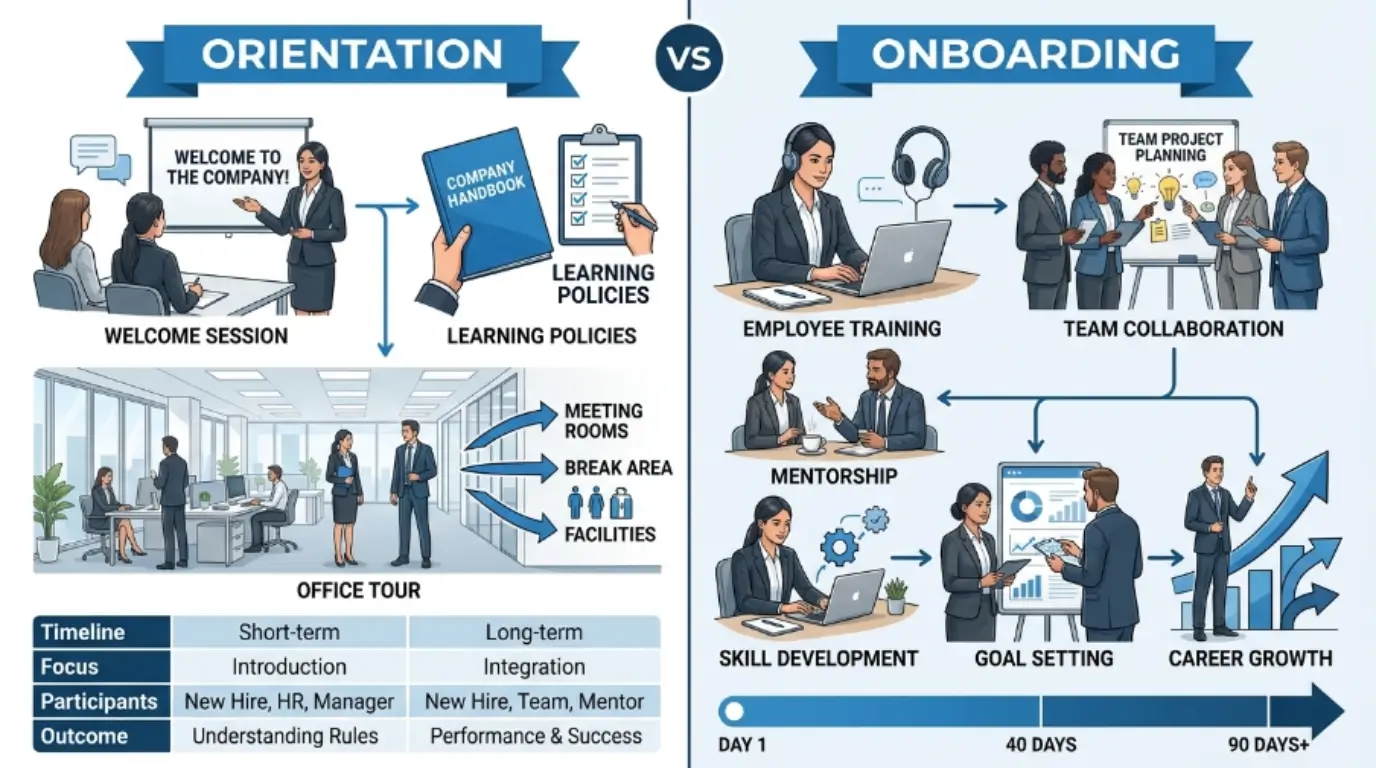
The difference between onboarding and orientation often becomes important when a new employee joins a company.
Imagine Sarah starting her first day at a new job. During the morning, she attends a session where she learns company policies, office rules, and workplace procedures.
Later, over the next few weeks, she receives training, meets team members, learns her responsibilities, and adapts to the company culture. Many people think these experiences are the same, but they are actually different.
Understanding the difference between onboarding and orientation helps employees, managers, HR professionals, students, and business leaders create a better workplace experience.
While orientation introduces employees to an organization, onboarding helps them become productive and successful over time.
In this article, you will learn the meaning, pronunciation, differences, similarities, examples, benefits, and practical uses of both concepts.
Key Difference Between Onboarding and Orientation
The main difference between onboarding and orientation is that orientation is a short introductory process, while onboarding is a longer process that helps employees integrate into the organization.
Orientation focuses on basic information such as policies, benefits, rules, and workplace expectations.
Onboarding focuses on training, development, relationship building, performance improvement, and cultural integration over weeks or months.
Why Is It Important to Know the Difference?
Knowing the difference between onboarding and orientation is important because organizations use both processes to support employee success.
For learners, it improves understanding of workplace management.
For HR professionals, it helps design effective employee programs.
For managers, it increases employee engagement and productivity.
For society, it contributes to better workplaces where people feel supported and valued.
Organizations that understand both concepts often experience higher employee satisfaction and lower turnover rates.
Pronunciation of Onboarding and Orientation
Onboarding
US Pronunciation: /ˈɑːnˌbɔːr.dɪŋ/
UK Pronunciation: /ˈɒnˌbɔː.dɪŋ/
Orientation
US Pronunciation: /ˌɔːr.i.enˈteɪ.ʃən/
UK Pronunciation: /ˌɔː.ri.enˈteɪ.ʃən/
Now that we understand their meanings and pronunciation, let’s explore the detailed differences between onboarding and orientation.
Difference Between Onboarding and Orientation: 10 Key Points
Purpose
Orientation introduces employees to the organization.
Onboarding helps employees become productive members of the organization.
Examples of Orientation:
- Learning company policies
- Receiving employee handbooks
Examples of Onboarding:
- Job-specific training
- Performance coaching
Duration
Orientation usually lasts a few hours or days.
Onboarding may continue for several weeks or months.
Examples of Orientation:
- One-day welcome session
- Half-day HR presentation
Examples of Onboarding:
- Three-month training plan
- Six-month mentorship program
Timing
Orientation occurs at the beginning of employment.
Onboarding begins on the first day and continues afterward.
Examples of Orientation:
- First-day office tour
- Initial paperwork session
Examples of Onboarding:
- Weekly progress meetings
- Ongoing skill development
Focus
Orientation focuses on company information.
Onboarding focuses on employee integration and growth.
Examples of Orientation:
- Explaining benefits
- Reviewing workplace rules
Examples of Onboarding:
- Developing professional skills
- Building workplace relationships
Training Scope
Orientation provides general information.
Onboarding provides detailed role-specific training.
Examples of Orientation:
- Safety procedures
- Attendance policies
Examples of Onboarding:
- Software training
- Project management training
Employee Integration
Orientation introduces employees to the workplace.
Onboarding helps employees feel part of the team.
Examples of Orientation:
- Meeting HR staff
- Visiting departments
Examples of Onboarding:
- Team collaboration activities
- Mentor assignments
Company Culture
Orientation explains company values.
Onboarding helps employees experience company culture.
Examples of Orientation:
- Mission statement presentation
- Values discussion
Examples of Onboarding:
- Team events
- Cultural workshops
Performance Expectations
Orientation briefly explains expectations.
Onboarding develops performance standards over time.
Examples of Orientation:
- Job overview
- Conduct expectations
Examples of Onboarding:
- Goal setting sessions
- Performance reviews
Relationship Building
Orientation introduces colleagues.
Onboarding develops strong workplace relationships.
Examples of Orientation:
- Employee introductions
- Department meetings
Examples of Onboarding:
- Team projects
- Networking opportunities
Long-Term Impact
Orientation creates first impressions.
Onboarding shapes long-term employee success.
Examples of Orientation:
- Welcome presentations
- Company introductions
Examples of Onboarding:
- Career development plans
- Leadership training
Nature and Behavior of Onboarding
Onboarding is developmental, continuous, and employee-centered. It focuses on helping employees learn, grow, and succeed within an organization. The process encourages engagement, confidence, and long-term commitment. Effective onboarding adapts to employee needs and supports career progression.
Nature and Behavior of Orientation
Orientation is informative, structured, and introductory. Its purpose is to provide essential information that employees need to begin work. Orientation is generally standardized and focuses on compliance, awareness, and immediate understanding of workplace expectations.
Why Do People Confuse Onboarding and Orientation?
People often confuse onboarding and orientation because both occur when employees join a company. They share the goal of helping new employees adjust to the workplace. However, orientation is only one part of the broader onboarding process. Since both involve introductions, training, and workplace information, many individuals mistakenly use the terms interchangeably.
Difference and Similarity Table
| Feature | Onboarding | Orientation |
| Purpose | Employee integration | Employee introduction |
| Duration | Weeks or months | Hours or days |
| Focus | Long-term success | Immediate information |
| Training | Detailed and role-specific | General and basic |
| Timing | Ongoing process | Initial stage |
| Relationship Building | Strong emphasis | Limited emphasis |
| Company Culture | Experience and practice | Introduction only |
| Performance Development | Major focus | Minor focus |
| Employee Engagement | Continuous | Initial |
| Goal | Productivity and retention | Awareness and readiness |
Similarities
| Similarity | Description |
| Employee Support | Both help new employees adjust |
| Workplace Learning | Both provide important information |
| Organizational Goals | Both improve employee success |
| Professional Development | Both contribute to workplace effectiveness |
Which Is Better in Different Situations?
Orientation is better when an organization needs to quickly introduce new employees to workplace rules, policies, and procedures. It provides the foundation employees need before beginning their duties.
Onboarding is better when organizations want long-term employee success, higher engagement, better retention, and stronger performance. Most successful companies use both orientation and onboarding together because they serve different but complementary purposes.
Onboarding vs Orientation in Metaphors and Similes
Onboarding Metaphors
- Onboarding is a bridge connecting employees to success.
- Onboarding is a roadmap guiding career growth.
- Onboarding is a garden where talent grows.
Orientation Metaphors
- Orientation is the front door to a new workplace.
- Orientation is a welcome sign for new employees.
- Orientation is a compass showing the initial direction.
Similes
- Onboarding is like learning to drive through practice.
- Orientation is like receiving a map before a journey.
- Onboarding is like planting and nurturing a tree.
- Orientation is like opening a book to its first page.
Connotative Meaning of Onboarding
Positive
- Growth
- Development
- Support
- Success
- Engagement
Example:
The company’s onboarding program helped employees feel valued and prepared.
Negative
- Time-consuming
- Resource-intensive
Example:
Poor onboarding can overwhelm employees with information.
Neutral
- Employee integration process
Example:
The organization updated its onboarding procedures.
Connotative Meaning of Orientation
Positive
- Welcome
- Introduction
- Guidance
- Preparation
Example:
The orientation session made new employees feel comfortable.
Negative
- Information overload
- Limited depth
Example:
A rushed orientation left employees confused.
Neutral
- Introductory process
Example:
The company scheduled orientation for Monday morning.
Idioms and Proverbs Related to the Words
Related to Onboarding
- Learn the ropes
- Get up to speed
- Hit the ground running
Examples:
- New employees must learn the ropes quickly.
- Effective onboarding helps workers get up to speed.
- Good training allows employees to hit the ground running.
Related to Orientation
- Find your bearings
- Know the lay of the land
- Start on the right foot
Examples:
- Orientation helps employees find their bearings.
- New hires learn the lay of the land during orientation.
- A strong orientation helps workers start on the right foot.
Works in Literature Related to Workplace Integration
Onboarding-Related Themes
- The One Minute Manager (Business, Kenneth Blanchard, 1982)
- First, Break All the Rules (Management, Marcus Buckingham, 1999)
- The Culture Code (Business, Daniel Coyle, 2018)
Orientation-Related Themes
- The Effective Executive (Management, Peter Drucker, 1967)
- Good to Great (Business, Jim Collins, 2001)
- Leaders Eat Last (Leadership, Simon Sinek, 2014)
Movies and Documentaries Related to Workplace Entry and Adaptation
Onboarding Themes
- The Intern (2015, USA)
- The Devil Wears Prada (2006, USA)
- Internship (2013, USA)
Orientation Themes
- Office Space (1999, USA)
- Up in the Air (2009, USA)
- The Company Men (2010, USA)
Frequently Asked Questions
Is onboarding the same as orientation?
No. Orientation is a short introduction, while onboarding is a long-term integration process.
Which comes first, onboarding or orientation?
Orientation usually occurs first and becomes part of onboarding.
How long does onboarding last?
Depending on the organization, onboarding may last from several weeks to several months.
Why is onboarding important?
It improves employee engagement, productivity, and retention.
Can a company have orientation without onboarding?
Yes, but employees may struggle to adapt and perform effectively.
How Both Are Useful for Society and Workplaces
Orientation helps employees understand workplace rules, responsibilities, and expectations. It creates a smooth beginning and reduces confusion.
Onboarding helps employees build confidence, skills, relationships, and long-term success. Together, both processes contribute to stronger organizations, happier employees, and more productive workplaces. Their combined impact benefits businesses, workers, and society as a whole.
Conclusion
The difference between onboarding and orientation lies mainly in their scope, duration, and purpose.
Orientation is a short-term introduction that provides essential workplace information, while onboarding is a comprehensive process that supports employee development and integration over time.
Although many people use the terms interchangeably, they serve different functions within an organization.
Understanding the difference between onboarding and orientation helps employees, managers, students, and HR professionals create better workplace experiences.
When used together effectively, orientation provides a strong starting point, while onboarding ensures long-term success, engagement, and growth.
Organizations that invest in both processes are more likely to build productive teams and maintain a positive workplace culture.