A young boy once slipped while playing football and got a deep cut on his arm. His worried parents rushed him to the hospital where the doctor said he needed “stitches.” Later, while reading the medical report, they noticed the word “sutures” written instead.
This created confusion because many people believe these words mean completely different things. In reality, they are closely related but used in slightly different ways in medicine.
Understanding the difference between sutures and stitches is important for students, medical learners, healthcare workers, and ordinary people.
These terms are often used interchangeably in daily conversation, but medical professionals use them more carefully. Knowing the difference between sutures and stitches helps people understand wound care, surgeries, and healing processes better.
It also improves communication between patients and doctors. In hospitals and clinics around the world, the difference between sutures and stitches matters because one term refers to the material while the other refers to the procedure.
This article explains the topic in easy language with examples, comparisons, literature references, FAQs, and practical uses.
Key Difference Between Sutures and Stitches
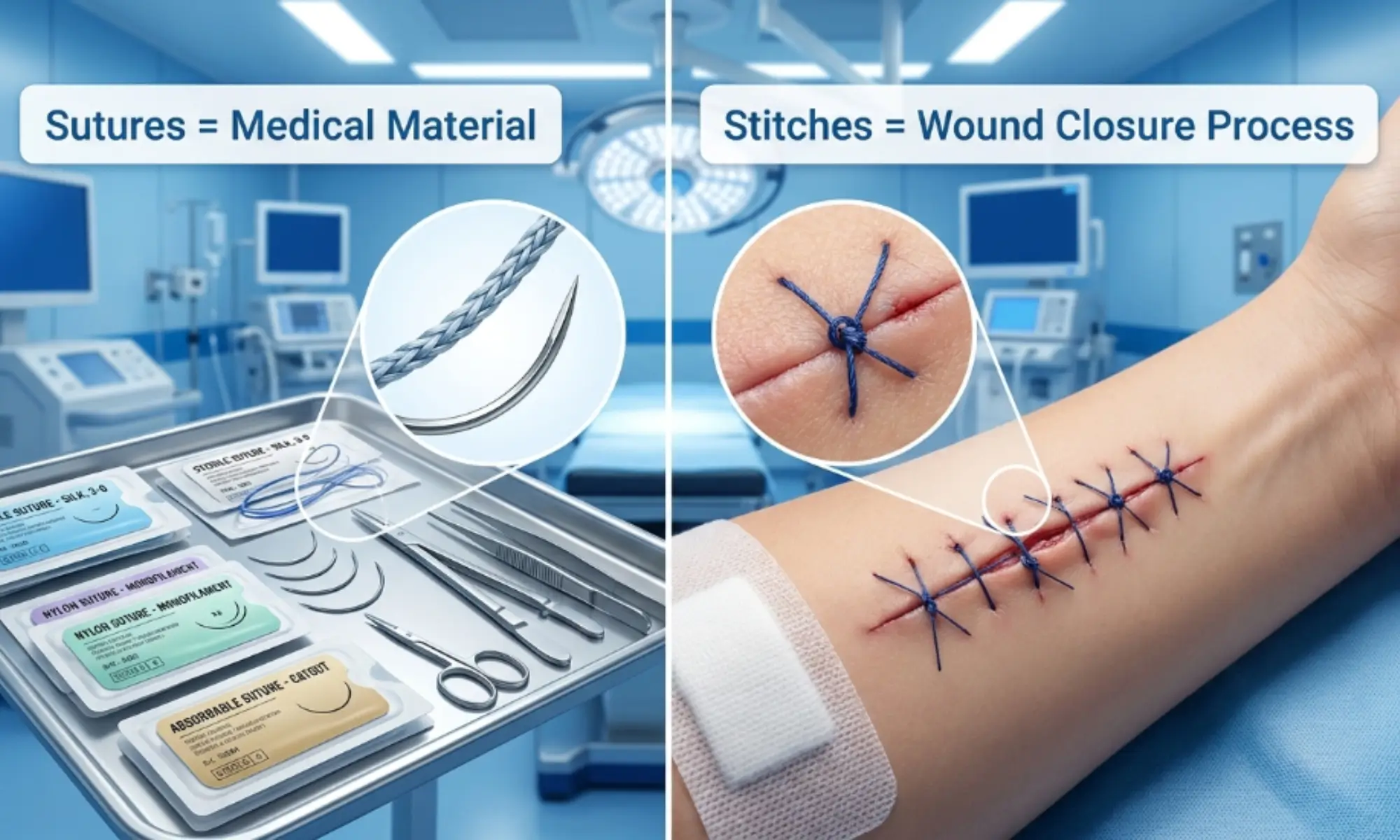
The main difference is simple:
- Sutures are the medical materials or threads used to close wounds.
- Stitches are the actual sewing process used to close the wound.
Doctors usually place sutures to create stitches. In everyday conversation, however, people commonly use both words to mean the same thing.
Why Is Their Difference Necessary to Know?
Understanding the difference is important for both learners and experts because these terms are used daily in healthcare. Medical students must learn the correct terminology for professional communication. Surgeons and nurses also rely on precise language to avoid confusion during treatment and surgeries.
For ordinary people, knowing the difference helps during emergencies, hospital visits, and recovery discussions. It also improves awareness about wound care and healing methods. In society, clear medical communication can reduce misunderstandings and help patients feel more confident about treatment procedures.
Pronunciation of Sutures and Stitches
Sutures
- US Pronunciation: Soo-chers
- UK Pronunciation: Syoo-chuhz
Stitches
- US Pronunciation: Stich-ez
- UK Pronunciation: Stich-iz
Now that the pronunciation and meanings are clear, let us move deeper into the detailed comparison between these two commonly confused medical terms.
Difference Between Sutures and Stitches
1. Meaning
Sutures
Sutures are the threads or materials doctors use to close cuts or surgical openings.
Examples
- The surgeon used dissolvable sutures after the operation.
- Silk sutures are often used in delicate surgeries.
Stitches
Stitches refer to the process of sewing the wound together.
Examples
- The patient needed five stitches after the accident.
- Her forehead stitches were removed after one week.
2. Medical Usage
Sutures
Medical professionals use the word sutures in technical discussions.
Examples
- The doctor selected absorbable sutures.
- Sutures were carefully sterilized before surgery.
Stitches
Patients and common people mostly use the word stitches.
Examples
- My brother got stitches after falling from a bike.
- The child cried while getting stitches.
3. Purpose
Sutures
Sutures physically support the tissue during healing.
Examples
- Sutures prevent the wound from reopening.
- Internal sutures support healing organs.
Stitches
Stitches help close the skin neatly.
Examples
- Tight stitches reduced bleeding quickly.
- Loose stitches may leave scars.
4. Material
Sutures
Sutures are made from silk, nylon, catgut, or synthetic fibers.
Examples
- Nylon sutures are very strong.
- Dissolvable sutures disappear naturally.
Stitches
Stitches are not materials but the final sewing result.
Examples
- The stitches looked neat after surgery.
- His stitches healed perfectly.
5. Types
Sutures
Sutures have many types such as absorbable and non-absorbable.
Examples
- Absorbable sutures are used internally.
- Non-absorbable sutures need removal.
Stitches
Stitches include interrupted stitches and continuous stitches.
Examples
- Continuous stitches heal large wounds quickly.
- Interrupted stitches reduce infection risks.
6. Removal Process
Sutures
Some sutures dissolve automatically.
Examples
- The internal sutures vanished after healing.
- Dissolvable sutures save removal time.
Stitches
Many stitches must be removed manually.
Examples
- Her stitches were removed after ten days.
- The nurse carefully cut the stitches.
7. Visibility
Sutures
Internal sutures are often hidden inside the body.
Examples
- The surgeon used hidden sutures internally.
- Cosmetic surgeries use invisible sutures.
Stitches
Stitches are often visible on the skin surface.
Examples
- His facial stitches were easy to notice.
- The stitches looked red at first.
8. Healing Support
Sutures
Sutures support deep tissue healing.
Examples
- Heart surgery requires strong sutures.
- Sutures keep organs connected.
Stitches
Stitches mainly help external skin healing.
Examples
- Stitches reduced the wound gap.
- The stitches protected the cut from dirt.
9. Technical Accuracy
Sutures
“Sutures” is the medically accurate term.
Examples
- Medical books discuss sutures in detail.
- Surgeons study different suture techniques.
Stitches
“Stitches” is more casual and commonly understood.
Examples
- Children understand the word stitches better.
- Patients often ask about stitches.
10. Professional Context
Sutures
Used mostly in hospitals and medical education.
Examples
- The surgeon requested finer sutures.
- Surgical sutures vary by operation type.
Stitches
Used in daily conversation and informal communication.
Examples
- He joked about getting stitches.
- The coach checked the player’s stitches.
Nature and Behaviour of Both
Sutures
Sutures are technical medical tools designed for wound closure and tissue repair. They are selected based on strength, flexibility, healing speed, and tissue type. Their behavior depends on the material used and whether they dissolve naturally or remain permanently.
Stitches
Stitches represent the visible outcome of suturing. Their appearance and healing depend on the doctor’s technique, wound condition, and patient care. Good stitches reduce scarring and help wounds heal properly.
Why Are People Confused About Their Use?
People are confused because both words are connected to wound closure. In normal conversation, doctors, patients, and media often use them interchangeably. Movies and television also simplify medical terms by using “stitches” instead of “sutures.” Since both refer to the same treatment area, the distinction becomes unclear for non-medical people.
Difference and Similarity Table
| Feature | Sutures | Stitches | Similarity |
| Meaning | Medical thread/material | Sewing process | Both close wounds |
| Usage | Professional term | Common term | Used in healthcare |
| Visibility | Can be internal | Usually visible | Help healing |
| Material | Silk, nylon, synthetic | Not a material | Related to wound care |
| Removal | Some dissolve | Often removed | Both support recovery |
| Context | Medical field | Everyday speech | Used after injuries |
| Function | Tissue support | Skin closure | Prevent infection |
| Technicality | More technical | More casual | Connected medically |
Which Is Better in What Situation?
Sutures
Sutures are better when doctors need strong and precise wound closure, especially in surgeries or deep injuries. Different suture materials are chosen depending on the body part and healing requirement. Internal surgeries almost always rely on sutures because they provide lasting support.
Stitches
Stitches are better understood in everyday communication. When explaining injuries to patients or children, doctors often use the word stitches because it sounds simpler and less technical. It helps reduce fear and confusion during treatment discussions.
How the Words Are Used in Metaphors and Similes
Sutures in Metaphors
- Time acted like sutures for his emotional wounds.
- Friendship became the sutures holding the family together.
Stitches in Metaphors
- Her jokes left everyone in stitches.
- The broken team needed emotional stitches after defeat.
Similes
- The scar was neat like fresh stitches.
- His recovery held together like strong sutures.
Connotative Meaning of Both Words
Sutures
- Positive: Healing, repair, precision
- Negative: Surgery, pain, injury
- Neutral: Medical procedure
Examples
- Positive: Modern sutures improve healing speed.
- Negative: The accident required emergency sutures.
- Neutral: Sutures are common in hospitals.
Stitches
- Positive: Recovery, healing
- Negative: Injury, scars
- Neutral: Medical treatment
Examples
- Positive: Her stitches healed beautifully.
- Negative: The deep cut needed many stitches.
- Neutral: The doctor removed the stitches carefully.
Idioms and Proverbs Related to the Words
Idioms with Stitches
- In stitches – laughing very hard
Example: The comedy show had everyone in stitches. - A stitch in time saves nine – solving a problem early prevents bigger problems
Example: Cleaning the wound quickly proved that a stitch in time saves nine.
Idioms with Sutures
There are no famous English idioms directly based on “sutures,” but the word appears in medical metaphors about healing and repair.
Works in Literature Related to Sutures and Stitches
Sutures
- Suture and Society – Medical Sociology – Daniel Lopez – 2012
- The Sutured Heart – Fiction – Clara Benson – 2018
Stitches
- Stitches: A Memoir – Graphic Memoir – David Small – 2009
- Nine Stitches – Mystery Novel – Ruth Ware – 2016
Movies Related to Sutures and Stitches
Sutures
- Sutures – 2009 – United States
- The Suture – 1993 – United Kingdom
Stitches
- Stitches – 2012 – Ireland
- Stitch – 2014 – United States
Frequently Asked Questions
1. Are sutures and stitches the same thing?
Not exactly. Sutures are the materials, while stitches are the sewing result or process.
2. Which word do doctors prefer?
Doctors usually prefer the word “sutures” in professional settings.
3. Do all stitches need removal?
No. Some stitches use dissolvable sutures that disappear naturally.
4. Why do people use the terms interchangeably?
Because both are connected to wound closure and healing.
5. Which is more technical: sutures or stitches?
“Sutures” is the more technical medical term.
How Both Are Useful for Surroundings
Sutures and stitches are extremely useful in healthcare and society. They help doctors save lives, repair injuries, and support surgeries.
Without them, wound healing would become difficult and infections could spread more easily. In hospitals, clinics, emergency rooms, and even veterinary medicine, these methods protect health and improve recovery.
They also help reduce scars and restore normal body function after accidents or surgeries.
Final Words for Sutures and Stitches
The difference between sutures and stitches may seem small, but understanding it improves medical knowledge and communication.
Sutures are the materials doctors use, while stitches are the visible sewing result that closes wounds. Both play a vital role in healing and recovery.
In everyday conversation, people may continue using the terms interchangeably, and that is completely normal. However, learning the correct distinction is valuable for students, healthcare professionals, and patients alike.
Whether in surgeries, emergencies, or simple injuries, sutures and stitches continue to serve as important tools that help the human body heal safely and effectively.