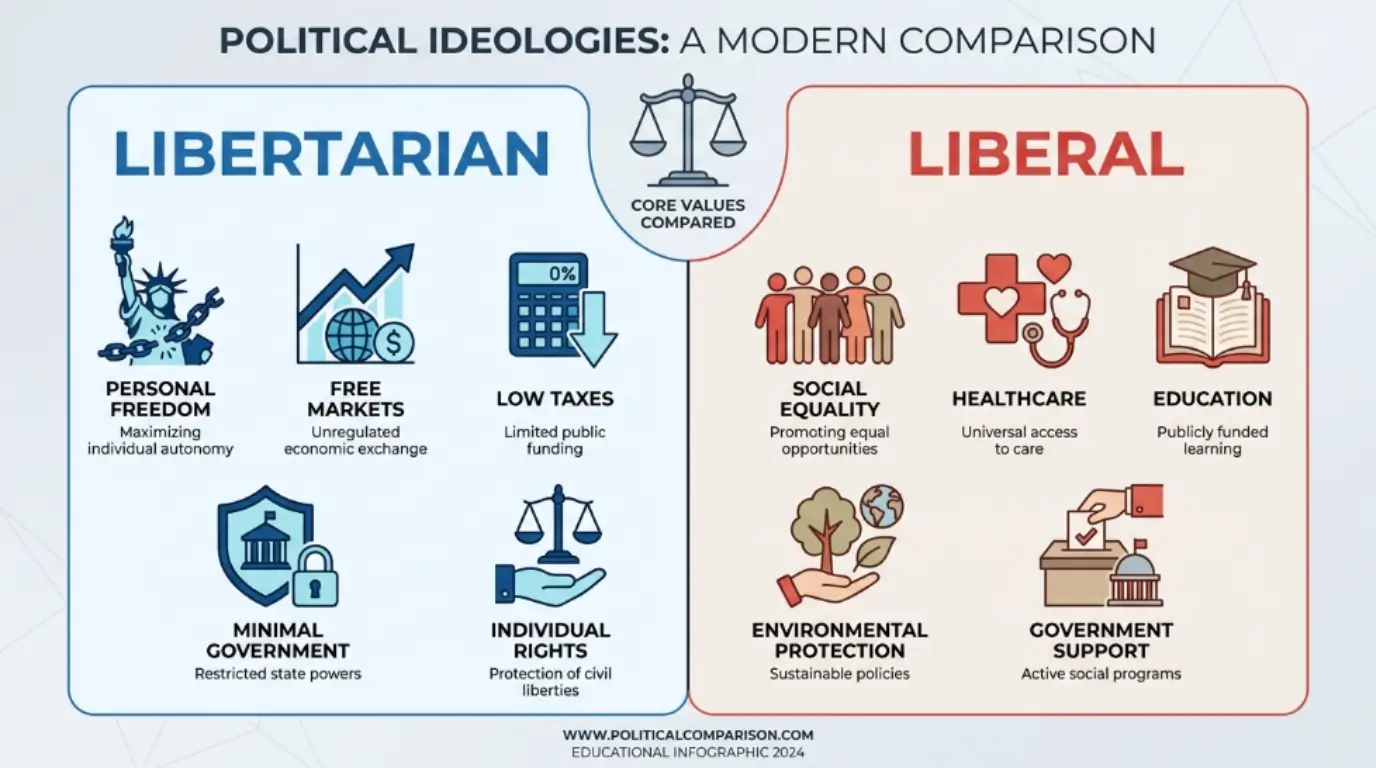
The difference between libertarian and liberal is a topic many people search when discussing politics, freedom, and government roles in society.
Imagine two friends debating taxes, free speech, and healthcare at a café. One believes the government should stay out of personal and economic life as much as possible, while the other thinks the government should help create equality and social welfare.
This real-world discussion perfectly explains the difference between libertarian and liberal viewpoints. Although both groups support individual rights and freedoms in some areas, they disagree on how much power the government should have.
Understanding the difference between libertarian and liberal ideas is important because these political beliefs influence laws, education, healthcare, and personal freedoms worldwide.
Learning this topic helps students, researchers, and voters understand modern society more clearly.
Key Difference Between Libertarian and Liberal
The main difference is that libertarians prefer minimal government involvement in both economic and personal matters, while liberals generally support government action to improve social equality and public welfare.
Why Is Their Difference Important in Society?
Knowing the difference helps learners, voters, and experts understand political debates and public policies. These ideologies shape laws related to healthcare, taxes, education, business, and civil rights. Understanding both viewpoints also promotes respectful discussion and better decision-making in democratic societies.
Pronunciation
| Word | US Pronunciation | UK Pronunciation |
| Libertarian | lib-er-TAIR-ee-un | lib-er-TAIR-ee-un |
| Liberal | LIB-er-ul | LIB-er-ul |
Before exploring the detailed comparison, let us understand how these political ideas differ in daily life, beliefs, and social impact.
Difference Between Libertarian and Liberal
| No. | Libertarian | Liberal |
| 1 | Supports limited government | Supports active government |
| 2 | Favors low taxes | Accepts higher taxes for welfare |
| 3 | Strongly supports free markets | Supports regulated markets |
| 4 | Values individual responsibility | Values social equality |
| 5 | Prefers fewer business regulations | Supports consumer protections |
| 6 | Supports personal freedom strongly | Supports personal freedom with social balance |
| 7 | Often opposes government welfare programs | Usually supports welfare programs |
| 8 | Believes people should solve problems privately | Believes government can solve social problems |
| 9 | Supports gun rights strongly | Often supports gun regulations |
| 10 | Wants minimal state intervention | Supports state intervention when necessary |
1. Role of Government
Libertarians believe the government should have very limited power. Liberals believe the government should actively improve society.
Examples of Libertarian
- Supporting fewer government agencies
- Wanting lower government spending
Examples of Liberal
- Supporting public healthcare
- Supporting government-funded education
2. Economic Policies
Libertarians favor free markets with fewer regulations. Liberals support economic regulations to protect workers and consumers.
Examples of Libertarian
- Reducing business taxes
- Opposing strict market regulations
Examples of Liberal
- Raising minimum wage
- Supporting labor protections
3. Taxation
Libertarians prefer low taxes. Liberals accept higher taxes to fund public programs.
Examples of Libertarian
- Lower income taxes
- Reducing government budgets
Examples of Liberal
- Funding social welfare through taxes
- Increasing public service budgets
4. Social Welfare
Libertarians believe charities and individuals should help society. Liberals support government welfare systems.
Examples of Libertarian
- Private charity organizations
- Community-based aid
Examples of Liberal
- Government healthcare programs
- Unemployment benefits
5. Personal Freedom
Both value freedom, but libertarians usually support fewer restrictions overall.
Examples of Libertarian
- Strong free speech protections
- Opposition to government surveillance
Examples of Liberal
- Supporting civil rights laws
- Supporting equal marriage rights
6. Healthcare
Libertarians prefer private healthcare systems. Liberals often support public healthcare access.
Examples of Libertarian
- Private insurance competition
- Reduced healthcare regulation
Examples of Liberal
- Public health insurance programs
- Government healthcare assistance
7. Education
Libertarians support private education choices. Liberals support public education systems.
Examples of Libertarian
- School choice programs
- Private school expansion
Examples of Liberal
- Public school funding
- Student aid programs
8. Gun Policies
Libertarians strongly defend gun ownership rights. Liberals often support stricter gun laws.
Examples of Libertarian
- Opposing firearm restrictions
- Supporting constitutional gun rights
Examples of Liberal
- Background checks
- Restrictions on certain weapons
9. Environmental Policies
Libertarians prefer market-based environmental solutions. Liberals support government environmental regulations.
Examples of Libertarian
- Private conservation efforts
- Business innovation for climate solutions
Examples of Liberal
- Government climate laws
- Environmental protection agencies
10. Immigration
Libertarians often support open movement and less control. Liberals support immigration with social protections.
Examples of Libertarian
- Easier immigration systems
- Reduced border restrictions
Examples of Liberal
- Immigration reform programs
- Refugee support systems
Nature and Behaviour of Libertarian and Liberal
Libertarians usually focus on independence, personal responsibility, and individual freedom. They prefer less government control and believe people should make their own choices.
Liberals focus more on equality, fairness, and social support. They believe governments can help reduce poverty and discrimination through policies and programs.
Why Are People Confused About Their Use?
People often confuse libertarian and liberal because both support personal freedoms like free speech and civil rights. Their names also sound similar. However, the major difference appears in economic and government policies. Libertarians want less government overall, while liberals support government involvement in social welfare and equality.
Difference and Similarity Table
| Feature | Libertarian | Liberal | Similarity |
| Personal Freedom | Strongly supports | Supports | Both value rights |
| Government Size | Very small | Active | Both accept democracy |
| Economy | Free market | Regulated market | Both support economic growth |
| Social Welfare | Limited | Strong support | Both want better society |
| Civil Rights | Strong support | Strong support | Shared support |
Which Is Better in What Situation?
Libertarian ideas may work better in situations where personal freedom, entrepreneurship, and free markets are important. For example, business owners may prefer fewer regulations and taxes to encourage innovation and economic growth.
Liberal ideas may work better in situations where social equality and public welfare are priorities. For example, government healthcare, public education, and social programs can help disadvantaged communities and reduce inequality.
Libertarian and Liberal in Metaphors and Similes
Libertarian Metaphors
- “A bird flying without a cage”
- “A captain steering their own ship”
Liberal Metaphors
- “A safety net for society”
- “A bridge helping everyone cross equally”
Similes
- “A libertarian values freedom like an open road.”
- “A liberal supports society like a tree giving shade.”
Connotative Meaning of Both Words
| Word | Connotation | Example |
| Libertarian | Positive or Neutral | “She respects libertarian values of freedom.” |
| Liberal | Positive, Neutral, or Negative depending on context | “He supports liberal social reforms.” |
Idioms or Proverbs Related to the Ideas
Libertarian Style Idioms
- “Live and let live”
- “Every man for himself”
Examples
- Libertarians often believe in “live and let live.”
- Some critics say free markets become “every man for himself.”
Liberal Style Idioms
- “It takes a village”
- “Lend a helping hand”
Examples
- Liberals often believe “it takes a village” to improve society.
- Social programs aim to “lend a helping hand” to citizens.
Works in Literature
Libertarian Related Works
- Atlas Shrugged — Ayn Rand — Philosophical Fiction — 1957
- The Moon Is a Harsh Mistress — Robert A. Heinlein — Science Fiction — 1966
Liberal Related Works
- The Conscience of a Liberal — Paul Krugman — Political Nonfiction — 2007
- A Theory of Justice — John Rawls — Philosophy — 1971
Movies Related to Libertarian and Liberal Ideas
Libertarian-Themed Movies
- V for Vendetta — 2005 — UK/USA
- The Pursuit of Happyness — 2006 — USA
Liberal-Themed Movies
- Milk — 2008 — USA
- Erin Brockovich — 2000 — USA
Frequently Asked Questions
1. What is the main difference between libertarian and liberal?
Libertarians support minimal government control, while liberals support government involvement for social welfare and equality.
2. Do libertarians and liberals both support freedom?
Yes, both support freedom, but libertarians focus more on individual liberty and liberals focus more on equal opportunity.
3. Which ideology supports lower taxes?
Libertarians generally support lower taxes more strongly than liberals.
4. Why are people confused between libertarian and liberal?
Both support civil rights and personal freedoms, which makes their beliefs seem similar at first.
5. Are libertarian and liberal ideas useful for society?
Yes, both contribute valuable ideas about freedom, fairness, responsibility, and social improvement.
Final Words
Understanding the difference between libertarian and liberal helps people better understand political discussions, laws, and social values.
Libertarians mainly focus on individual freedom and limited government, while liberals emphasize equality and government support for social welfare.
Both ideologies aim to improve society, but they use different methods to achieve their goals. Learning these differences allows students, researchers, and citizens to participate more thoughtfully in debates and decision-making.
In modern society, both viewpoints continue to influence politics, education, healthcare, and economic systems around the world.