Have you ever walked through a grocery store and noticed labels like “organic vegetables” and “inorganic fertilizers”? Many people see these words daily but still feel confused about their actual meanings.
The difference between organic and inorganic is important in science, farming, chemistry, and even daily life.
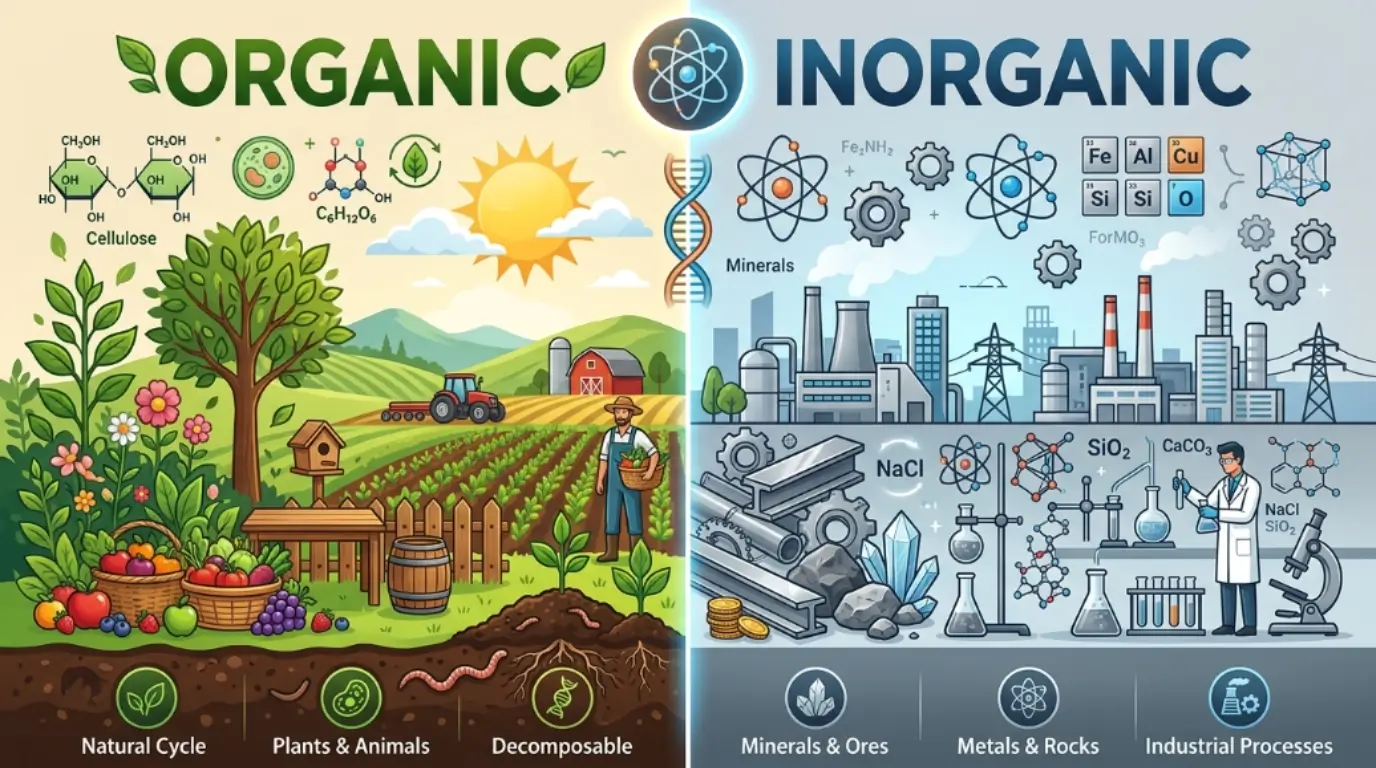
Organic things are usually linked with living organisms or natural carbon compounds, while inorganic things are generally related to minerals, metals, or non-living matter.
Understanding the difference between organic and inorganic helps students, researchers, and ordinary people make better decisions about food, health, and the environment.
In schools and industries, the difference between organic and inorganic is also essential for learning chemistry, agriculture, and environmental science.
Whether you are buying food, studying science, or caring for nature, knowing the difference between organic and inorganic can make life easier and smarter.
Pronunciation of Organic and Inorganic
| Word | US Pronunciation | UK Pronunciation |
| Organic | /or-GAN-ik/ | /aw-GAN-ik/ |
| Inorganic | /in-or-GAN-ik/ | /in-aw-GAN-ik/ |
Both words may sound simple, but their meanings open the door to an interesting comparison that affects science, farming, health, and the world around us.
Key Difference Between Organic and Inorganic
The main difference is that organic substances usually contain carbon and are connected to living organisms, while inorganic substances generally do not contain carbon and come from non-living materials like minerals and metals.
Organic compounds are often natural and complex, while inorganic compounds are usually simpler and more mineral-based.
Why Is Their Difference Necessary to Know?
Understanding the difference between organic and inorganic is valuable for both learners and experts because these terms are widely used in chemistry, agriculture, medicine, and environmental studies.
Students need this knowledge to understand science subjects clearly. Farmers use it to choose fertilizers and farming methods. Scientists use it in laboratories for research and inventions. Consumers also benefit because they can make informed choices about food, products, and environmental safety.
Knowing the difference also helps society promote healthier lifestyles and better environmental protection.
Difference Between Organic and Inorganic
1. Source
Organic: Comes from living organisms or carbon-based materials.
Examples: Sugar, proteins.
Inorganic: Comes from minerals or non-living sources.
Examples: Salt, iron.
2. Presence of Carbon
Organic: Usually contains carbon atoms.
Examples: Methane, ethanol.
Inorganic: Usually lacks carbon atoms.
Examples: Water, sodium chloride.
3. Bonding Type
Organic: Mostly forms covalent bonds.
Examples: Glucose, benzene.
Inorganic: Often forms ionic bonds.
Examples: Calcium oxide, potassium chloride.
4. Complexity
Organic: More complex in structure.
Examples: DNA, starch.
Inorganic: Simpler structures.
Examples: Ammonia, carbon dioxide.
5. Flammability
Organic: Often flammable.
Examples: Petrol, alcohol.
Inorganic: Usually non-flammable.
Examples: Sand, water.
6. Solubility
Organic: Dissolves better in organic solvents.
Examples: Oil, wax.
Inorganic: Dissolves better in water.
Examples: Salt, baking soda.
7. Reaction Speed
Organic: Reactions are generally slower.
Examples: Fermentation, digestion.
Inorganic: Reactions are often faster.
Examples: Acid-base reactions, rusting.
8. Melting and Boiling Points
Organic: Lower melting and boiling points.
Examples: Butter, paraffin.
Inorganic: Higher melting and boiling points.
Examples: Iron, sodium chloride.
9. Electrical Conductivity
Organic: Poor conductors of electricity.
Examples: Plastic, sugar.
Inorganic: Good conductors in molten or dissolved form.
Examples: Copper sulfate, sodium chloride solution.
10. Usage
Organic: Used in food, fuels, and living systems.
Examples: Vitamins, vegetable oil.
Inorganic: Used in construction and industrial products.
Examples: Cement, metals.
Nature and Behaviour of Organic and Inorganic
Organic substances are usually linked with life processes. They are more flexible, combustible, and biologically active. Many organic compounds break down naturally over time.
Inorganic substances are generally stable and mineral-based. They are less flexible but stronger and more heat-resistant. Many inorganic materials last longer in harsh environments.
Why Are People Confused About Their Use?
People often confuse organic and inorganic because the words are used in different fields. In food markets, “organic” means naturally grown without synthetic chemicals. In chemistry, it refers to carbon-containing compounds.
Similarly, “inorganic” may sound unhealthy to some people, but many inorganic substances like water and minerals are essential for life.
The changing meanings in science and marketing create confusion for many learners.
Difference and Similarity Table
| Feature | Organic | Inorganic | Similarity |
| Source | Living organisms | Non-living matter | Both exist in nature |
| Carbon | Usually present | Usually absent | Both can form compounds |
| Bond Type | Covalent | Ionic | Both involve chemical bonding |
| Complexity | Complex | Simple | Both have molecular structures |
| Solubility | Organic solvents | Water | Both can dissolve in liquids |
| Flammability | Often flammable | Usually non-flammable | Both react chemically |
| Conductivity | Poor conductor | Good conductor | Both can transfer energy |
| Usage | Food and biology | Industry and minerals | Both are useful daily |
Which Is Better in What Situation?
Organic products are often better for farming, health-conscious lifestyles, and environmentally friendly practices. Organic food may reduce exposure to synthetic chemicals and support sustainable agriculture.
Inorganic materials are better for construction, manufacturing, and industrial work because they are stronger, more durable, and often cheaper. Metals, minerals, and inorganic chemicals are necessary for modern technology and infrastructure.
Both are useful in different situations, so one is not completely better than the other.
Organic and Inorganic in Metaphors and Similes
People sometimes use these words symbolically in language.
Organic Metaphors
- “Her friendship grew organically like a tree.”
- “The company had organic growth.”
Connotative Meaning: Positive and natural.
Inorganic Metaphors
- “Their conversation felt inorganic and forced.”
- “The relationship seemed inorganic.”
Connotative Meaning: Often negative or artificial, but sometimes neutral in scientific contexts.
Idioms or Proverbs Related to the Words
There are no direct traditional idioms using these exact words, but similar expressions exist.
Examples
- “As natural as the earth” (related to organic)
- “Built like a rock” (related to inorganic strength)
Sentences
- Her ideas developed as naturally as an organic garden.
- The bridge stood strong, built like a rock with inorganic materials.
Works in Literature Related to Organic and Inorganic
- “Organic Chemistry” — Genre: Educational Science | Writer: Jonathan Clayden | Year: 2000
- “Inorganic Chemistry” — Genre: Academic Science | Writer: Catherine Housecroft | Year: 2001
- “Silent Spring” — Genre: Environmental Literature | Writer: Rachel Carson | Year: 1962
Movies Related to Organic and Inorganic Themes
- Erin Brockovich — 2000, USA
- Dark Waters — 2019, USA
- The Martian — 2015, USA
Frequently Asked Questions
1. What is the main difference between organic and inorganic?
Organic substances usually contain carbon and come from living organisms, while inorganic substances mainly come from minerals and non-living sources.
2. Is water organic or inorganic?
Water is inorganic because it does not contain carbon-hydrogen bonds.
3. Are organic foods healthier?
Organic foods may reduce exposure to synthetic chemicals, but overall health also depends on balanced nutrition.
4. Why is carbon important in organic compounds?
Carbon can form many stable bonds, making complex life molecules possible.
5. Can inorganic substances support life?
Yes. Water, oxygen, and minerals are inorganic substances essential for life.
How Both Are Useful for Surroundings
Organic substances help support life, farming, ecosystems, and biodegradable products. They improve soil quality and maintain natural balance.
Inorganic substances are important for buildings, roads, machines, medicines, and technology. Without inorganic materials, modern infrastructure would not exist.
Together, both organic and inorganic materials create balance in nature and human development.
Final Words for Organic and Inorganic
The difference between organic and inorganic is much more than a science lesson. It influences food, health, industries, technology, and the environment.
Organic materials are closely connected with life and nature, while inorganic materials provide strength, durability, and industrial support.
Both have unique properties and important roles in society. Learning their differences helps students understand science better and allows people to make informed choices in everyday life.
Instead of seeing them as opposites, it is better to understand how both work together to support the world around us.