In everyday life, people often hear the terms “lawyer” and “paralegal” used side by side, especially in legal dramas or real courtroom situations.
Imagine someone involved in a property dispute they visit a law firm, meet a professional who gives legal advice, and another who prepares documents and organizes files.
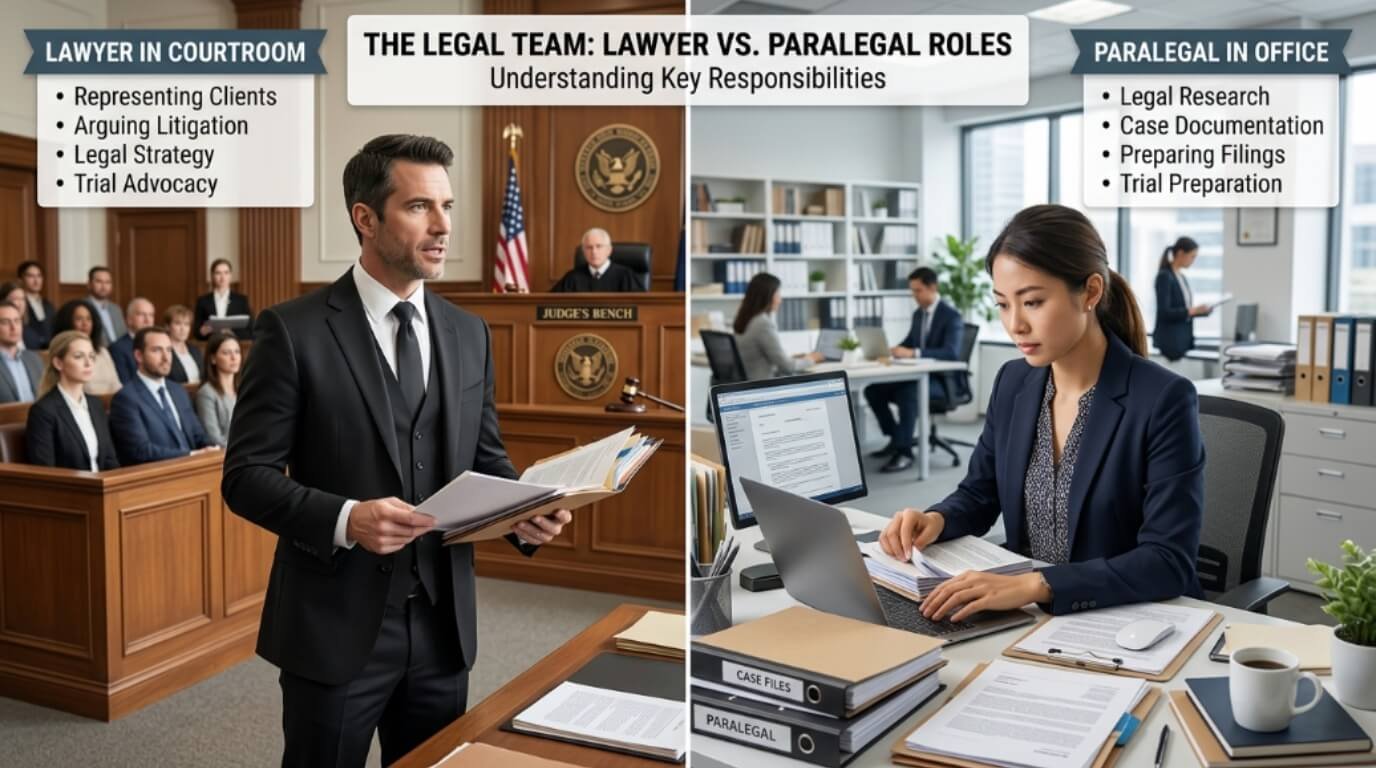
This is where the difference between lawyer and paralegal becomes important. A lawyer represents clients in court, while a paralegal supports legal work behind the scenes.
Understanding the difference between lawyer and paralegal helps avoid confusion when seeking legal help. Whether you’re a student, job seeker, or client, knowing the difference between lawyer and paralegal ensures you approach the right professional.
In simple terms, the difference between lawyer and paralegal lies in authority, education, and responsibilities.
Key Difference Between the Both
The main difference is that a lawyer is licensed to practice law and represent clients in court, while a paralegal assists lawyers but cannot provide legal advice independently.
Why Is Their Difference Important in Society?
Knowing the difference helps people choose the right legal support. Lawyers handle serious matters like court cases, while paralegals make legal services more efficient and affordable. This distinction ensures the legal system runs smoothly, saving time and reducing costs for society.
Pronunciation (US & UK)
- Lawyer:
- US: /ˈlɔɪ.ɚ/
- UK: /ˈlɔɪ.ə/
- Paralegal:
- US: /ˌpær.əˈliː.ɡəl/
- UK: /ˌpær.əˈliː.ɡəl/
Now that you understand the basics, let’s explore their differences in detail.
Difference Between Lawyer and Paralegal
1. Education
A lawyer must complete a law degree and pass a bar exam.
A paralegal usually completes a diploma or certification course.
Examples:
- A lawyer studies for years at law school.
- A paralegal may complete a 1–2 year program.
2. License
Lawyers need a license to practice law.
Paralegals do not require a license in most regions.
Examples:
- A licensed lawyer can appear in court.
- A paralegal cannot represent clients legally.
3. Role in Court
Lawyers represent clients in court.
Paralegals cannot speak in court on behalf of clients.
Examples:
- A lawyer argues a case before a judge.
- A paralegal prepares case files.
4. Legal Advice
Lawyers can give legal advice.
Paralegals cannot provide independent legal advice.
Examples:
- A lawyer suggests legal actions.
- A paralegal gathers information only.
5. Responsibilities
Lawyers handle cases fully.
Paralegals assist with research and paperwork.
Examples:
- A lawyer drafts contracts.
- A paralegal organizes documents.
6. Salary
Lawyers earn higher salaries.
Paralegals earn moderate salaries.
Examples:
- A corporate lawyer earns a high income.
- A paralegal earns a stable income.
7. Client Interaction
Lawyers directly deal with clients.
Paralegals interact under supervision.
Examples:
- A lawyer consults clients.
- A paralegal schedules meetings.
8. Decision-Making
Lawyers make final legal decisions.
Paralegals follow instructions.
Examples:
- A lawyer decides case strategy.
- A paralegal supports that strategy.
9. Work Independence
Lawyers work independently.
Paralegals work under lawyers.
Examples:
- A lawyer runs a law firm.
- A paralegal works in a team.
10. Career Growth
Lawyers have broader career options.
Paralegals have limited growth unless they study further.
Examples:
- A lawyer becomes a judge.
- A paralegal becomes a senior assistant.
Nature and Behaviour
Lawyers are decision-makers, confident, and authoritative. They handle pressure and take responsibility.
Paralegals are detail-oriented, organized, and supportive. They focus on accuracy and teamwork.
Why People Are Confused
Both work in legal settings, wear similar professional attire, and deal with legal documents. This makes it hard for outsiders to see the difference.
Table: Difference and Similarities
| Aspect | Lawyer | Paralegal | Similarity |
| Education | Law degree | Certification | Legal knowledge |
| License | Required | Not required | Work in law |
| Role | Represents clients | Assists lawyers | Support justice |
| Salary | Higher | Moderate | Stable careers |
| Authority | High | Limited | Work in legal field |
Which Is Better in What Situation?
If you need legal advice, court representation, or decision-making, a lawyer is the better choice. They are trained to handle complex legal matters and defend your rights.
If you need help with documentation, research, or cost-effective legal support, a paralegal is a great option. They make legal services more affordable and efficient.
Metaphors and Similes
- Lawyer: “A lawyer is like a captain steering a ship through a legal storm.”
- Paralegal: “A paralegal is like the engine that keeps the ship moving.”
Connotative Meaning
- Lawyer: Positive (authority), Negative (expensive), Neutral (professional)
- Paralegal: Positive (supportive), Neutral (assistant role), Slight Negative (limited power)
Examples:
- “He fought like a lawyer in court.”
- “She worked quietly like a paralegal behind the scenes.”
Idioms & Proverbs
- “A good lawyer knows the law.”
- “Justice delayed is justice denied.”
- “Every lawyer was once a beginner.”
Works in Literature
- To Kill a Mockingbird – Genre: Fiction, Writer: Harper Lee, Year: 1960
- The Firm – Genre: Legal Thriller, Writer: John Grisham, Year: 1991
Movies Related to Lawyers
- A Few Good Men – 1992, USA
- Legally Blonde – 2001, USA
- The Lincoln Lawyer – 2011, USA
FAQs
1. Can a paralegal become a lawyer?
Yes, by completing a law degree and passing the bar exam.
2. Do paralegals go to court?
They may assist but cannot represent clients.
3. Who earns more?
Lawyers generally earn more than paralegals.
4. Is a paralegal job important?
Yes, they support lawyers and improve efficiency.
5. Can a lawyer work without a paralegal?
Yes, but paralegals make work easier and faster.
Conclusion
Understanding the difference between lawyer and paralegal is essential for anyone dealing with legal matters or considering a career in law. \
Lawyers take on the role of decision-makers and representatives in court, while paralegals provide valuable support through research and documentation.
Both roles are equally important in maintaining an efficient legal system. By knowing the difference between lawyer and paralegal, individuals can make better choices, whether hiring legal help or choosing a career path.
In the end, both professionals work together to ensure justice is served effectively.