A young employee named Ali joined a small company. On his first day, he attended a training session to understand the company’s software and workflow.
Within a few hours, he learned how to use the tools needed for his job. However, over the next few months, Ali became more confident, improved his communication skills, and started solving problems independently.
This change did not happen in a single class. It happened gradually as he gained experience and maturity.
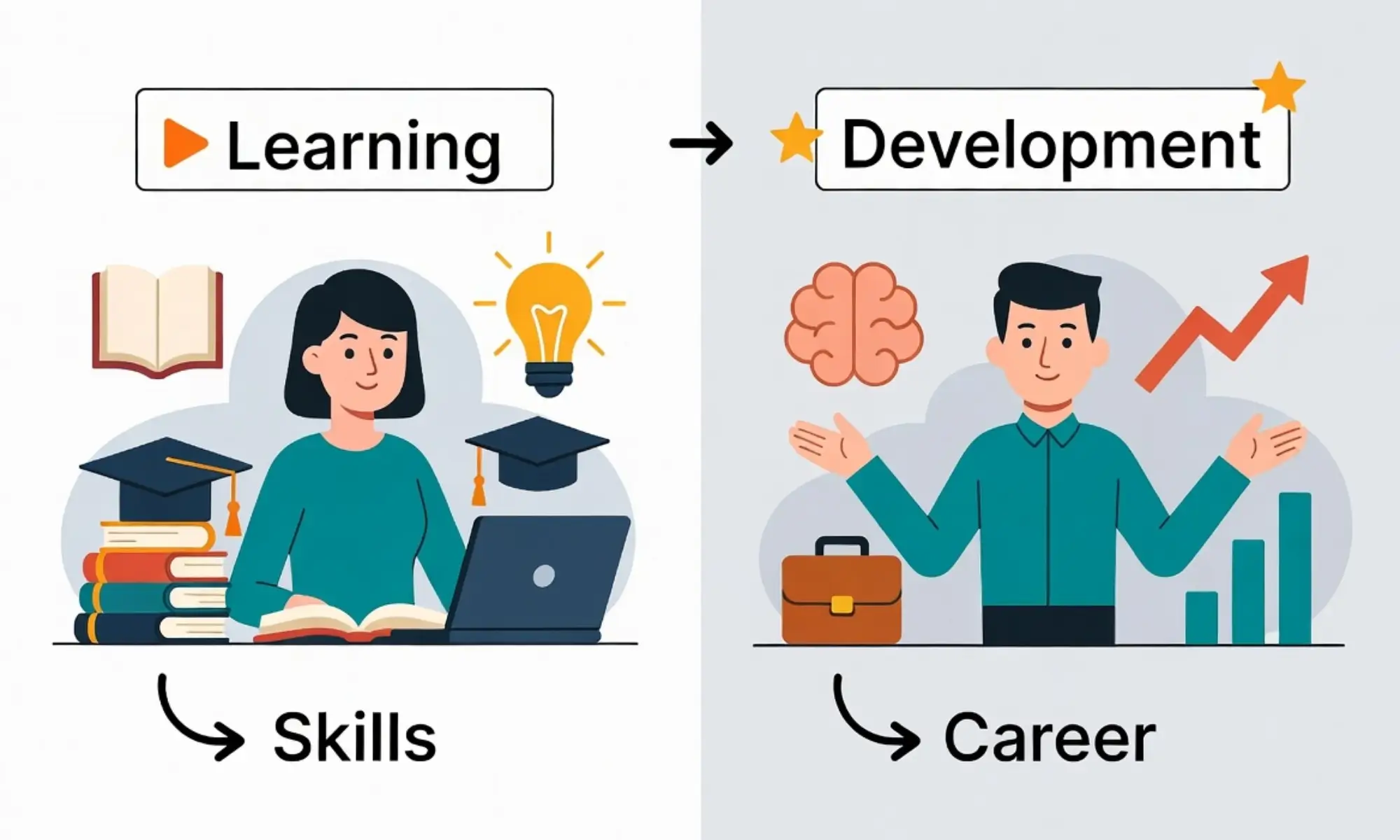
This story clearly explains the difference between learning and development. Learning often happens when a person gains knowledge or skills through study, training, or experience.
Development, on the other hand, is a broader and longer process that involves overall growth in abilities, thinking, and behavior.
Understanding the difference between learning and development helps people recognize how knowledge turns into personal and professional growth.
The difference between learning and development is important in education, workplaces, and everyday life because it shows how short-term learning contributes to long-term development.
Key Difference Between Learning and Development
The main difference between learning and development is that learning focuses on acquiring knowledge or skills, while development refers to the gradual improvement and growth of a person over time. Learning is usually quick and specific, whereas development is slow and continuous.
Why Knowing Their Difference Is Important
Understanding the difference between learning and development helps learners, teachers, and professionals plan better educational and career strategies. Learning gives people immediate knowledge, but development builds long-term abilities such as leadership, critical thinking, and emotional intelligence. When society understands this distinction, educational systems and workplaces can focus not only on teaching facts but also on shaping well-rounded individuals.
Pronunciation
Learning
- US: /ˈlɝː.nɪŋ/
- UK: /ˈlɜː.nɪŋ/
Development
- US: /dɪˈvel.əp.mənt/
- UK: /dɪˈvel.əp.mənt/
Learning gives us the tools, but development shapes how we use those tools. With this idea in mind, let us explore their differences in detail.
Difference Between Learning and Development
1. Definition
Learning means gaining knowledge or skills through study or experience. Development means overall growth and improvement over time.
Examples of Learning
- A student learning multiplication tables in math class.
- A worker learning how to operate a new machine.
Examples of Development
- A child gradually improving problem-solving ability as they grow.
- An employee becoming a strong team leader over several years.
2. Time Duration
Learning can happen quickly, sometimes in minutes or hours. Development usually takes months or years.
Examples of Learning
- Learning a new vocabulary word in a language class.
- Learning how to cook a simple recipe.
Examples of Development
- A musician improving performance skills over many years.
- A student developing critical thinking during higher education.
3. Focus
Learning focuses on knowledge or specific skills. Development focuses on overall abilities and personality growth.
Examples of Learning
- Learning computer programming basics.
- Learning how to drive a car.
Examples of Development
- Developing leadership qualities.
- Developing emotional intelligence.
4. Process Type
Learning is usually structured through training or education. Development often happens naturally through life experiences.
Examples of Learning
- Attending a professional training workshop.
- Watching an online tutorial to learn graphic design.
Examples of Development
- Gaining maturity through workplace challenges.
- Improving communication through social interactions.
5. Scope
Learning has a narrow scope because it focuses on specific topics. Development has a broader scope covering physical, mental, and emotional growth.
Examples of Learning
- Learning the rules of chess.
- Learning how to write an email professionally.
Examples of Development
- A teenager developing independence and responsibility.
- An employee developing career confidence.
6. Measurement
Learning can often be measured through tests or assessments. Development is harder to measure because it involves gradual improvement.
Examples of Learning
- Passing a math test after studying.
- Completing a certification course.
Examples of Development
- Becoming more confident in public speaking over time.
- Becoming better at teamwork.
7. Source
Learning usually comes from teachers, books, or training. Development often comes from personal experiences and life situations.
Examples of Learning
- Learning history from a teacher.
- Learning coding from an online course.
Examples of Development
- Learning patience through real-life challenges.
- Developing resilience after overcoming difficulties.
8. Speed
Learning can occur quickly with practice or instruction. Development progresses slowly and gradually.
Examples of Learning
- Learning to use a smartphone feature in minutes.
- Learning a shortcut key on a computer.
Examples of Development
- Developing creativity through years of artistic practice.
- Developing professional confidence through work experience.
9. Purpose
Learning aims to gain knowledge or perform a task. Development aims to improve overall capability and growth.
Examples of Learning
- Learning a formula in mathematics.
- Learning how to use accounting software.
Examples of Development
- Developing analytical thinking.
- Developing strategic planning skills.
10. Outcome
Learning produces knowledge or skills. Development produces maturity, wisdom, and broader abilities.
Examples of Learning
- Learning the basics of photography.
- Learning grammar rules.
Examples of Development
- Developing artistic vision as a photographer.
- Developing strong writing style over years.
Nature and Behaviour of Learning and Development
Nature of Learning
Learning is intentional, structured, and often guided by teachers or mentors. It focuses on gaining information and practicing specific skills.
Nature of Development
Development is natural and long-term. It involves gradual improvement in personality, thinking ability, and behavior through life experiences.
Why People Are Confused About Their Use
People often confuse these terms because learning contributes to development. For example, learning new skills helps a person grow professionally. Since both processes involve improvement and progress, they appear similar. However, learning is usually a part of development rather than the entire process.
Table: Difference and Similarity
| Aspect | Learning | Development |
| Meaning | Gaining knowledge or skills | Overall growth and improvement |
| Duration | Short-term | Long-term |
| Scope | Specific topics | Broad abilities |
| Measurement | Tests and assessments | Harder to measure |
| Process | Structured and planned | Gradual and natural |
| Similarity | Both involve improvement and personal progress |
Which Is Better in What Situation?
When Learning Is Better
Learning is more useful when a person needs specific knowledge quickly. For example, learning a new software program helps employees perform their tasks efficiently. In academic settings, learning allows students to understand subjects such as science or mathematics in a short time.
When Development Is Better
Development is more beneficial when long-term growth is the goal. Leadership, creativity, and emotional intelligence develop gradually through experiences. Organizations often focus on development programs to prepare employees for future roles and responsibilities.
Metaphors and Similes
Learning
- “Learning is like collecting tools in a toolbox.”
- “Her mind absorbed information like a sponge.”
Development
- “Development is like a tree growing stronger every year.”
- “His personality developed like a flower slowly blooming.”
Connotative Meaning
Learning
- Positive: gaining knowledge, curiosity
- Neutral: educational process
- Negative: sometimes linked with academic pressure
Example:
- “Continuous learning opens new opportunities.”
Development
- Positive: growth, improvement, progress
- Neutral: gradual change
- Negative: sometimes associated with slow progress
Example:
- “Personal development takes patience and effort.”
Idioms or Proverbs Related to Learning
- “Live and learn.”
- “Learning is a treasure that will follow its owner everywhere.”
- “The more you learn, the more you earn.”
Works in Literature
Learning
- Emile, or On Education — Jean-Jacques Rousseau — Philosophy/Education — 1762
- The Learning Tree — Gordon Parks — Novel — 1963
Development
- Human Development — Diane E. Papalia — Psychology — 1985
- Development as Freedom — Amartya Sen — Economics — 1999
Movies Related to the Themes
Learning
- Dead Poets Society — 1989 — USA
- The Theory of Everything — 2014 — UK
Development
- Boyhood — 2014 — USA
- The Pursuit of Happyness — 2006 — USA
Frequently Asked Questions
1. What is the main difference between learning and development?
Learning focuses on gaining knowledge or skills, while development focuses on overall growth over time.
2. Can learning lead to development?
Yes. Continuous learning helps individuals develop better abilities and understanding.
3. Is development possible without learning?
Development usually includes learning, but it also involves experiences and maturity.
4. Why are both important in education?
Learning provides knowledge, while development shapes personality and critical thinking.
5. How are both useful in society?
They help people improve skills, grow professionally, and contribute positively to their communities.
Conclusion
Learning and development are closely related but not identical processes. Learning focuses on gaining knowledge or specific skills through education, practice, or experience.
Development, however, represents a broader and longer journey of growth that shapes a person’s abilities, thinking, and personality.
In education and professional life, learning acts as the foundation that supports development.
By understanding the difference between learning and development, individuals can focus not only on acquiring knowledge but also on improving their overall capabilities.
This awareness encourages continuous improvement and helps people adapt to changing environments, making both learning and development essential for personal success and social progress.