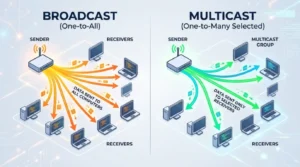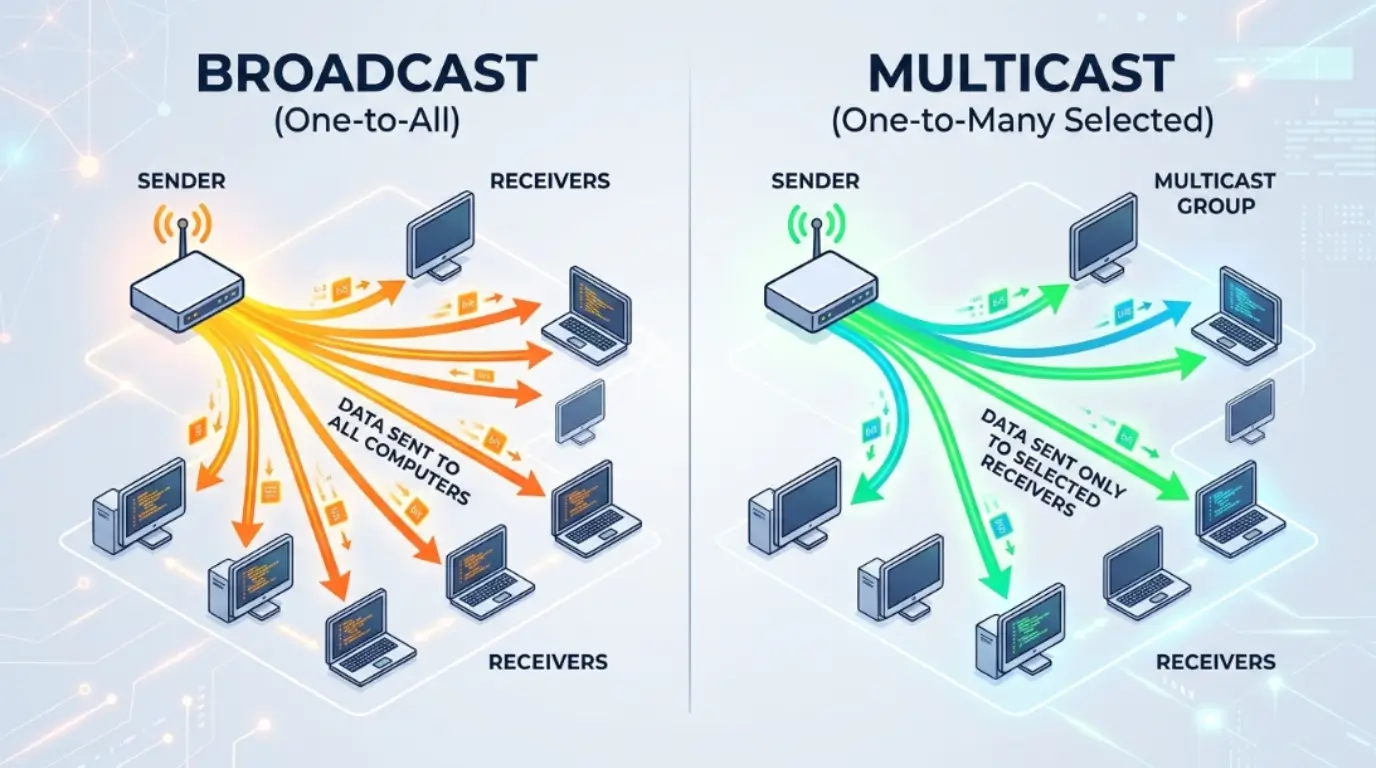
Imagine you are watching a cricket match live on TV. The signal goes to millions of people at the same time. This is called broadcast. Now think about a WhatsApp group where only selected people receive your message. That is closer to multicast.
The difference between broadcast and multicast is easy when you see it in real life. Broadcast sends data to everyone.
Multicast sends data only to a selected group. In networking, this difference between broadcast and multicast helps systems work faster and smarter.
If we understand the difference between broadcast and multicast, we can improve internet speed and reduce data waste.
That’s why learning the difference between broadcast and multicast is important for both beginners and experts.
Pronunciation
- Broadcast
- US: /ˈbrɔːd.kæst/
- UK: /ˈbrɔːd.kɑːst/
- Multicast
- US: /ˈmʌl.ti.kæst/
- UK: /ˈmʌl.ti.kɑːst/
Now let’s dive deeper and clearly understand how they differ.
Key Difference Between Broadcast and Multicast
Broadcast sends data to all devices in a network. Multicast sends data to only selected devices that join a group.
Why Is Their Difference Important?
Understanding the difference between broadcast and multicast helps reduce network traffic. Broadcast can slow systems because it sends data everywhere. Multicast saves bandwidth by sending data only where needed.
For students, it builds basic networking knowledge. For professionals, it improves system design and performance. In society, it powers live streaming, online classes, and smart communication systems efficiently.
Difference Between Broadcast and Multicast (10 Points with Examples)
1. Target Audience
- Broadcast: Sends to all devices
- Example 1: TV signals
- Example 2: Public announcements
- Multicast: Sends to a group
- Example 1: Zoom meeting participants
- Example 2: IPTV subscribers
2. Data Delivery
- Broadcast: One-to-all
- Example 1: Radio transmission
- Example 2: Network ARP request
- Multicast: One-to-many (selected)
- Example 1: Online webinar
- Example 2: Live stock updates to traders
3. Network Traffic
- Broadcast: High traffic
- Example 1: LAN flooding
- Example 2: Large office network slowdown
- Multicast: Low traffic
- Example 1: Efficient video streaming
- Example 2: Gaming servers
4. Efficiency
- Broadcast: Less efficient
- Example 1: Sending data to unused devices
- Example 2: Wasted bandwidth
- Multicast: More efficient
- Example 1: Targeted delivery
- Example 2: Optimized streaming
5. Control
- Broadcast: No control over receivers
- Example 1: Open TV signals
- Example 2: Public WiFi messages
- Multicast: Controlled group
- Example 1: Private online classes
- Example 2: Company meetings
6. Addressing
- Broadcast: Uses broadcast address
- Example 1: 255.255.255.255
- Example 2: Network-wide messages
- Multicast: Uses multicast IP
- Example 1: 224.0.0.1
- Example 2: Group communication
7. Usage
- Broadcast: Simple networks
- Example 1: Small LAN
- Example 2: Basic communication
- Multicast: Advanced networks
- Example 1: Streaming platforms
- Example 2: Online gaming
8. Security
- Broadcast: Less secure
- Example 1: Anyone can receive
- Example 2: Data exposure
- Multicast: More secure
- Example 1: Group-based access
- Example 2: Controlled membership
9. Scalability
- Broadcast: Not scalable
- Example 1: Large networks crash
- Example 2: Traffic overload
- Multicast: Highly scalable
- Example 1: Live events
- Example 2: Global webinars
10. Real-Life Use
- Broadcast: TV, radio
- Multicast: Netflix streaming, Zoom calls
Nature and Behaviour
- Broadcast is open and wide. It spreads data everywhere without checking who needs it.
- Multicast is selective and smart. It sends data only to interested users.
Why People Get Confused
People think both send data to many users, so they seem the same. But the key confusion is about who receives the data—everyone (broadcast) vs selected group (multicast).
Difference and Similarity Table
| Feature | Broadcast | Multicast | Similarity |
| Audience | All devices | Selected group | Both send to multiple users |
| Efficiency | Low | High | Used in networking |
| Control | No control | Controlled group | Data transmission method |
| Traffic | High | Low | Used for communication |
Which Is Better in What Situation?
Broadcast is better for simple communication where everyone must receive the message. For example, network discovery or public alerts.
Multicast is better when only a group needs the data. It saves bandwidth and improves speed. For example, video streaming or online classes.
Metaphors and Similes
- Broadcast: “Like shouting in a crowd”
- Multicast: “Like talking in a private group”
Connotative Meaning
- Broadcast: Neutral to negative (wasteful sometimes)
- Multicast: Positive (efficient and smart)
Examples
- “His message was broadcast like a loudspeaker.”
- “Their ideas spread like a multicast group.”
Idioms or Expressions
- “Spread the word” (broadcast idea)
- “Selective sharing” (multicast idea)
Works in Literature
- “Broadcasting Modernism” – Debra Rae Cohen (2009, Media Studies)
- “Multicast Networking” – C. Kenneth Miller (1999, Technical)
Movies Related to Broadcasting
- Broadcast News (1987, USA)
- Live from Baghdad (2002, USA)
(No direct movies on multicast, as it is a technical term)
FAQs
1. What is the main difference between broadcast and multicast?
Broadcast sends to all, multicast sends to a group.
2. Where is broadcast used?
In TV, radio, and simple networks.
3. Where is multicast used?
In streaming, gaming, and online meetings.
4. Which is more efficient?
Multicast is more efficient.
5. Why are both useful?
Broadcast is simple. Multicast is smart and saves data.
Conclusion
The difference between broadcast and multicast is simple but powerful. Broadcast is wide and open, while multicast is selective and efficient.
Both play important roles in communication systems. Broadcast helps in sending messages to everyone quickly. Multicast improves performance by targeting specific users.
By understanding the difference between broadcast and multicast, we can build faster and smarter networks.
Whether you are a student or an expert, knowing this concept helps you understand how modern communication works in daily life.