Imagine you are watching a live football match online. The video quality looks sharp, but suddenly the stream freezes for a few seconds.
Later, the video plays again smoothly. This situation often happens because of two important network factors: bandwidth and latency.
Many people experience this issue but do not understand the difference between bandwidth and latency.
The difference between bandwidth and latency is simple but very important in networking and internet performance.
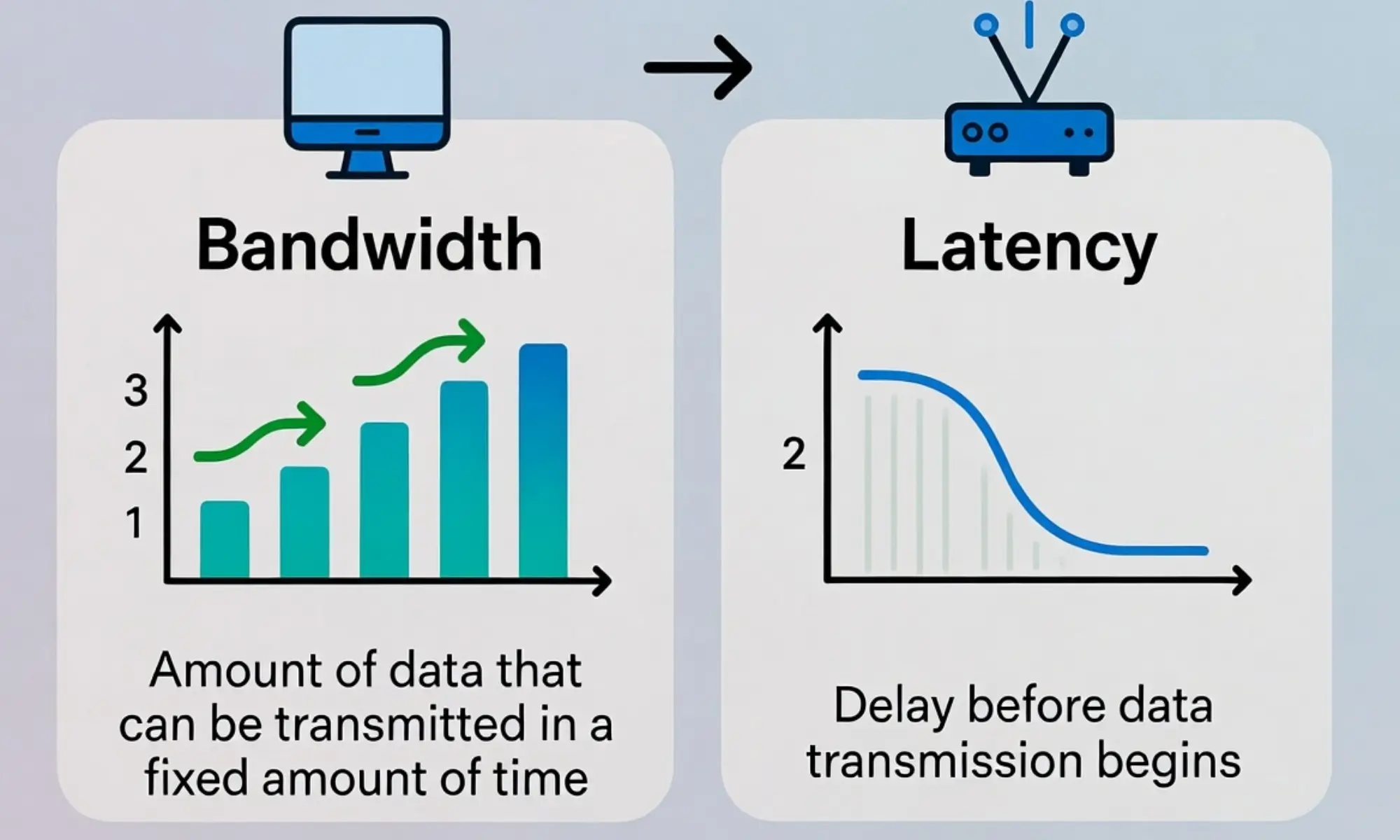
Bandwidth refers to how much data can travel through a network at one time, while latency refers to how long it takes for data to travel from one point to another.
Understanding the difference between bandwidth and latency helps people improve internet usage, gaming performance, video streaming, and communication systems.
For students, IT professionals, and everyday internet users, knowing the difference between bandwidth and latency helps explain why a connection can be fast but still feel slow sometimes.
Key Difference Between Bandwidth and Latency
The main difference between bandwidth and latency is that bandwidth measures data capacity, while latency measures data delay.
Bandwidth tells us how much data can be transferred per second in a network. Latency tells us how quickly data begins to travel after a request is made.
For example, a network may have high bandwidth but still experience delays if latency is high.
Why Is It Important to Know the Difference?
Understanding the difference between bandwidth and latency is important for students, network engineers, gamers, and businesses. In modern society, many services such as online education, cloud computing, video calls, and digital banking rely on internet performance.
If people only focus on bandwidth, they might ignore latency problems that cause delays. For example, a gamer may have a high-speed internet plan but still experience lag because of high latency. Similarly, companies running cloud services must control both bandwidth and latency to ensure smooth data transfer. Knowing this difference helps people choose better internet plans, design faster networks, and improve digital communication.
Pronunciation
Bandwidth
- US: /ˈbænd.wɪdθ/
- UK: /ˈbænd.wɪdθ/
Latency
- US: /ˈleɪ.tən.si/
- UK: /ˈleɪ.tən.si/
Understanding these terms clearly leads us to explore the detailed difference between bandwidth and latency.
Difference Between Bandwidth and Latency
1. Basic Meaning
Bandwidth refers to the maximum amount of data that can be transmitted through a network in a given time.
Examples
- A home internet plan offering 100 Mbps has high bandwidth.
- A fiber network can transfer large files quickly.
Latency refers to the time it takes for data to travel from sender to receiver.
Examples
- A delay of 20 milliseconds in online gaming represents latency.
- Video calls may lag due to high latency.
2. Measurement Unit
Bandwidth is measured in bits per second (bps), such as Mbps or Gbps.
Examples
- A 50 Mbps connection can transfer moderate data quickly.
- A 1 Gbps fiber network supports heavy internet usage.
Latency is measured in milliseconds (ms).
Examples
- A latency of 10 ms is considered very fast.
- A latency of 200 ms causes noticeable delays.
3. Focus of Performance
Bandwidth focuses on data volume.
Examples
- Streaming 4K videos requires high bandwidth.
- Downloading large files needs strong bandwidth.
Latency focuses on response time.
Examples
- Online gaming needs low latency.
- Video conferencing requires quick responses.
4. Analogy Example
Bandwidth can be compared to the width of a highway.
Examples
- A wide highway allows many cars to travel.
- More lanes mean more traffic capacity.
Latency can be compared to travel time on the road.
Examples
- A long distance increases travel time.
- Traffic signals can slow travel.
5. Impact on Streaming
Bandwidth affects video quality.
Examples
- Higher bandwidth allows HD streaming.
- Low bandwidth causes blurry video.
Latency affects playback delay.
Examples
- High latency causes buffering.
- Live streams may appear delayed.
6. Role in Gaming
Bandwidth supports game downloads and updates.
Examples
- Large games download faster with higher bandwidth.
- Multiplayer games require steady bandwidth.
Latency affects gameplay responsiveness.
Examples
- Low latency prevents lag.
- High latency causes delayed player actions.
7. Network Infrastructure
Bandwidth depends on connection type and network capacity.
Examples
- Fiber networks provide higher bandwidth.
- Old copper cables limit bandwidth.
Latency depends on distance and routing.
Examples
- Data traveling long distances increases latency.
- Multiple network hops add delay.
8. Data Transfer Behavior
Bandwidth handles large data transfers.
Examples
- Uploading videos requires high bandwidth.
- Cloud backups use large bandwidth.
Latency affects small quick data requests.
Examples
- Web page loading depends on latency.
- Online chats require quick responses.
9. User Experience
Bandwidth improves overall speed perception.
Examples
- Faster downloads feel smoother.
- Streaming services work better.
Latency improves responsiveness.
Examples
- Fast website reactions improve user experience.
- Instant messaging depends on low latency.
10. Optimization Methods
Bandwidth can be improved by upgrading internet plans.
Examples
- Switching to fiber increases bandwidth.
- Using better routers improves throughput.
Latency can be reduced by optimizing network routes.
Examples
- Using nearby servers lowers latency.
- Gaming servers closer to users reduce lag.
Nature and Behaviour of Both
Bandwidth behaves like a capacity measure. It determines how much information a network can handle at once. Networks with higher bandwidth can carry more data simultaneously.
Latency behaves like a time delay factor. It measures the speed at which communication begins between devices. Even with large bandwidth, high latency can slow interactions.
Why Are People Confused?
Many people believe that faster internet always means higher bandwidth. However, a network may offer large bandwidth but still suffer delays due to latency. Because both factors affect speed and performance, users often mix them up.
Difference and Similarity Table
| Feature | Bandwidth | Latency | Similarity |
| Meaning | Data capacity | Data delay | Both affect network speed |
| Unit | Mbps, Gbps | Milliseconds | Both measured in technical metrics |
| Function | Data transfer volume | Response time | Both influence user experience |
| Impact | Download speed | Network lag | Both affect internet quality |
Which Is Better in What Situation?
Bandwidth is more important when large amounts of data must be transferred quickly. For example, downloading large files, streaming high-definition videos, or transferring cloud backups requires high bandwidth. A network with strong bandwidth can handle multiple users and large data flows efficiently.
Latency is more important when fast response time is required. Online gaming, video conferencing, remote control systems, and financial trading platforms depend on extremely low latency. Even if bandwidth is high, a system with high latency will feel slow during interactive activities.
Metaphors and Similes
Writers sometimes use networking terms metaphorically.
Examples
- “Her creativity had wide bandwidth, able to handle many ideas at once.”
- “His response time had low latency, like lightning speed.”
Connotative Meaning
Bandwidth
Positive: capacity, ability to handle tasks
Example: “She has the bandwidth to manage many projects.”
Neutral: technical network capacity
Negative: lack of capacity
Example: “I don’t have the bandwidth for extra work.”
Latency
Positive: quick response when low
Example: “The system runs with low latency.”
Negative: delay or slow reaction
Example: “High latency caused the meeting lag.”
Works in Literature
Although technical terms rarely appear as titles, networking topics appear in technology books.
- Computer Networking: A Top-Down Approach — Educational, James Kurose & Keith Ross, 2000
- Network Algorithmics — Technology, George Varghese, 2004
Movies Related to Technology Themes
- The Social Network — 2010 — USA
- Blackhat — 2015 — USA
Frequently Asked Questions
1. What is the main difference between bandwidth and latency?
Bandwidth measures how much data can be transferred, while latency measures how long data takes to travel.
2. Which is more important for gaming?
Latency is usually more important because gamers need quick responses.
3. Does higher bandwidth reduce latency?
Not necessarily. They are separate network factors.
4. Why does my internet feel slow even with high bandwidth?
High latency or network congestion may cause delays.
5. Can both be optimized together?
Yes. Better network infrastructure and routing can improve both.
How Both Are Useful for Our Surroundings
Bandwidth and latency are essential for modern digital life. High bandwidth supports streaming services, online learning, and cloud storage.
Low latency supports communication tools such as video calls, online gaming, and remote work systems. Together, they ensure efficient digital communication and better user experience in everyday technology.
Conclusion
The difference between bandwidth and latency is fundamental to understanding network performance.
Bandwidth measures the capacity of a network to transfer data, while latency measures the time it takes for data to travel between devices. Both factors play important roles in digital communication and internet performance.
In practical situations, high bandwidth ensures that large amounts of data can move quickly, while low latency ensures fast responses during interactive activities.
When both are optimized together, users experience smooth streaming, faster downloads, and responsive online services.
Understanding the difference between bandwidth and latency helps individuals, businesses, and IT professionals design better networks and improve the quality of modern digital communication.