Imagine a star point guard driving toward the hoop. With a sudden, sharp pivot, a sickening “pop” echoes through the gym. His knee buckles; his season is over in a fraction of a second. This is the hallmark of an ACL tear.
Now, shift your focus to a veteran marathoner. As she pushes through the final mile, a sharp, snapping sensation hits the back of her heel, as if she’s been kicked. She collapses, clutching her ankle. That is the devastating rupture of the Achilles tendon.
While both represent the nightmares of athletes and surgeons alike, the difference between ACL and Achilles is fundamental to how we move. One acts as the internal stabilizer of the knee joint, while the other serves as the powerful lever that allows us to walk, run, and jump.
Understanding the difference between ACL and Achilles isn’t just for medical students; it’s vital for anyone looking to protect their physical longevity.
Because the difference between ACL and Achilles involves two entirely different types of tissue in different locations, mismanaging one for the other can lead to lifelong mobility issues.
Why the Difference Matters to Learners, Experts, and Society
In a society increasingly focused on fitness and longevity, distinguishing between these two powerhouses is crucial. For learners and fitness enthusiasts, knowing the difference between ACL and Achilles helps in tailoring injury-prevention exercises—focusing on landing mechanics for the knee versus eccentric loading for the heel. For experts, it’s about precision in rehabilitation. Socially, these injuries carry a massive economic burden through surgery costs and lost productivity. Recognizing the difference between ACL and Achilles ensures that we value the intricate engineering of the human body and apply the right “maintenance” to the right parts.
Pronunciation Guide
| Term | US English | UK English |
| ACL | A-C-L (Ay-See-El) | A-C-L (Ay-See-El) |
| Achilles | uh-KIL-eez | uh-KIL-eez |
But how do these two structural giants actually compare when we look under the hood? Let’s dive into the specifics.
The Comprehensive Difference Between ACL and Achilles
10 Points of Distinction
- Anatomical Location
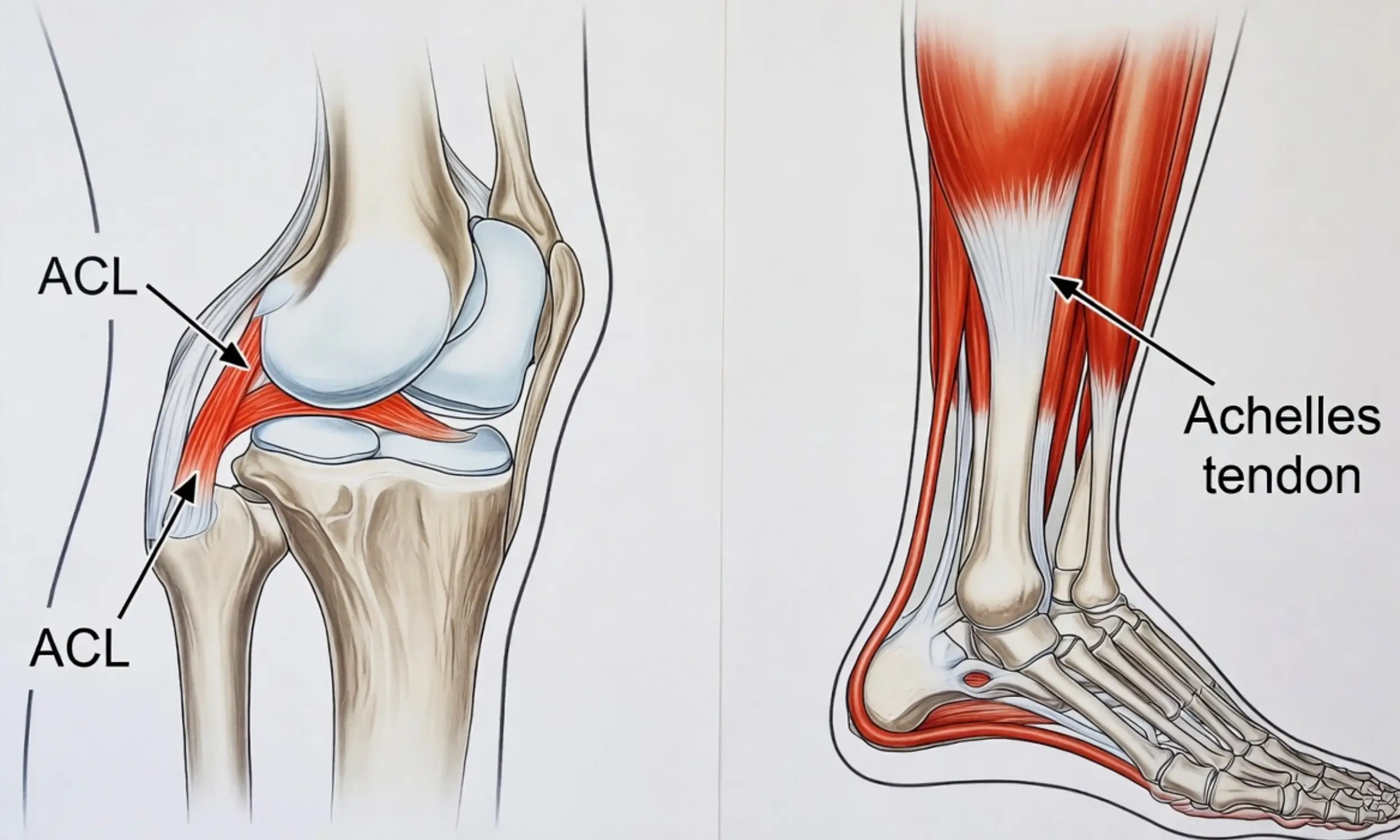
- The ACL is located deep inside the knee joint.
- The Achilles is located at the back of the lower leg, connecting the calf to the heel.
- Example: You cannot touch your ACL from the outside; you can easily feel your Achilles above your heel.
- Tissue Type
- The ACL is a ligament (connects bone to bone).
- The Achilles is a tendon (connects muscle to bone).
- Example: The ACL links the femur to the tibia; the Achilles links the gastrocnemius muscle to the calcaneus bone.
- Primary Function
- The ACL prevents the shin bone from sliding out in front of the thigh bone.
- The Achilles allows for “plantar flexion” (pointing the toes down).
- Example: Use your ACL to stay stable while pivoting; use your Achilles to stand on your tiptoes.
- Injury Mechanism
- ACL injuries usually happen during sudden stops or changes in direction.
- Achilles injuries often occur during explosive pushing-off motions.
- Example: A soccer player cutting left might tear an ACL; a sprinter starting a race might rupture an Achilles.
- Surgical Approach
- ACL surgery usually requires a graft (replacement tissue).
- Achilles surgery often involves stitching the two ends of the tendon back together.
- Example: Surgeons may use a hamstring tendon to “build” a new ACL; they sew the original Achilles back together.
- Blood Supply
- The ACL has a relatively poor blood supply, making natural healing difficult.
- The Achilles has a better blood supply but has “watershed zones” with low flow.
- Example: A full ACL tear almost never heals on its own; a partial Achilles tear might heal with rest.
- Physical Appearance (Post-Injury)
- ACL tears cause massive swelling inside the knee (hemarthrosis).
- Achilles ruptures often show a visible “gap” or divot above the heel.
- Example: The knee looks like a grapefruit; the heel looks like it has a missing chunk.
- Diagnostic Tests
- Doctors use the Lachman Test to check for ACL stability.
- Doctors use the Thompson Test (squeezing the calf) to check the Achilles.
- Example: If the shin slides forward, it’s ACL; if the foot doesn’t move when the calf is squeezed, it’s Achilles.
- Rehabilitation Timeline
- ACL recovery typically takes 9–12 months for athletes.
- Achilles recovery can take 6–9 months, but regaining explosive power takes longer.
- Example: A basketball player returns to the court a year after ACL surgery; a runner might jog after 6 months of Achilles rehab.
- Age of Prevalence
- ACL injuries are very common in young athletes (teens and 20s).
- Achilles ruptures are more common in “weekend warriors” (ages 30–50).
- Example: A high school gymnast is at high risk for ACL; a 40-year-old playing pickup basketball is at high risk for Achilles.
Nature and Behaviour
The ACL (Anterior Cruciate Ligament): It is a “gatekeeper.” Its behavior is rigid and reactionary. It doesn’t stretch much; it holds firm until the force is too great, at which point it snaps. It operates in a dark, fluid-filled environment.
The Achilles Tendon: It is a “spring.” Its nature is elastic and dynamic. It stores energy as you step and releases it to propel you forward. It is the thickest and strongest tendon in the human body, behaving like a high-tension cable.
Why Do People Confuse Them?
The confusion stems from their shared status as “season-ending injuries.” Because both are associated with a loud “pop” and immediate inability to play sports, people often group them together as general “leg injuries.” Furthermore, because both names are widely used in sports commentary, the anatomical distinction gets lost in the shared drama of the injury.
Comparison Table: ACL vs. Achilles
| Feature | ACL | Achilles |
| Type | Ligament | Tendon |
| Joint | Knee | Ankle / Heel |
| Action | Stabilization | Propulsion |
| Common Sound | Loud “Pop” | Loud “Snap” |
| Surgical Need | High (for athletes) | Moderate to High |
| Similarity | Both are critical for sports | Both are critical for sports |
| Similarity | Both require long rehab | Both require long rehab |
Which is Better in What Situation?
The ACL is “better” (or more vital) in situations requiring stability and agility. If you are skiing down a mountain or playing defensive football, your ACL is the MVP because it keeps your leg from folding inward. Without a functional ACL, your knee feels “loose,” making any lateral movement dangerous.
The Achilles is “better” for power and speed. If you are a high jumper or a sprinter, your Achilles is the primary engine. It converts the strength of your calf muscles into forward or upward motion. It is the ultimate tool for human locomotion and verticality.
Metaphors, Similes, and Connotations
- Metaphor: “He is the ACL of our department” (The stabilizer who keeps things from falling apart).
- Simile: “The rope snapped like a ruptured Achilles.”
- ACL Connotation (Neutral): Usually seen as a structural necessity. Example: “The ACL is a vital component of knee mechanics.”
- Achilles Connotation (Negative): Often implies a hidden, fatal weakness (derived from “Achilles’ Heel”). Example: “His temper was his Achilles’ heel.”
Idioms and Proverbs
- “Achilles’ Heel”: A weakness in spite of overall strength.
- Example: “The team is incredible, but their slow defense is their Achilles’ heel.”
- “Pop the ACL”: Often used in sports to denote a sudden end to a career.
- Example: “He was on track for the MVP until he popped his ACL in the third quarter.”
In Literature and Film
Literature:
- The Iliad (Epic Poetry, Homer, c. 8th Century BC): The origin of the name “Achilles” and the myth of his heel.
- The Knees of the Gods (Fiction, Various): Often uses knee stability as a metaphor for fate.
Movies:
- Troy (2004, USA): Focuses on the legendary Achilles.
- The Program (1993, USA): Features a dramatic depiction of a football player’s knee injury.
FAQs
- Can you walk without an ACL? Yes, many people walk normally, but the knee may “give out” during sports.
- Can you walk without an Achilles? It is extremely difficult to walk normally; you cannot “push off” the ground.
- Which injury is more painful? Achilles ruptures are often described as more intensely painful, like being shot in the leg.
- Are women more prone to ACL tears? Yes, due to hip anatomy and hormonal factors.
- Is Achilles tendonitis the same as a rupture? No, tendonitis is inflammation; a rupture is a complete tear.
Usefulness for Surroundings
Both structures help us interact with our environment. The ACL allows us to navigate uneven terrain safely, while the Achilles allows us to move efficiently across distances, enabling everything from hiking to manual labor.
Final Words and Conclusion
While they reside in different parts of the leg, the ACL and Achilles are the twin pillars of human movement. One offers the stillness of stability; the other offers the fire of movement.
Understanding the difference between ACL and Achilles empowers us to move smarter, train harder, and recover better.In conclusion, whether you are a professional athlete or a casual walker, your mobility relies on the health of these two structures.
The ACL keeps your knee steady under pressure, while the Achilles provides the spring in your step.
By respecting the difference between ACL and Achilles, we can better appreciate the complex symphony of our anatomy. Protect your knees, strengthen your heels, and stay in the game.